Quarkus vs Spring Boot: Which Java Framework Should You Choose?
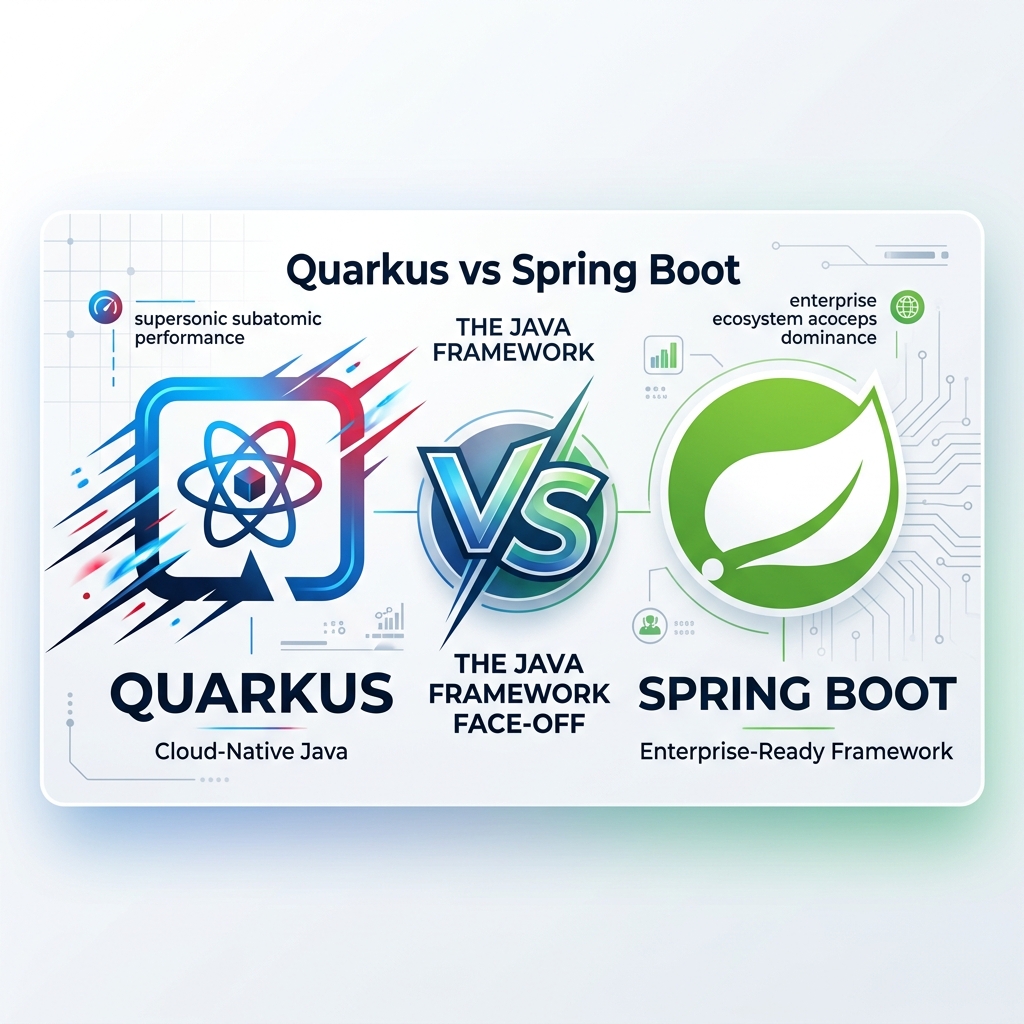
For over a decade, Spring Boot has reigned supreme as the de facto standard for building enterprise Java applications. Its rich ecosystem, convention-over-configuration paradigm, robust dependency injection engine, and vast community support made Java the bedrock of backend systems worldwide.
However, the shift toward Cloud-Native Architectures, Kubernetes orchestration, Docker containerization, and Serverless execution (AWS Lambda, Knative) introduced new technical challenges for backend infrastructure: memory efficiency, instant scaling, and cold-start latency.
Traditional Java frameworks, engineered for long-running monolithic servers, were not originally designed for ephemeral containerized environments. When microservices scale horizontally from 0 to 50 instances on Kubernetes or execute as short-lived serverless functions, waiting 3 to 10 seconds for a Java Virtual Machine (JVM) process to boot—while consuming 200MB+ of heap memory—presents an operational and financial handicap.
Enter Quarkus: a Kubernetes-native Java framework built from the ground up to tailor Java specifically for GraalVM and OpenJDK HotSpot. Dubbed “Supersonic Subatomic Java”, Quarkus fundamentally redefines how Java code compiles, boots, and executes.
In this architectural comparison guide, we will break down Quarkus vs Spring Boot across core architecture, runtime memory, cold start times, developer experience, reactive models, ecosystem maturity, and actionable decision frameworks to help you choose the right framework for your next project.
1. Core Architectural Philosophies
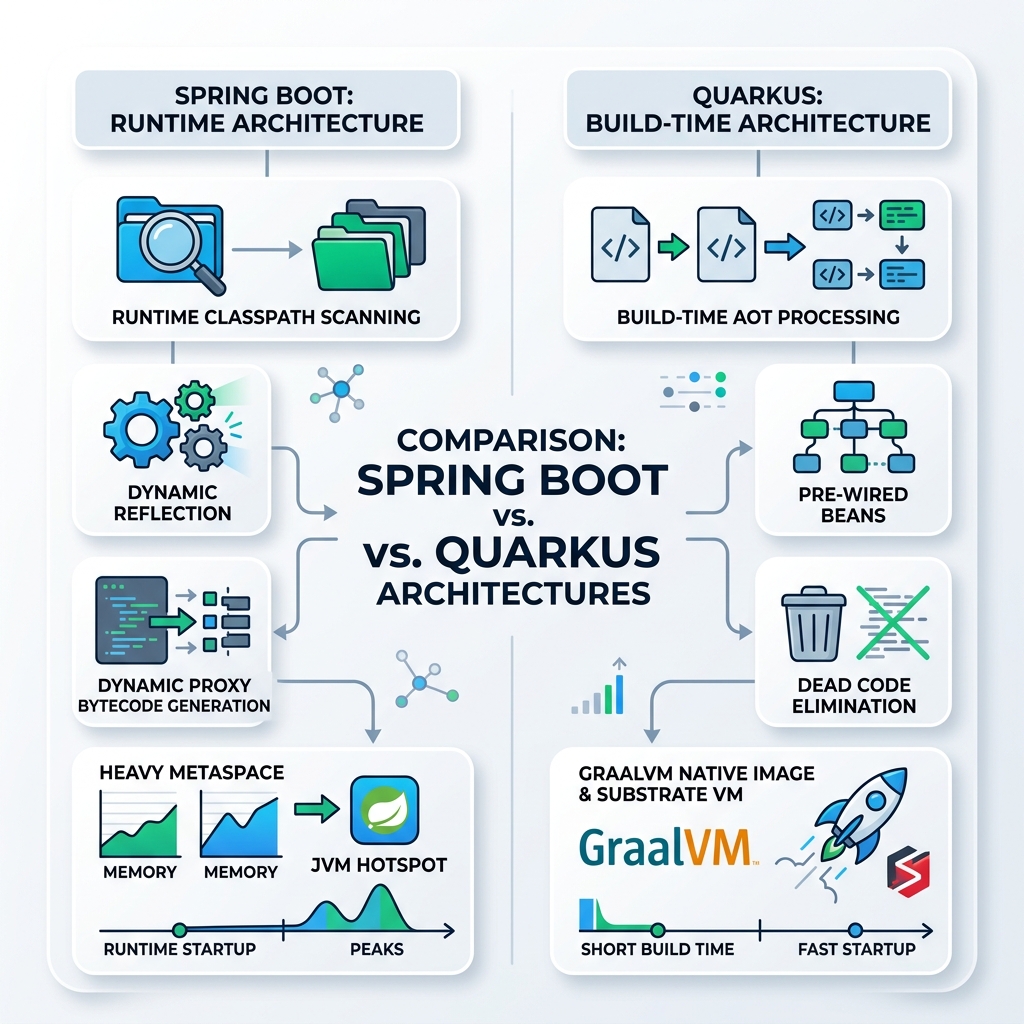
The fundamental difference between Spring Boot and Quarkus lies in when application metadata, dependency wiring, and configuration scanning take place: Runtime vs. Build-Time.
A. Spring Boot: Reflection-Heavy Runtime Assembly
Spring Boot operates using dynamic runtime reflection and classpath discovery:
- Classpath Scanning: When a Spring Boot application launches, it scans all JAR files in the classpath looking for annotations (
@Component,@Service,@RestController,@Entity). - Annotation Introspection: Spring uses Java reflection (
Class.forName(),getDeclaredMethods()) to dynamically inspect constructors, fields, and injection targets. - Dynamic Proxy Generation: To provide features like Aspect-Oriented Programming (AOP),
@Transactionaldatabase boundaries, and@PreAuthorizesecurity checks, Spring generates dynamic bytecode proxies in memory using ByteBuddy or CGLIB. - Metaspace & Memory Inflation: All reflected class descriptors, annotation metadata, and dynamic proxies must remain stored in JVM Metaspace and Resident Set Size (RSS) memory throughout the lifetime of the process.
While this dynamic architecture offers flexibility, it imposes a mandatory CPU and memory tax every single time the application boots up.
B. Quarkus: Build-Time Ahead-Of-Time (AOT) Optimization
Quarkus solves the cloud-native challenge through a paradigm shift: moving dynamic reflection and dependency resolution from runtime to build time.
- Extension Framework & Build Steps: During build time (
mvn packageor./gradlew build), Quarkus extensions analyze annotations, parse configuration files, and pre-build the entire dependency injection graph. - Static Bytecode Generation: Quarkus replaces dynamic reflection and runtime proxies with pre-generated static bytecode routines. When the application starts, it instantiates pre-wired components directly.
- Dead Code Elimination (Tree Shaking): Unused classes, methods, and library pathways are identified upfront and stripped from the binary output.
- GraalVM Native Image Readiness: Because all reflection metadata is resolved upfront during the build, Quarkus compiles seamlessly into a native executable binary using GraalVM Substrate VM without needing manual JSON reflection hints.
2. Memory Footprint & Startup Time Performance Benchmarks
In cloud infrastructure, memory consumption (RAM) and startup latency directly dictate server hosting costs and system resilience during traffic spikes.
Performance Metric Comparison
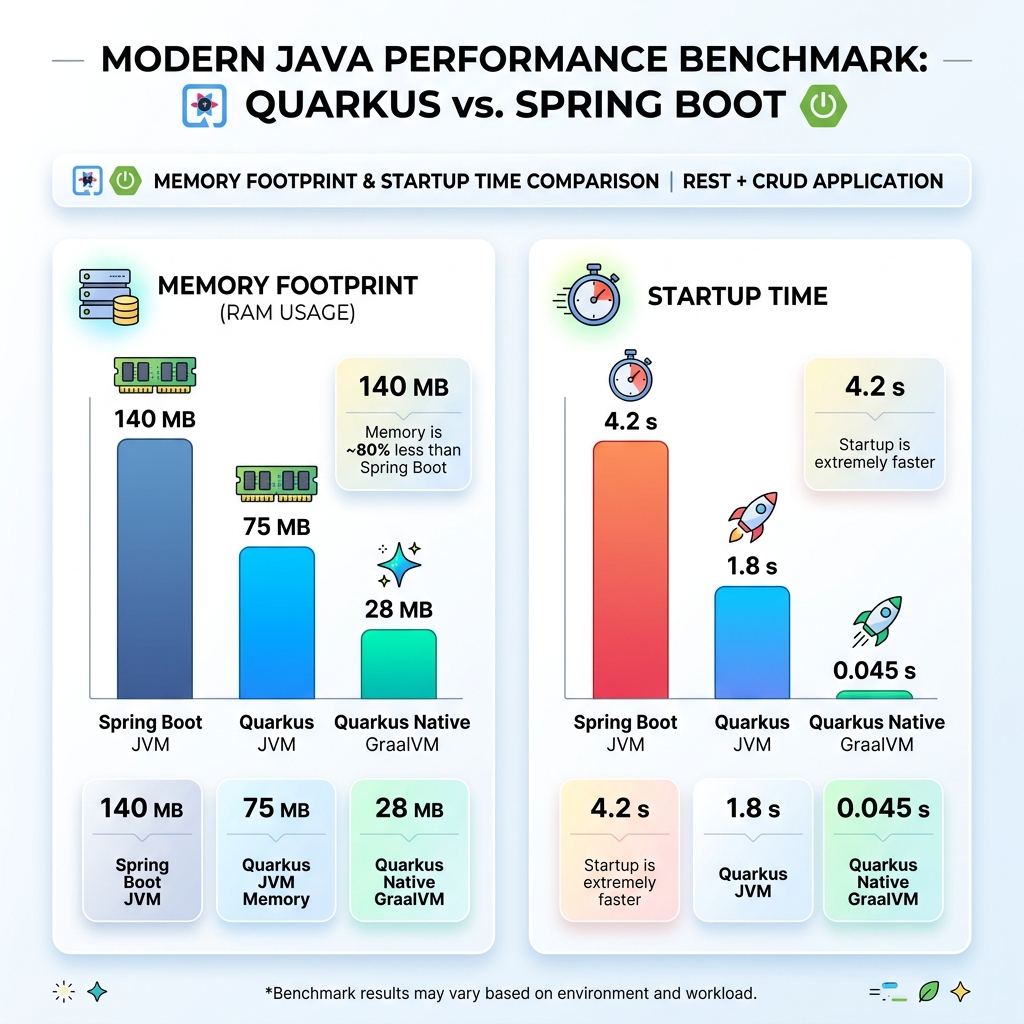
Below is a typical performance comparison between Spring Boot and Quarkus for a standard REST microservice connecting to a PostgreSQL database (CRUD operations):
| Deployment Target | Framework & Execution Engine | RSS Memory Footprint (Idle) | Cold Start Boot Time | Relative Container Density |
|---|---|---|---|---|
| Traditional JVM | Spring Boot (OpenJDK HotSpot) | ~140 MB – 220 MB | 3.5s – 6.0s | 1x Baseline |
| Optimized JVM | Quarkus (OpenJDK HotSpot) | ~75 MB – 110 MB | 1.2s – 1.8s | 2x Higher Density |
| Native Binary | Quarkus Native (GraalVM) | ~28 MB – 45 MB | 0.015s – 0.045s | 5x – 7x Higher Density |
Key Takeaways from Benchmarks:
- Sub-Second Cold Starts: Quarkus running as a GraalVM native binary boots in tens of milliseconds, making Java competitive with Go and Rust for AWS Lambda, Knative, and serverless architectures.
- Drastic RAM Reductions: Running Quarkus on a standard OpenJDK JVM cuts idle RAM usage nearly in half compared to Spring Boot. When compiled to a native executable, memory consumption drops by up to 80%.
- Cluster Pod Density: On a Kubernetes cluster with 16GB RAM worker nodes, you can run roughly 60 Spring Boot pod instances versus 400+ Quarkus native instances.
3. Developer Experience (DX) & Live Coding
A framework’s raw performance is meaningless if developer productivity suffers. Both Quarkus and Spring Boot prioritize developer experience, but with distinct tooling strategies.
Spring Boot DX: Spring Initializr & DevTools
- Spring Initializr (
start.spring.io): The gold standard for bootstrapping new microservices with curated starter dependencies (spring-boot-starter-web,spring-boot-starter-data-jpa). - Spring Boot DevTools: Enables automatic application restart whenever files on the classpath are updated. While helpful, it requires a full context reload, taking 2 to 5 seconds per change.
- Ecosystem Familiarity: Almost every Java developer, IDE (IntelliJ IDEA, Eclipse, VS Code), and CI/CD tool natively understands Spring Boot project conventions out of the box.
Quarkus DX: Zero-Restart Live Coding & Dev UI
- Quarkus Dev Mode (
quarkus dev): Changes made to.javacode, HTML templates, application properties, or configuration files reflect instantly (under 500ms) without restarting the JVM process. Background HTTP requests trigger hot compilation on demand. - Continuous Testing: Quarkus runs unit and integration tests in the background while you code. Pressing
rin the terminal re-runs affected tests instantly as files are saved. - Dev Services (Automatic Testcontainers): If your application requires PostgreSQL, Kafka, or Redis, Quarkus automatically detects the dependency, spins up a Docker container in dev mode, and configures database connection strings dynamically—no local DB setup required.
- Interactive Dev UI (
/q/dev): Provides an interactive browser UI embedded in the application showing active extensions, configuration visualizers, REST endpoints, database schemas, and health endpoints.
4. Imperative vs. Reactive Programming Models
Modern cloud applications often need to handle high concurrency while remaining responsive under heavy throughput.
SPRING BOOT (Dual API Stacks):
┌─────────────────────────────┐    ┌─────────────────────────────┐
│    Spring MVC (Imperative)  │    │  Spring WebFlux (Reactive)  │
│    Tomcat / Servlet Thread  │    │  Netty / Reactor Core Engine│
└─────────────────────────────┘    └─────────────────────────────┘

QUARKUS (Unified Reactive Core):
┌────────────────────────────────────────────────────────────────┐
│               Mutiny / Reactive & Imperative APIs              │
├────────────────────────────────────────────────────────────────┤
│            Eclipse Vert.x Non-Blocking Event Loop              │
└────────────────────────────────────────────────────────────────┘
Spring Boot: Separate Stacks (MVC vs WebFlux)
Spring Boot splits imperative and reactive paradigms into two separate modules:
- Spring MVC: Based on the traditional thread-per-request model using Embedded Tomcat or Jetty. Easy to reason about, blocking I/O.
- Spring WebFlux: Built on Project Reactor and Netty for non-blocking reactive streams. Switching from Spring MVC to WebFlux requires changing paradigms, client drivers (R2DBC instead of JDBC), and programming models.
Quarkus: Unified Non-Blocking Engine (Vert.x + Mutiny)
Quarkus unifies imperative and reactive models on a single non-blocking architecture:
- Eclipse Vert.x Core: The underlying engine of Quarkus is built entirely on Eclipse Vert.x event loops.
- Mutiny Reactive Framework: Quarkus uses Mutiny, an intuitive, event-driven reactive library that simplifies async stream handling (
Uni<T>andMulti<T>). - Coexistence: You can write standard blocking imperative code (e.g.,
@GETwith blocking JPA calls) alongside non-blocking reactive endpoints inside the exact same class file. Quarkus automatically dispatches blocking calls to a managed worker thread pool without blocking the main event loop.
5. Ecosystem, Community & Enterprise Adoption
                       QUARKUS vs SPRING BOOT ECOSYSTEM MATURITY

               SPRING BOOT                                   QUARKUS
    ┌─────────────────────────────────┐           ┌─────────────────────────────────┐
    │ - 10+ Years Enterprise History  │           │ - Backed by Red Hat & IBM       │
    │ - Vast StackOverflow Depth      │           │ - Built on Jakarta EE Standards │
    │ - Endless 3rd-Party Starters    │           │ - Fast Growing Extension Hub    │
    │ - Spring Security & Spring Data │           │ - Kubernetes-First Integrations │
    └─────────────────────────────────┘           └─────────────────────────────────┘
Spring Boot: Unrivaled Maturity & Dominance
- Ecosystem Dominance: Spring Boot has been refined for over a decade. Nearly every third-party SDK (AWS, Azure, Stripe, Kafka, Elasticsearch) provides an official Spring Boot Starter.
- Talent Availability: Millions of Java engineers worldwide are proficient in Spring Boot, reducing hiring and onboarding friction.
- Battle-Tested Frameworks: Spring Security and Spring Data JPA provide unmatched security mechanisms and object-relational mapping features for enterprise software.
Quarkus: Red Hat Backing & Standards Alignment
- Red Hat & IBM Backing: Quarkus is supported by Red Hat as a core framework for enterprise Cloud-Native Java (included in Red Hat OpenShift Runtimes).
- Standards-Based (Jakarta EE & MicroProfile): Rather than inventing proprietary annotations, Quarkus adopts open standards including Jakarta REST (JAX-RS), Contexts and Dependency Injection (CDI), Hibernate ORM, and Eclipse MicroProfile.
- Spring Compatibility Extension: Quarkus offers a compatibility layer (
quarkus-spring-boot-properties,quarkus-spring-web,quarkus-spring-data-jpa) allowing developers to use familiar@Autowired,@RestController, and Spring Data annotations inside Quarkus applications.
6. Feature-by-Feature Comparison Matrix
The table below summarizes the key trade-offs between Quarkus and Spring Boot across technical and operational criteria:
| Feature / Criteria | Spring Boot | Quarkus | Winner / Advantage |
|---|---|---|---|
| Primary Architecture | Dynamic Runtime Reflection & Scanning | Build-Time AOT Compilation & Dependency Resolution | Quarkus (Cloud Native) |
| Startup Latency (JVM) | 3.5s – 6.0s | 1.2s – 1.8s | Quarkus |
| Startup Latency (Native) | ~1.5s – 3.0s (Spring Native) | 0.015s – 0.045s (GraalVM) | Quarkus |
| Idle RAM Footprint | ~140 MB – 220 MB | 28 MB – 75 MB | Quarkus |
| Live Reload DX | DevTools (Full context restart ~3s) | quarkus dev (Zero-restart hot reload < 500ms) |
Quarkus |
| Test Integration | Spring Test, Testcontainers | Continuous Testing + Automatic Dev Services | Quarkus |
| Ecosystem Maturity | Exceptionally High (10+ years) | Moderate / Rapidly Growing | Spring Boot |
| Talent Pool & Hiring | Massive worldwide developer base | Growing, but requires learning curve | Spring Boot |
| Enterprise Security | Spring Security (Unmatched flexibility) | Quarkus Security (CDI + Elytron) | Spring Boot |
| Standards Compliance | Spring Ecosystem Proprietary | Jakarta EE & Eclipse MicroProfile | Quarkus |
| Kubernetes / Serverless | Supported via Cloud Native Buildpacks | Native Kubernetes manifests & AWS Lambda extensions | Quarkus |
| Reactive Integration | Split (Spring MVC vs Spring WebFlux) | Unified (Vert.x + Mutiny event loop core) | Quarkus |
7. Decision Framework: Which Should You Choose?
Making the choice between Quarkus and Spring Boot comes down to assessing your team’s existing skillsets, deployment targets, and operational priorities.
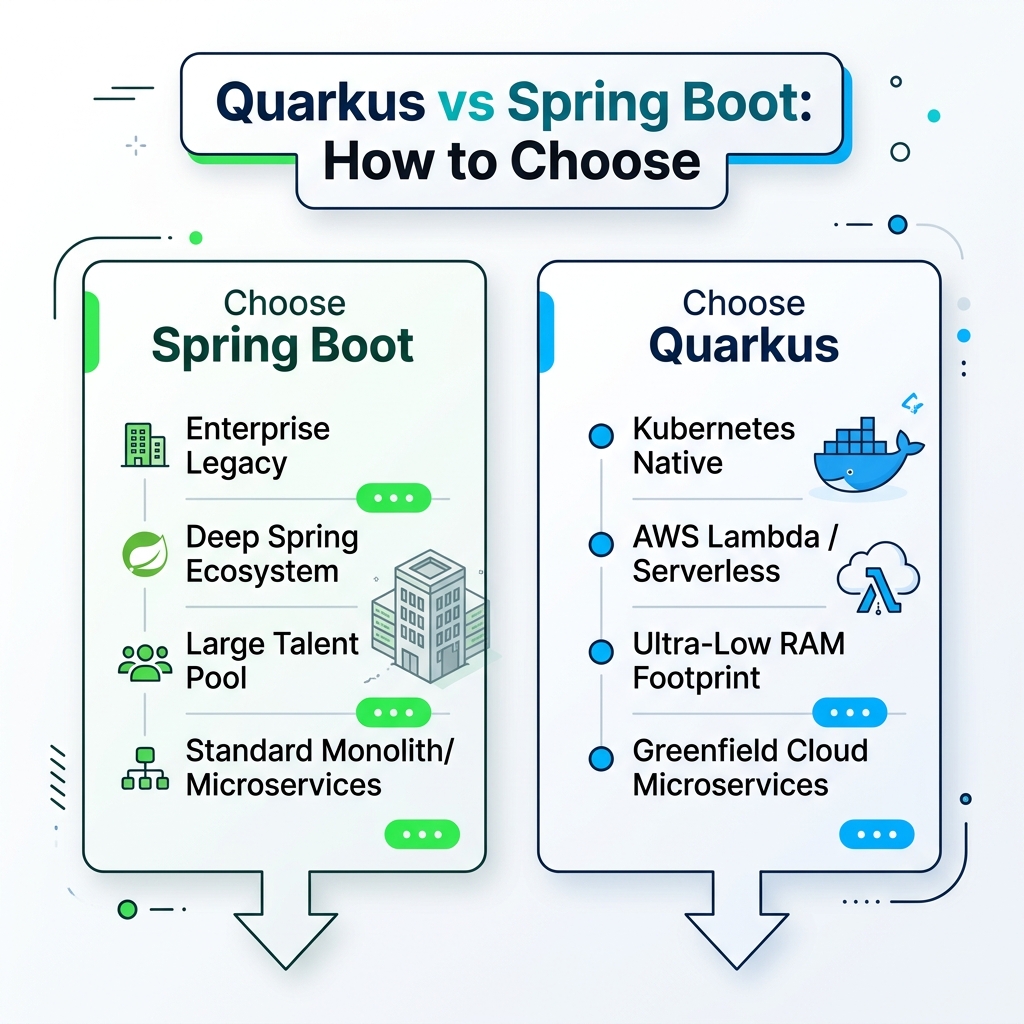
Choose Spring Boot if:
- You Have Large Existing Codebases: Migrating multi-year enterprise Spring Boot monoliths to Quarkus offers limited ROI if you intend to run on traditional VMs or monolithic servers.
- Your Team Knocks Out Code in Spring: If your engineering team is deeply accustomed to Spring Security, Spring Integration, and complex Spring Cloud libraries, staying on Spring Boot minimizes delivery risk.
- Peak Memory Consumption is Secondary: If your services run continuously on dedicated VMs where long uptime is standard and RAM footprint isn’t a primary driver of cloud costs.
- You Need Niche 3rd-Party Spring Integration: Certain legacy enterprise libraries and proprietary vendor SDKs only provide out-of-the-box starters for Spring Boot.
Choose Quarkus if:
- You are Deploying on Kubernetes or OpenShift: Quarkus is designed specifically for containerized microservices running on Kubernetes, allowing you to maximize pod density and cut cloud infrastructure bills significantly.
- You are Building Serverless / AWS Lambda Functions: For event-driven architectures where functions scale down to zero, Quarkus native binaries deliver millisecond cold starts that eliminate execution latency penalties.
- You Want the Best Java Developer Experience: Live coding with
quarkus dev, instant background testing, and automatic Testcontainers integration dramatically accelerate developer iteration speed. - You are Starting Greenfield Cloud-Native Microservices: For modern microservice architectures, Quarkus provides a future-proof, standards-aligned Java foundation built for high concurrency and lightweight memory footprints.
8. Conclusion
Java is no longer a slow, memory-heavy enterprise monolith runtime. The rise of Quarkus proves that Java can deliver the instant startup times and subatomic memory footprints required by modern cloud-native architectures without sacrificing Java’s robust type safety and object-oriented elegance.
- Spring Boot remains the reliable, battle-tested workhorse of enterprise software development, offering an unmatched ecosystem and talent pool.
- Quarkus represents the next generation of Java development—combining build-time optimization, GraalVM native compilation, and outstanding developer ergonomics to make Java thrive in the Kubernetes era.
By evaluating your project’s scaling requirements, cloud runtime environment, and operational costs, you can confidently choose the framework that best positions your architecture for long-term success.
Recommended Further Reading
Tags
Empower Your Digital Presence & Workflows
Explore top-tier tools built by Ghaznix to streamline your links, surveys, and brand growth.