Why Modern Microservices Prefer gRPC Over REST
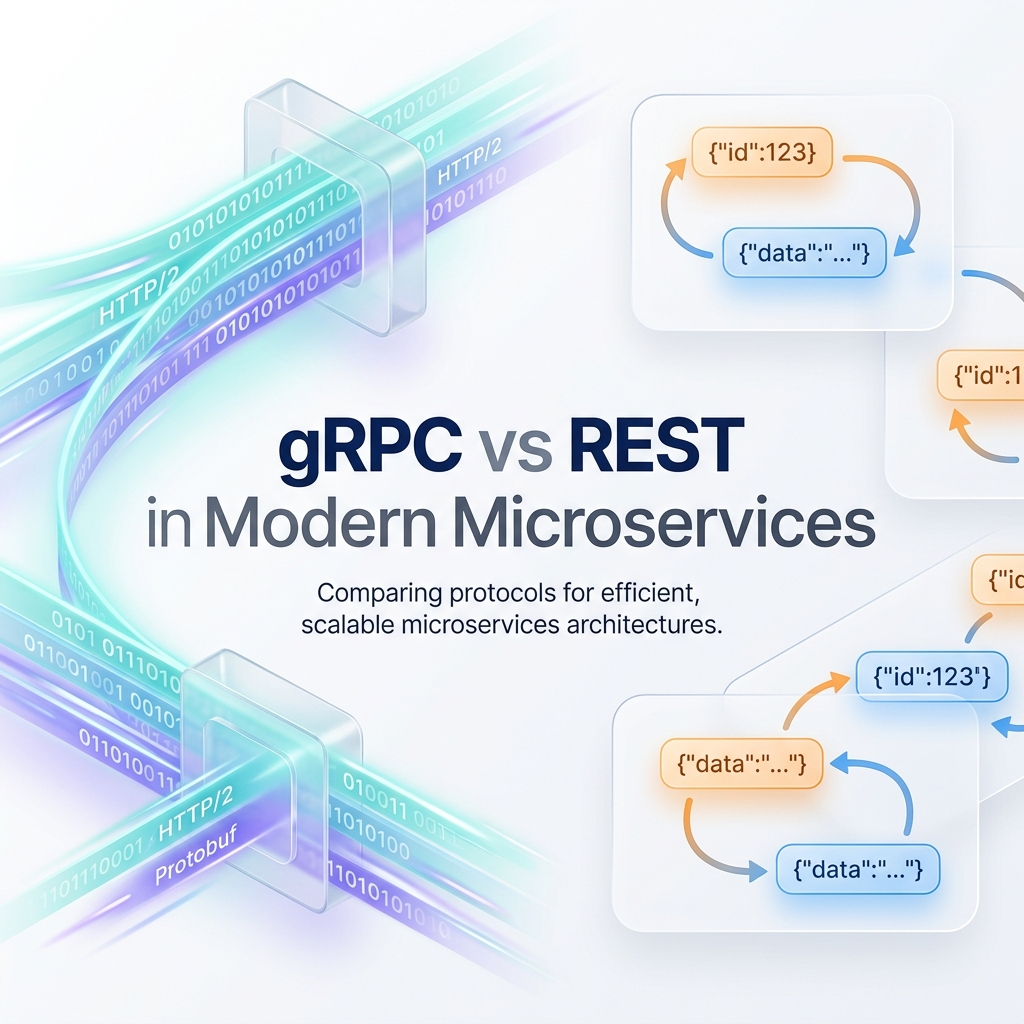
In a monolithic architecture, components communicate via in-memory method calls, which are instantaneous and highly reliable. When moving to a microservices architecture, however, these components are separated by network boundaries. Communication becomes an out-of-process network call (Inter-Process Communication, or IPC).
For years, REST (Representational State Transfer) over HTTP/1.1 with JSON payloads has been the default standard for building web APIs. While REST is excellent for public-facing web services and client-to-server interaction, it introduces significant bottlenecks when used for high-frequency, low-latency, internal service-to-service communication.
This is why modern microservices are rapidly shifting toward gRPC (Google Remote Procedure Call). In this article, we will analyze the limitations of REST, dissect the architectural pillars of gRPC, and walk through a complete implementation of a gRPC service in Java.
1. The Bottlenecks of REST in Microservices
REST has powered the web for over two decades. However, its underlying technologies are not optimized for internal distributed architectures:
A. The Overhead of Plain-Text JSON
JSON is human-readable, which makes debugging easy, but it is extremely inefficient for machine-to-machine communication:
- Serialization/Deserialization Cost: Parsing text string tokens and converting them to objects consumes substantial CPU cycles.
- Large Payload Size: JSON keys are repeated in every single request (e.g.,
{"transactionId": "123", "amount": 99.99}). For systems processing millions of requests per second, this redundant metadata wastes immense network bandwidth.
B. HTTP/1.1 Connection Limitations
REST typically runs on HTTP/1.1, which exhibits several structural inefficiencies:
- Head-of-Line (HoL) Blocking: On a single TCP connection, a client must wait for the current request’s response before sending the next one.
- Connection Pooling Exhaustion: To handle concurrent requests, clients must open multiple TCP connections. This results in significant OS resource overhead, socket exhaustion, and slow-start performance penalties as connections are continuously opened and closed.
C. Weak API Contracts
REST APIs lack a built-in, compile-time contract. While OpenAPI/Swagger helps document APIs, they are separate from the codebase. It is easy for a backend developer to change a JSON field name and accidentally break downstream services without compile-time warnings.
2. The Architectural Pillars of gRPC
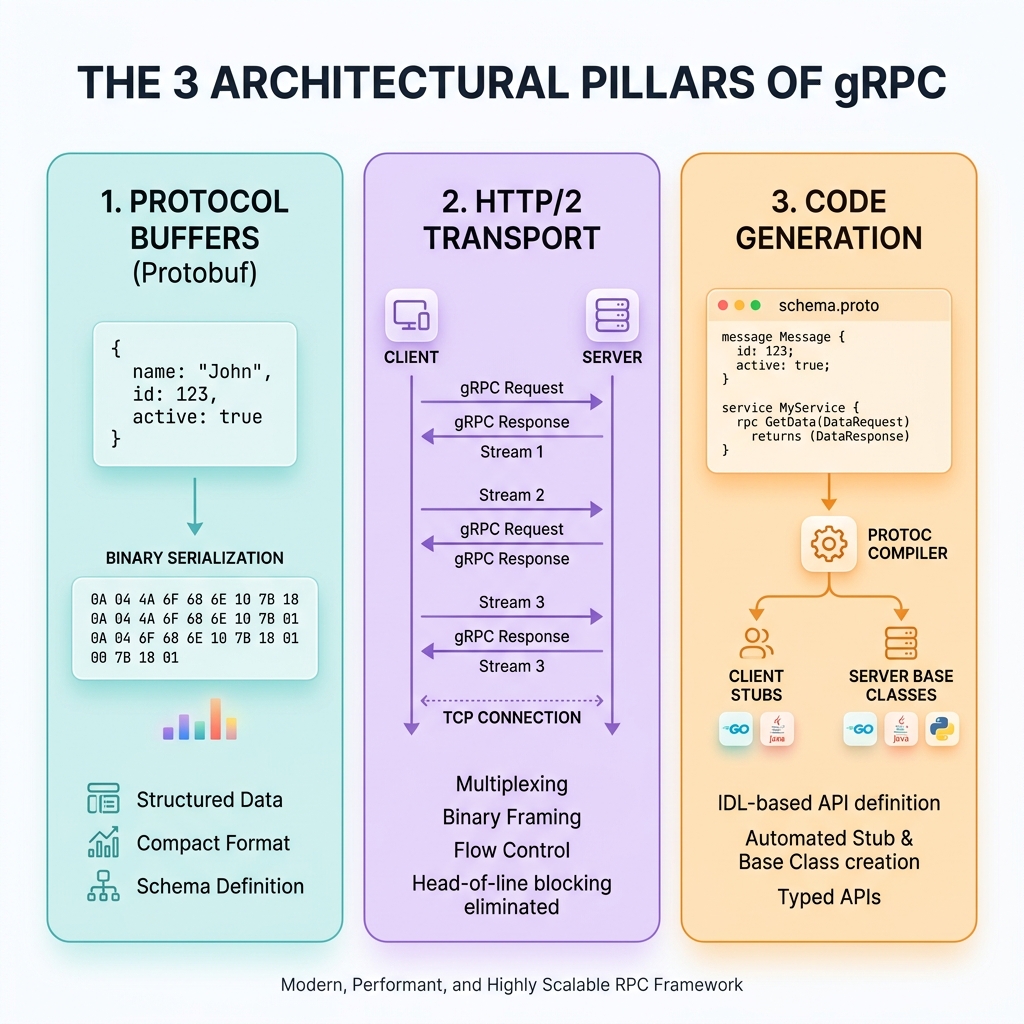
Introduced by Google in 2015, gRPC is an open-source, high-performance RPC framework designed specifically for cloud-native applications. It solves REST’s bottlenecks using three key technologies:
A. Protocol Buffers (Protobuf)
Instead of JSON, gRPC uses Protocol Buffers as its Interface Definition Language (IDL) and message serialization format.
- Protobuf is a highly optimized binary serialization mechanism.
- Fields are serialized as small numeric tags rather than text names.
- Payloads are up to 70-80% smaller than JSON, and serialization is up to 10x faster, significantly reducing CPU and bandwidth usage.
B. HTTP/2 Multiplexing
gRPC utilizes HTTP/2 as its transport protocol, bringing several performance optimizations:
- True Multiplexing: Multiple requests and responses can be interleaved simultaneously over a single long-lived TCP connection, completely eliminating Head-of-Line blocking.
- Header Compression (HPACK): HTTP headers are compressed, further reducing request size.
- Streaming Support: HTTP/2 natively supports unidirectional client streaming, server streaming, and full bidirectional streaming.
C. Code Generation and Strict Contracts
By defining the API structure in a .proto file, gRPC generates client stubs and server base classes in dozens of languages (Java, Go, Python, C++, etc.). The contract is compile-time safe; if the server updates its interface, client builds fail immediately if they do not match the new contract.
3. Java Implementation: Building a gRPC Service
Let’s build a practical Java gRPC application. We will implement a high-throughput Payment Processing Service where a client submits a payment request and receives a transaction confirmation.
Step 1: Define the API Contract (payment.proto)
We start by defining our service interface and message structures in a Protocol Buffer file.
syntax = "proto3";

option java_multiple_files = true;
option java_package = "com.ghaznix.grpc.payment";
option java_outer_classname = "PaymentProto";

package payment;

// The Payment Service definition
service PaymentService {
  // Unary RPC: Sends a single payment request and receives a confirmation
  rpc ProcessPayment (PaymentRequest) returns (PaymentResponse);
}

// The Payment Request message
message PaymentRequest {
  string transaction_id = 1;
  string customer_id = 2;
  double amount = 3;
  string currency = 4;
}

// The Payment Response message
message PaymentResponse {
  string transaction_id = 1;
  string status = 2;
  string message = 3;
  string timestamp = 4;
}
Step 2: Implement the Server-Side Logic
After compiling the .proto file (usually handled automatically by Maven or Gradle gRPC plugins), the tool generates the PaymentServiceImplBase class. We extend this class to implement the business logic.
package com.ghaznix.grpc.payment;

import io.grpc.stub.StreamObserver;
import java.time.Instant;

public class PaymentServiceImpl extends PaymentServiceGrpc.PaymentServiceImplBase {

    @Override
    public void processPayment(PaymentRequest request, StreamObserver<PaymentResponse> responseObserver) {
        System.out.println("Received payment request for customer: " + request.getCustomerId()
                + " with amount: " + request.getAmount() + " " + request.getCurrency());

        // Process payment logic (simulation)
        String status = request.getAmount() > 0 ? "SUCCESS" : "DECLINED";
        String message = status.equals("SUCCESS") ? "Payment processed successfully." : "Invalid payment amount.";

        PaymentResponse response = PaymentResponse.newBuilder()
                .setTransactionId(request.getTransactionId())
                .setStatus(status)
                .setMessage(message)
                .setTimestamp(Instant.now().toString())
                .build();

        // Send the response to the client
        responseObserver.onNext(response);

        // Signal that the RPC execution is complete
        responseObserver.onCompleted();
    }
}
Step 3: Bootstrap the gRPC Server
Next, we create a server class to start the gRPC server on a specific port and register our service implementation.
package com.ghaznix.grpc.payment;

import io.grpc.Server;
import io.grpc.ServerBuilder;
import java.io.IOException;
import java.util.concurrent.TimeUnit;

public class PaymentServer {

    private Server server;

    public void start() throws IOException {
        int port = 50051;
        server = ServerBuilder.forPort(port)
                .addService(new PaymentServiceImpl())
                .build()
                .start();

        System.out.println("gRPC Server started, listening on port " + port);

        Runtime.getRuntime().addShutdownHook(new Thread(() -> {
            System.err.println("*** Shutting down gRPC server since JVM is shutting down");
            try {
                PaymentServer.this.stop();
            } catch (InterruptedException e) {
                e.printStackTrace(System.err);
            }
            System.err.println("*** Server shut down");
        }));
    }

    public void stop() throws InterruptedException {
        if (server != null) {
            server.shutdown().awaitTermination(30, TimeUnit.SECONDS);
        }
    }

    public void blockUntilShutdown() throws InterruptedException {
        if (server != null) {
            server.awaitTermination();
        }
    }

    public static void main(String[] args) throws IOException, InterruptedException {
        final PaymentServer server = new PaymentServer();
        server.start();
        server.blockUntilShutdown();
    }
}
Step 4: Implement the Client (Blocking and Async Stubs)
A major benefit of gRPC is that it generates two types of stubs for the client:
- BlockingStub: Synchronous, blocking execution (similar to standard REST calls).
- Stub: Asynchronous, non-blocking execution using callback observers.
package com.ghaznix.grpc.payment;

import io.grpc.ManagedChannel;
import io.grpc.ManagedChannelBuilder;
import java.util.concurrent.TimeUnit;

public class PaymentClient {

    private final ManagedChannel channel;
    private final PaymentServiceGrpc.PaymentServiceBlockingStub blockingStub;

    public PaymentClient(String host, int port) {
        // Create a communication channel to the server
        this.channel = ManagedChannelBuilder.forAddress(host, port)
                .usePlaintext() // Disables TLS for local development
                .build();

        // Create the synchronous blocking stub
        this.blockingStub = PaymentServiceGrpc.newBlockingStub(channel);
    }

    public void shutdown() throws InterruptedException {
        channel.shutdown().awaitTermination(5, TimeUnit.SECONDS);
    }

    public void executePayment(String txId, String customerId, double amount) {
        PaymentRequest request = PaymentRequest.newBuilder()
                .setTransactionId(txId)
                .setCustomerId(customerId)
                .setAmount(amount)
                .setCurrency("USD")
                .build();

        System.out.println("Sending payment request for: " + txId);

        // Execute unary synchronous call
        PaymentResponse response = blockingStub.processPayment(request);

        System.out.println("Server Response: " + response.getStatus() + " | " + response.getMessage());
    }

    public static void main(String[] args) throws InterruptedException {
        PaymentClient client = new PaymentClient("localhost", 50051);
        try {
            client.executePayment("TX-99081", "customer-abc-123", 250.75);
        } finally {
            client.shutdown();
        }
    }
}
4. Architectural Comparison: gRPC vs. REST
The table below outlines the core characteristics of both paradigms:
| Architectural Feature | REST (Representational State Transfer) | gRPC (Google Remote Procedure Call) |
|---|---|---|
| Protocol | HTTP/1.1 (Standard), HTTP/2 (Optional) | HTTP/2 (Strict Requirement) |
| Payload Format | Plain-Text JSON, XML, HTML | Binary Protocol Buffers (Protobuf) |
| API Paradigm | Resources (URI paths + GET/POST/PUT/DELETE) | Remote Procedures (Methods/Functions calls) |
| Contract Quality | Loose (OpenAPI/Swagger is optional/external) | Strict (Defined in .proto files at compilation) |
| Multiplexing | No (Head-of-Line blocking in HTTP/1.1) | Yes (Multiple streams on single TCP connection) |
| Streaming Types | Unidirectional Server-Sent Events (SSE) only | Client, Server, and Bidirectional Streaming |
| Code Generation | External tools needed (e.g., Swagger Codegen) | Built-in via Protobuf compiler (protoc) |
| Browser Support | Universal (Direct web client access) | Limited (Requires grpc-web proxy translation) |
5. When to Choose gRPC over REST?
Despite gRPC’s massive performance advantages, it is not a silver bullet. The choice of protocol depends on the context within your system architecture:
- Use gRPC for Internal Microservice Mesh: For high-volume service-to-service communication, gRPC’s low latency, binary compactness, and streaming capabilities make it the superior choice. It reduces internal server CPU overhead and speeds up overall response times.
- Use REST for Edge / Public APIs: Because web browsers cannot natively make gRPC calls without translation layers, REST remains the best choice for public APIs, integrations with third-party webhooks, and direct communication from client browsers to the edge of your architecture.
By combining the two—exposing REST at the API Gateway level and leveraging gRPC for internal microservice communication—architects can build systems that are both highly interoperable and blazing-fast.
Explore more software development and backend engineering insights on the Ghaznix Blog →
Empower Your Digital Presence & Workflows
Explore top-tier tools built by Ghaznix to streamline your links, surveys, and brand growth.