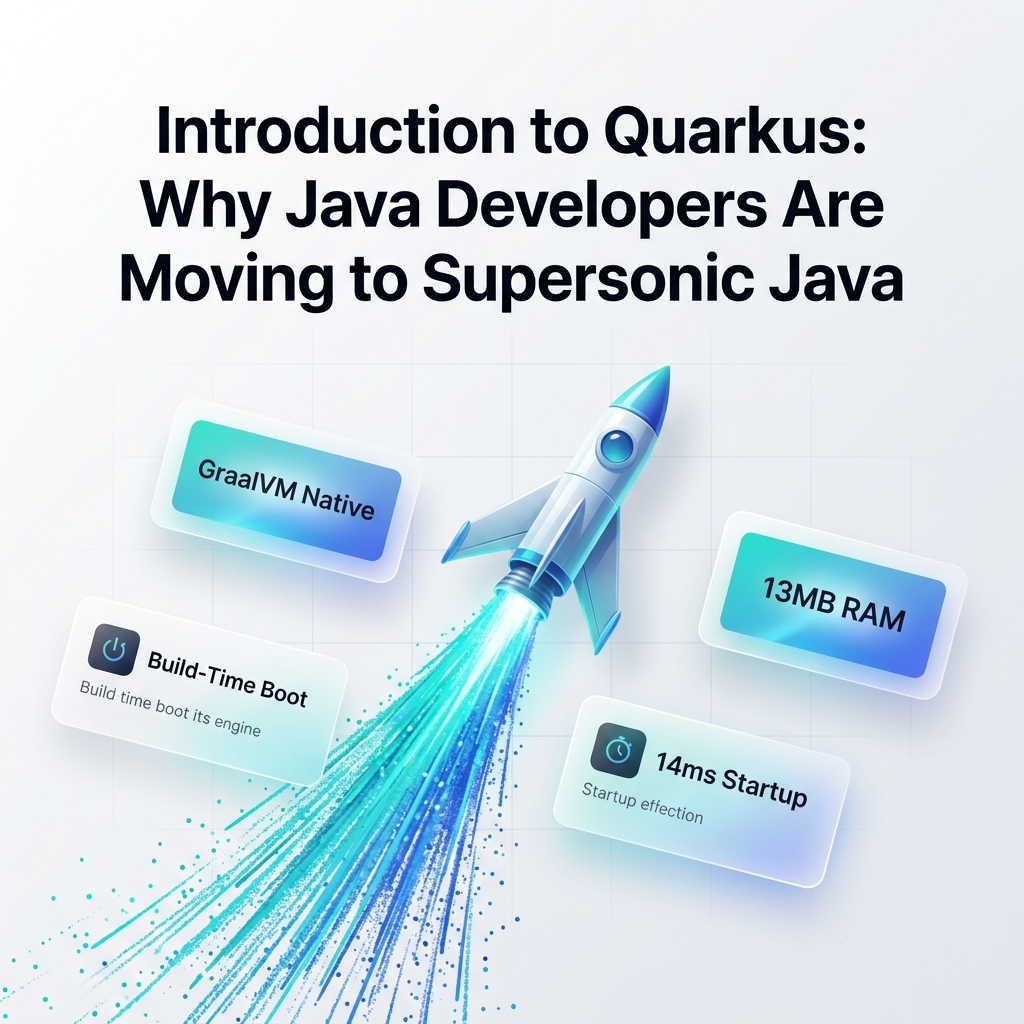
Introduction to Quarkus: Why Java Developers Are Moving to Supersonic Java
For nearly three decades, Java has been the dominant force in enterprise software development. Its rich ecosystem, robust object-oriented foundation, platform independence via the Java Virtual Machine (JVM), and battle-tested frameworks like Spring Boot made it the undisputed king of backend infrastructure.
However, the shift toward Cloud-Native Architectures, Kubernetes orchestration, Containerization (Docker), and Serverless Computing (AWS Lambda, Knative) exposed a severe vulnerability in traditional Java application frameworks: high memory overhead and slow startup times.
When a microservice needs to scale horizontally from zero to 100 replicas in response to a spike in traffic, or when a serverless function executes on demand, waiting 3 to 10 seconds for a Java process to boot is unacceptable. Modern cloud infrastructure demands instant startup and lightweight memory consumption—traits traditionally reserved for languages like Go, Rust, or Node.js.
Enter Quarkus: a Kubernetes-native Java framework designed specifically for GraalVM and OpenJDK HotSpot. Often dubbed “Supersonic Subatomic Java”, Quarkus fundamentally re-engineers how Java applications compile, boot, and run.
In this deep-dive guide, we will explore why Java developers are embracing Quarkus, how Quarkus achieves sub-second startup times and micro-memory footprints, the architectural mechanics of Build-Time Optimization, and how to build a production-ready reactive microservice in Java with Quarkus.
1. The Cloud-Native Dilemma of Traditional Java
To understand why Quarkus exists, we must examine how traditional Java frameworks like Spring Boot or Jakarta EE operate under the hood.
A. The Heavy Runtime Initialization Cost
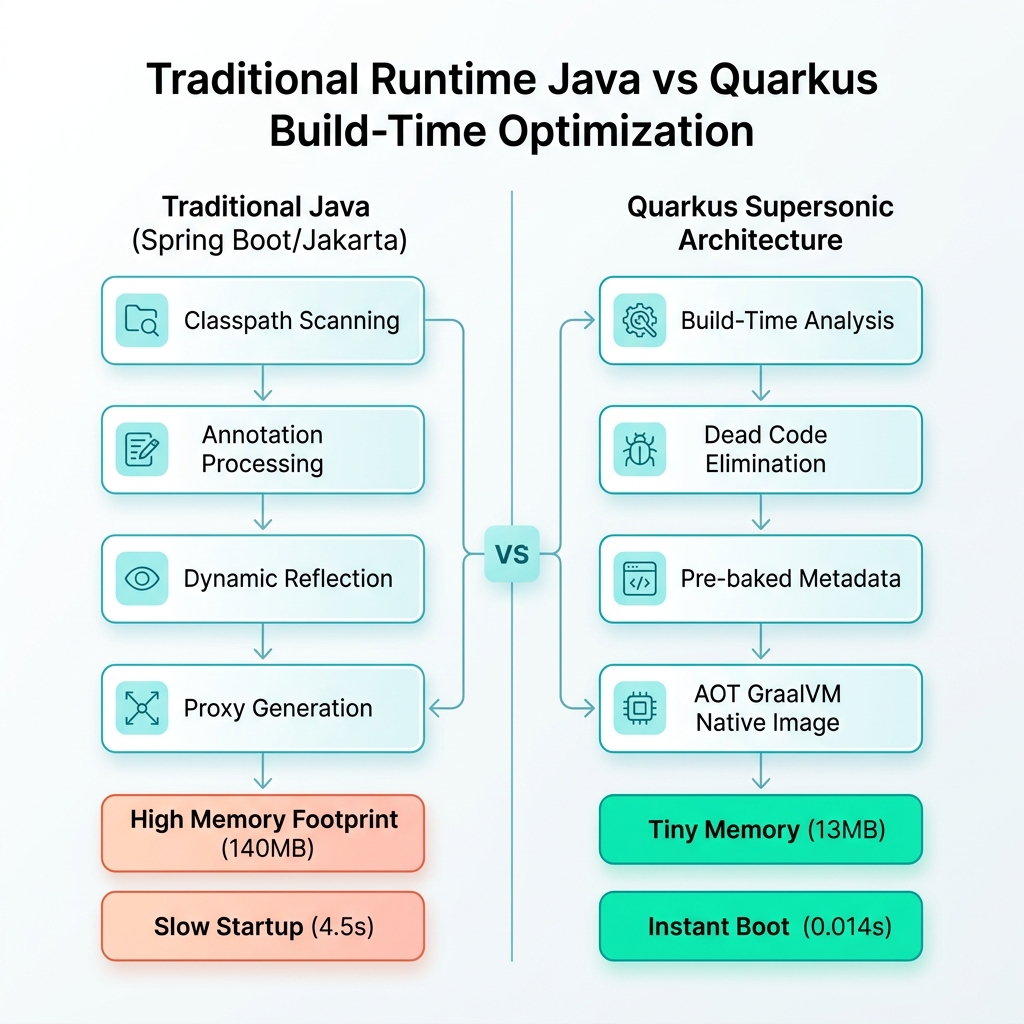
Traditional Java frameworks rely heavily on runtime dynamic reflection, classpath scanning, and proxy generation:
- Classpath Scanning: During startup, the JVM scans every JAR file in the classpath to discover annotations such as
@Component,@Service,@Controller, or@Entity. - Annotation Processing & Reflection: The framework uses reflection (
Class.forName(),getDeclaredFields()) to build an in-memory graph of beans, configuration properties, and dependencies. - Dynamic Proxy Creation: CGLIB or ByteBuddy generates dynamic bytecode proxies in runtime memory to support Aspect-Oriented Programming (AOP), database transaction management (
@Transactional), and security boundaries. - Metaspace & RSS Inflation: All metadata, reflected class descriptors, and generated proxies must be retained in memory inside the JVM’s Metaspace and Resident Set Size (RSS).
This runtime reflection loop requires considerable CPU cycles and inflates heap memory consumption. A basic CRUD REST service in traditional Java can easily consume 140MB to 300MB of RAM at idle and take 3 to 8 seconds to start.
B. The Financial Penalty in Cloud Computing
In serverless and containerized environments, cloud providers charge based on two metrics: allocated memory (GB) and execution duration (milliseconds).
- Cold Starts: If a serverless function takes 5 seconds to boot, end-users experience noticeable latency, and you pay for 5 seconds of idle startup computation.
- Density & Pod Scalability: In a Kubernetes cluster with a worker node possessing 16GB of RAM, you can only run ~40 traditional Spring Boot microservice instances before running out of memory. If each instance consumed only 15MB of RAM, the same node could host over 800 instances.
2. Quarkus Architecture: Shifting Work from Runtime to Build Time
Quarkus solves the cloud-native dilemma through a radical architectural paradigm shift: moving dynamic operations from runtime to build time.
Build-Time Processing (Ahead-Of-Time Optimization)
Instead of executing classpath scanning, annotation parsing, and bean graph wiring every time the application boots, Quarkus performs all these heavy operations once during the build phase (mvn package or ./gradlew build).
- Extension Architecture & Build Steps: Quarkus uses a pluggable extension framework. When compiling your application, Quarkus extensions parse annotations, generate optimized static bytecode, and resolve dependency injection graphs upfront.
- Pre-Baked Metadata: All dependency injection metadata is pre-calculated. When the application starts, Quarkus directly instantiates pre-compiled classes without invoking reflection or scanning classpaths.
- Dead Code Elimination (Tree Shaking): During the build process, Quarkus identifies classes, methods, and libraries that are unused by your application and completely strips them out.
By the time your application JAR or native binary is produced, all runtime overhead has been eliminated. The JVM simply loads pre-wired static bytecodes and starts instantly.
3. GraalVM Native Image vs. OpenJDK HotSpot
Quarkus provides a dual execution model: it runs exceptionally fast on standard OpenJDK HotSpot, but it reaches its maximum performance potential when compiled into a GraalVM Native Image.
+-----------------------------------------------------------------------+
|                         Java Source Code (.java)                      |
+-----------------------------------------------------------------------+
                                    |
                                    v (Standard javac)
+-----------------------------------------------------------------------+
|                            Bytecode (.class)                          |
+-----------------------------------------------------------------------+
                       /                         \
                      /                           \
                     v                             v
   +----------------------------------+   +----------------------------------+
   |      OpenJDK HotSpot JVM         |   |     GraalVM Native Image (AOT)   |
   |  - JIT Compilation (C1/C2)       |   |  - Substrate VM                  |
   |  - Dynamic Class Loading         |   |  - No Classpath Scanning          |
   |  - Fast throughput, longer boot  |   |  - Millisecond boot, tiny RAM    |
   +----------------------------------+   +----------------------------------+
Ahead-of-Time (AOT) Compilation & Substrate VM
GraalVM Native Image takes Java bytecode and compiles it directly into an OS-specific standalone executable binary (ELF binary on Linux, Mach-O on macOS, EXE on Windows).
- Closed-World Assumption: GraalVM assumes that all reachable code, classes, and resources are known at build time.
- Substrate VM: The native executable embeds a miniature runtime engine called Substrate VM, which handles memory management, thread scheduling, and garbage collection without launching a full JVM instance.
- Zero Reflection Overhead: Because Quarkus prepares reflection configurations and proxy definitions during build time, GraalVM native image compilation succeeds smoothly without the manual configuration files historically required by native GraalVM builds.
4. Performance Benchmarks: The Empirical Evidence
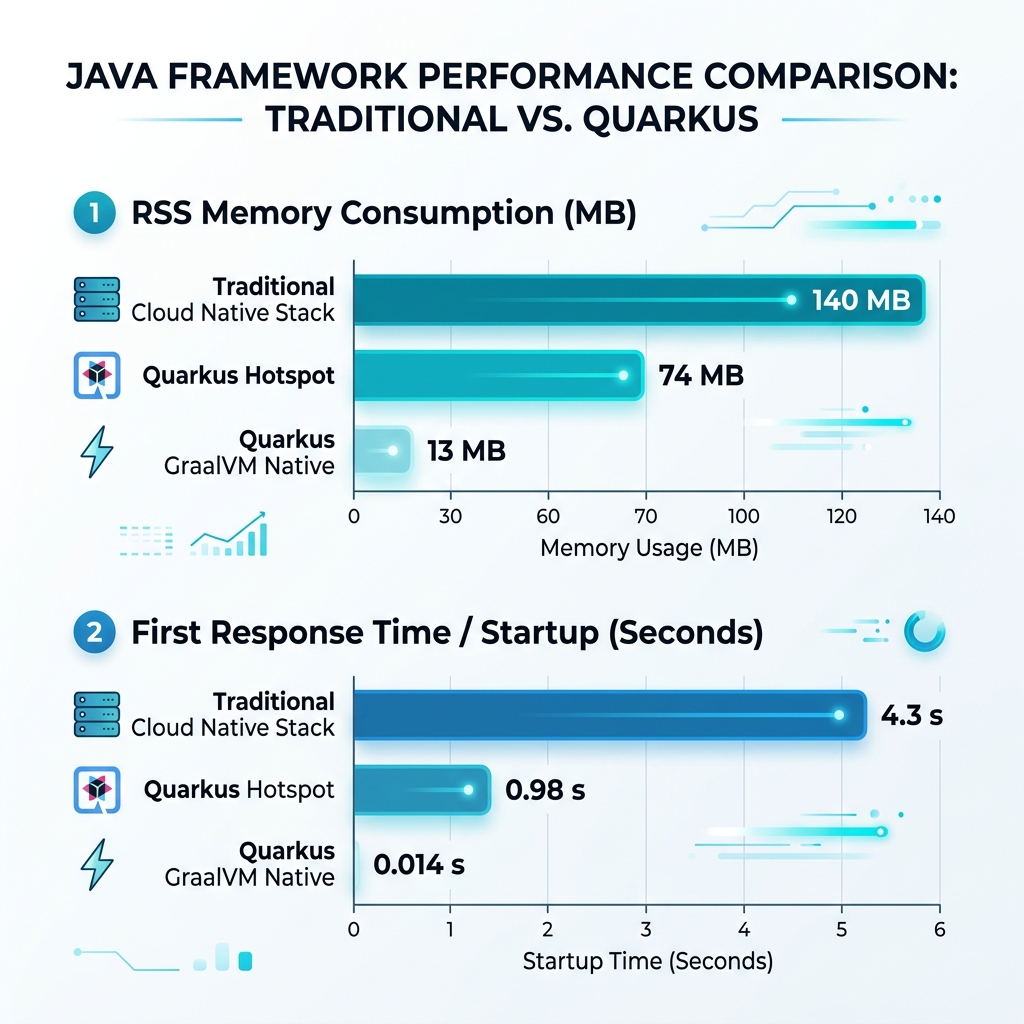
To illustrate the stark contrast in performance, let’s examine standard industry benchmark comparisons across three Java runtime configurations running a standard REST + Database CRUD service:
- Traditional Cloud-Native Stack (Traditional JVM / Spring Boot)
- Quarkus on OpenJDK HotSpot
- Quarkus on GraalVM Native Image
Performance Summary Table
| Metric | Traditional Stack (JVM) | Quarkus (HotSpot JVM) | Quarkus (GraalVM Native) |
|---|---|---|---|
| REST RSS Memory | ~140 MB | ~74 MB | ~13 MB |
| REST + CRUD RSS Memory | ~218 MB | ~112 MB | ~35 MB |
| REST Startup Time | ~4.3 seconds | ~0.98 seconds | ~0.014 seconds (14ms) |
| REST + CRUD Startup Time | ~9.5 seconds | ~2.0 seconds | ~0.042 seconds (42ms) |
| Executable Artifact | Large Fat JAR (~50MB) | Optimized JAR (~20MB) | Standalone Native Binary (~30MB) |
Notice that Quarkus compiled to a native image boots in 14 milliseconds—faster than a single blink of an eye—and consumes a mere 13 MB of RAM. This makes Java fully competitive with Go and Rust for serverless and cloud-native deployments.
5. Reactive & Imperative Dual-Core Engine
Historically, Java developers had to choose between two mutually exclusive programming models:
- Imperative (Thread-per-request): Simple, readable blocking code using standard JDBC drivers and synchronous REST endpoints.
- Reactive (Event Loop): Asynchronous, non-blocking code (e.g., RxJava, Project Reactor) capable of high throughput, but notorious for complex callback chains and difficult debugging.
Quarkus unifies both worlds under a single, cohesive engine powered by Eclipse Vert.x and Netty.
                      +---------------------------------+
                      |     Client HTTP Request         |
                      +---------------------------------+
                                       |
                                       v
                      +---------------------------------+
                      |       Eclipse Vert.x I/O        |
                      |          (Event Loop)           |
                      +---------------------------------+
                                   /       \
                                  /         \
                                 v           v
                 +-------------------+   +-------------------+
                 | Reactive Endpoint |   |Blocking Endpoint  |
                 | (Event Loop)      |   | (Worker Thread)   |
                 | - Mutiny (Uni/Multi)| | - Standard JDBC   |
                 | - Non-blocking    |   | - Imperative Code |
                 +-------------------+   +-------------------+
In Quarkus, non-blocking I/O is the foundation. If you write traditional blocking code, Quarkus automatically dispatches the execution to a managed worker thread pool. If you use reactive types like SmallRye Mutiny (Uni<T> and Multi<T>), execution stays on the high-performance non-blocking event loop thread.
6. Developer Joy: Live Coding & Dev Services
Beyond runtime performance, Quarkus delivers a revolutionary developer experience designed to eliminate the tedious build-test-restart feedback loop.
A. Zero-Restart Live Coding (quarkus:dev)
When running mvn quarkus:dev, Quarkus launches live-coding mode. You can edit Java files, change properties, modify HTML templates, or update database schemas.
The next time you trigger an HTTP request in your browser or terminal, Quarkus detects the file changes, re-applies build steps, and hot-reloads the application in under 500 milliseconds. You never need to manually stop and restart your application server during development.
B. Quarkus Dev Services (Zero-Configuration Testcontainers)
Connecting a microservice to a PostgreSQL database, Kafka broker, or Redis cache usually requires writing a docker-compose.yml file and configuring local database ports.
With Quarkus Dev Services:
- If Quarkus detects a database dependency (e.g.,
quarkus-reactive-pg-client) but no database URL is configured inapplication.properties, Quarkus automatically spins up a Docker container running PostgreSQL via Testcontainers in the background. - It injects connection credentials into your running application automatically.
- When you stop dev mode, the container cleanups itself cleanly.
7. Hands-on Walkthrough: Building a Production-Ready Reactive Quarkus Service
Let’s build a clean, high-performance Quarkus microservice in Java that exposes a REST API connected to a PostgreSQL database using Hibernate Reactive with Panache.
Step 1: Project Dependencies (pom.xml)
<?xml version="1.0" encoding="UTF-8"?>
<project xmlns="http://maven.apache.org/POM/4.0.0"
         xmlns:xsi="http://www.w3.org/2001/XMLSchema-instance"
         xsi:schemaLocation="http://maven.apache.org/POM/4.0.0 http://maven.apache.org/xsd/maven-4.0.0.xsd">
    <modelVersion>4.0.0</modelVersion>

    <groupId>com.ghaznix.quarkus</groupId>
    <artifactId>user-service</artifactId>
    <version>1.0.0-SNAPSHOT</version>

    <properties>
        <compiler-plugin.version>3.13.0</compiler-plugin.version>
        <maven.compiler.release>21</maven.compiler.release>
        <project.build.sourceEncoding>UTF-8</project.build.sourceEncoding>
        <quarkus.platform.artifact-id>quarkus-bom</quarkus.platform.artifact-id>
        <quarkus.platform.group-id>io.quarkus.platform</quarkus.platform.group-id>
        <quarkus.platform.version>3.15.1</quarkus.platform.version>
    </properties>

    <dependencyManagement>
        <dependencies>
            <dependency>
                <groupId>${quarkus.platform.group-id}</groupId>
                <artifactId>${quarkus.platform.artifact-id}</artifactId>
                <version>${quarkus.platform.version}</version>
                <type>pom</type>
                <scope>import</scope>
            </dependency>
        </dependencies>
    </dependencyManagement>

    <dependencies>
        <!-- RESTEasy Reactive for high-performance HTTP endpoints -->
        <dependency>
            <groupId>io.quarkus</groupId>
            <artifactId>quarkus-resteasy-reactive-jackson</artifactId>
        </dependency>

        <!-- Hibernate Reactive with Panache for active-record data access -->
        <dependency>
            <groupId>io.quarkus</groupId>
            <artifactId>quarkus-hibernate-reactive-panache</artifactId>
        </dependency>

        <!-- Reactive PostgreSQL Driver -->
        <dependency>
            <groupId>io.quarkus</groupId>
            <artifactId>quarkus-reactive-pg-client</artifactId>
        </dependency>

        <!-- Quarkus SmallRye OpenAPI / Swagger UI -->
        <dependency>
            <groupId>io.quarkus</groupId>
            <artifactId>quarkus-smallrye-openapi</artifactId>
        </dependency>

        <!-- Testing -->
        <dependency>
            <groupId>io.quarkus</groupId>
            <artifactId>quarkus-junit5</artifactId>
            <scope>test</scope>
        </dependency>
        <dependency>
            <groupId>io.rest-assured</groupId>
            <artifactId>rest-assured</artifactId>
            <scope>test</scope>
        </dependency>
    </dependencies>

    <build>
        <plugins>
            <plugin>
                <groupId>${quarkus.platform.group-id}</groupId>
                <artifactId>quarkus-maven-plugin</artifactId>
                <version>${quarkus.platform.version}</version>
                <executions>
                    <execution>
                        <goals>
                            <goal>build</goal>
                        </goals>
                    </execution>
                </executions>
            </plugin>
        </plugins>
    </build>
</project>
Step 2: Define the Reactive Entity (UserEntity.java)
Quarkus simplified data access with Panache, an Active-Record pattern implementation on top of Hibernate.
package com.ghaznix.quarkus.entity;

import io.quarkus.hibernate.reactive.panache.PanacheEntity;
import io.smallrye.mutiny.Uni;

import jakarta.persistence.Column;
import jakarta.persistence.Entity;
import jakarta.persistence.Table;
import jakarta.validation.constraints.Email;
import jakarta.validation.constraints.NotBlank;
import java.time.Instant;

@Entity
@Table(name = "users")
public class UserEntity extends PanacheEntity {

    @NotBlank(message = "Username cannot be blank")
    @Column(unique = true, nullable = false)
    public String username;

    @Email(message = "Email must be valid")
    @Column(unique = true, nullable = false)
    public String email;

    @Column(nullable = false)
    public String role;

    @Column(name = "created_at", nullable = false, updatable = false)
    public Instant createdAt = Instant.now();

    /**
     * Helper method to find a user reactively by email.
     */
    public static Uni<UserEntity> findByEmail(String email) {
        return find("email", email).firstResult();
    }
}
Step 3: Implement the Reactive REST Resource (UserResource.java)
Using RESTEasy Reactive and SmallRye Mutiny, our HTTP endpoints operate fully asynchronously on non-blocking threads:
package com.ghaznix.quarkus.resource;

import com.ghaznix.quarkus.entity.UserEntity;
import io.quarkus.hibernate.reactive.panache.Panache;
import io.smallrye.mutiny.Uni;

import jakarta.enterprise.context.ApplicationScoped;
import jakarta.validation.Valid;
import jakarta.ws.rs.*;
import jakarta.ws.rs.core.MediaType;
import jakarta.ws.rs.core.Response;
import java.net.URI;
import java.util.List;

@Path("/api/v1/users")
@Produces(MediaType.APPLICATION_JSON)
@Consumes(MediaType.APPLICATION_JSON)
@ApplicationScoped
public class UserResource {

    @GET
    public Uni<List<UserEntity>> getAllUsers() {
        return UserEntity.listAll();
    }

    @GET
    @Path("/{id}")
    public Uni<Response> getUserById(@PathParam("id") Long id) {
        return UserEntity.<UserEntity>findById(id)
                .onItem().ifNotNull().transform(user -> Response.ok(user).build())
                .onItem().ifNull().continueWith(() -> Response.status(Response.Status.NOT_FOUND).build());
    }

    @POST
    public Uni<Response> createUser(@Valid UserEntity user) {
        return Panache.withTransaction(user::persist)
                .replaceWith(() -> Response.created(URI.create("/api/v1/users/" + user.id))
                        .entity(user)
                        .build());
    }

    @DELETE
    @Path("/{id}")
    public Uni<Response> deleteUser(@PathParam("id") Long id) {
        return Panache.withTransaction(() -> UserEntity.deleteById(id))
                .map(deleted -> deleted
                        ? Response.noContent().build()
                        : Response.status(Response.Status.NOT_FOUND).build());
    }
}
Step 4: Application Configuration (application.properties)
# Quarkus Application Configuration
quarkus.application.name=user-service
quarkus.http.port=8080

# Database Schema Management (Automatically managed by Dev Services in dev mode)
quarkus.hibernate-orm.database.generation=drop-and-create
quarkus.hibernate-orm.log.sql=true

# SmallRye OpenAPI & Swagger UI Configuration
quarkus.smallrye-openapi.path=/swagger-ui
quarkus.swagger-ui.always-include=true
Notice that we did not configure database URLs, usernames, or passwords! When you run ./mvnw quarkus:dev, Quarkus automatically detects PostgreSQL, launches a Docker container, sets up database schema tables, and opens Swagger UI at http://localhost:8080/swagger-ui.
Step 5: Building and Executing Native Executables
To run in instant Live-Coding Dev Mode:
./mvnw quarkus:dev
To build a native Linux binary using GraalVM inside a Docker container (no local GraalVM installation required):
./mvnw package -Dnative -Dquarkus.native.container-build=true
To launch the resulting binary directly on your OS:
./target/user-service-1.0.0-SNAPSHOT-runner
__  ____  __  _____   ___  __ ____  ______
 --/ __ \/ / / / _ | / _ \/ //_/ / / / __/
 -/ /_/ / /_/ / __ |/ , _/ ,< / /_/ /\ \
--\___\_\____/_/ |_/_/|_/_/|_|\____/___/
2026-08-26 01:37:15,102 INFO  [io.quarkus] (main) user-service 1.0.0-SNAPSHOT native (powered by Quarkus 3.15.1) started in 0.016s. Listening on: http://0.0.0.0:8080
2026-08-26 01:37:15,103 INFO  [io.quarkus] (main) Profile prod activated.
2026-08-26 01:37:15,103 INFO  [io.quarkus] (main) Installed features: [cdi, hibernate-reactive, panache, reactive-pg-client, resteasy-reactive, resteasy-reactive-jackson, smallrye-openapi]
0.016 seconds startup!
8. Strategic Feature Comparison: Quarkus vs. Spring Boot
| Capability / Feature | Traditional Spring Boot 3.x | Quarkus 3.x |
|---|---|---|
| Primary Architecture | Runtime Reflection & Dynamic Scanning | Build-Time Processing & AOT Optimization |
| Native Compilation | Spring Native (Requires complex hints) | First-Class GraalVM Native Integration |
| Startup Speed (Native) | ~0.1 - 0.5s | ~0.01 - 0.04s |
| Memory RSS Footprint | 140MB - 300MB | 13MB - 40MB |
| Dev Environment | Hot-swapping via DevTools (Limited) | Zero-Restart Live Coding (quarkus:dev) |
| Third-Party Services | Manual Docker / Testcontainers config | Automatic Dev Services (Zero-Config Containers) |
| Standards Support | Spring Ecosystem Specific | Jakarta EE & MicroProfile Standard Specs |
| Reactive Paradigm | Spring WebFlux (Separate Stack) | Unified Engine (Vert.x Core / Reactive + Imperative) |
9. Conclusion: Is It Time to Switch to Quarkus?
Quarkus is not merely another web framework; it represents the evolution of Java for the cloud-native era. By combining build-time optimization with GraalVM native compilation, Quarkus invalidates the legacy stereotype that Java is too slow or too memory-heavy for modern microservices and serverless functions.
When Should You Choose Quarkus?
- Serverless & Event-Driven Applications: If you are deploying microservices to AWS Lambda, GCP Cloud Run, or Knative, Quarkus native binaries completely eliminate cold start issues.
- High-Density Kubernetes Clusters: If your infrastructure bill is dominated by cluster RAM consumption, migrating services to Quarkus can cut memory costs by up to 75%.
- Reactive Microservices: If you build high-throughput systems requiring non-blocking streaming (Kafka, gRPC, WebSockets), Quarkus delivers top-tier performance out of the box.
Java is no longer anchored down by slow startups or bloated runtimes. With Quarkus, Java developers can build cloud-native applications with Supersonic Speed and Subatomic Footprint.
Tags
Empower Your Digital Presence & Workflows
Explore top-tier tools built by Ghaznix to streamline your links, surveys, and brand growth.