Choreography vs. Orchestration: Designing Distributed Workflows in Microservices
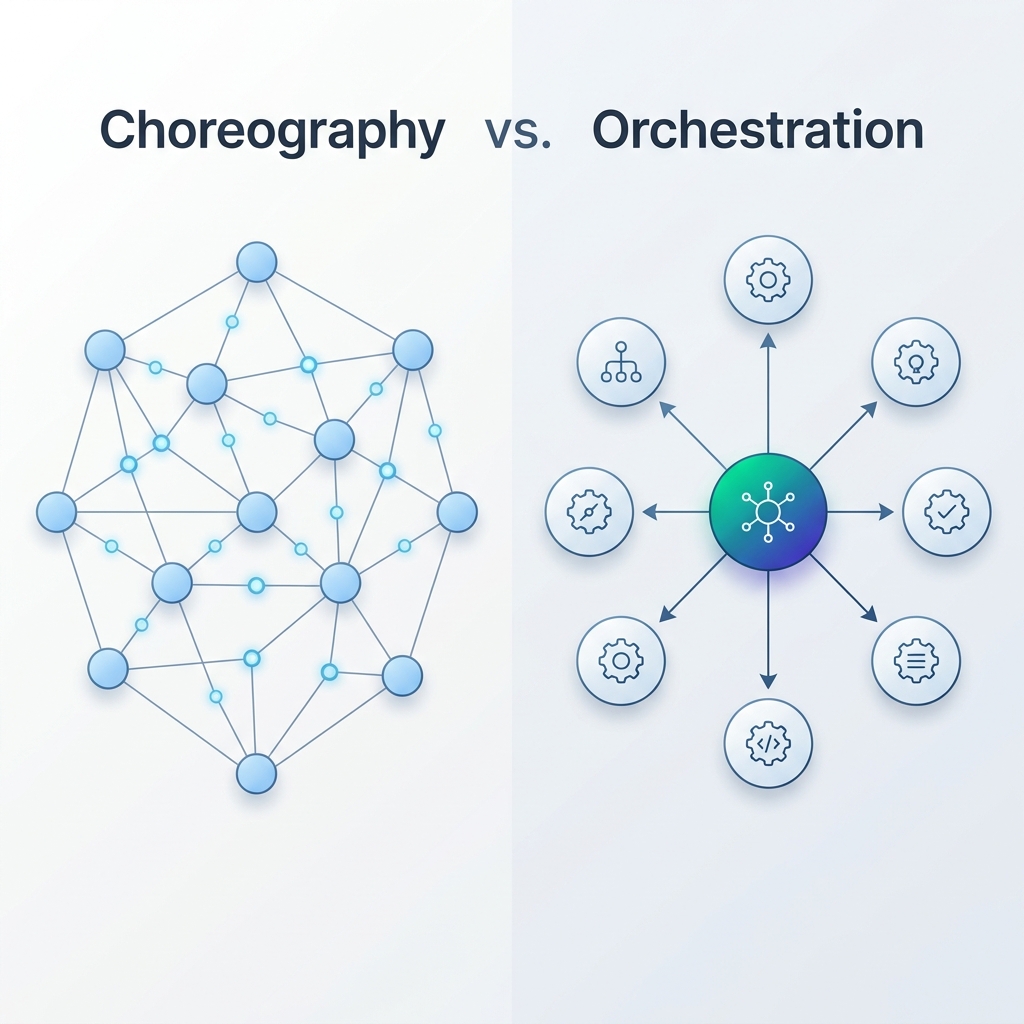
In a monolithic architecture, executing a complex business transaction—such as fulfilling an e-commerce order—is straightforward. All data resides in a single relational database, allowing developers to wrap multiple database writes across inventory, payments, and shipping inside a single ACID transaction. If an error occurs at any point, a SQL ROLLBACK instantly restores system consistency.
However, modern cloud-native systems adopt a Microservices Architecture, where each service owns its data and exposes distinct API boundaries. In this distributed paradigm, a single end-to-end business operation spans multiple independent microservices and database engines.
Because two-phase commit (2PC) protocols are slow, blocking, and fragile across cloud networks, distributed systems must coordinate workflows asynchronously while maintaining eventual consistency.
This brings software architects to a fundamental design decision: Should you use Choreography or Orchestration to manage distributed microservice workflows?
In this comprehensive guide, we will break down both architectural patterns, explore real-world analogies, analyze architectural trade-offs, detail production code implementations in Go and Java, and establish a framework for selecting the right pattern for your infrastructure.
Real-World Analogy: Flash Mob vs. Symphony Orchestra
To build an intuitive mental model for both patterns, consider how groups of human performers coordinate their actions:
The Choreography Analogy: A Flash Mob Dancers Network
Imagine a group of professional street dancers performing a flash mob routine. There is no instructor standing on stage pointing at individual dancers to command their next move. Instead, each dancer listens to the central music track and reacts dynamically to the movements of the dancer next to them.
- When Dancer A completes a flip, Dancer B recognizes that visual cue and begins spinning.
- When Dancer B finishes spinning, Dancer C steps forward.
- Key Characteristic: Decentralized, reactive, and autonomous. Every participant understands their own responsibility without central direction.
The Orchestration Analogy: A Symphony Orchestra
Now imagine a 70-piece classical symphony orchestra. The violinists, percussionists, and cellists do not take cues by watching each other’s hands across the stage. Instead, everyone looks directly at the Conductor.
- The Conductor signals the violins when to play soft strings.
- The Conductor points to the drums to signal a percussion strike.
- If a musician misses a tempo, the Conductor coordinates the tempo adjustment or signals a pause.
- Key Characteristic: Centralized, explicit, and command-driven. A single leader directs all participants.
1. Choreography Architecture: Decentralized & Event-Driven
In Choreography, distributed microservices communicate reactively without a central master coordinator. Services publish domain events to an asynchronous message broker (such as Apache Kafka, RabbitMQ, or AWS EventBridge) whenever their internal state changes. Downstream microservices subscribe to relevant event topics and independently decide what action to take next.
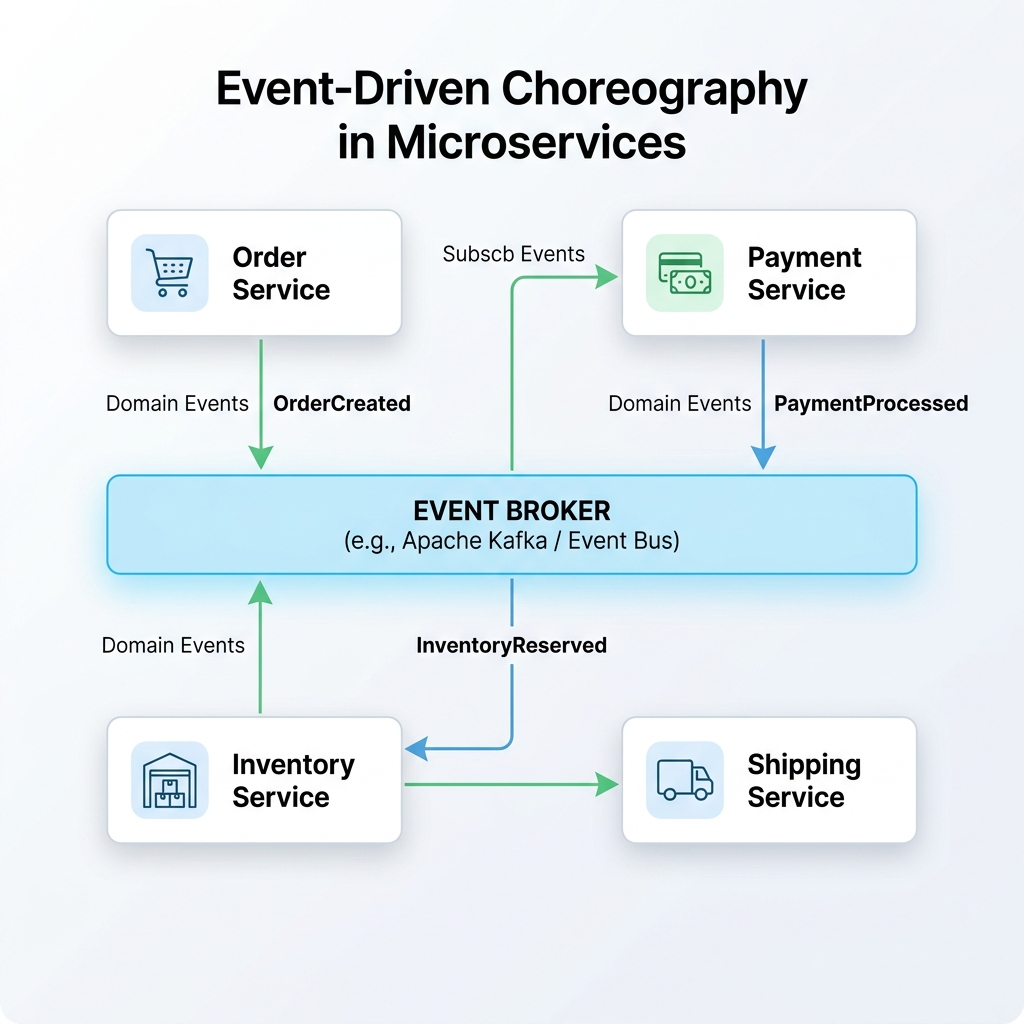
E-Commerce Flow under Choreography
Consider an e-commerce checkout process using choreography:
- Order Service: Receives an HTTP POST checkout request, writes the pending order to its database, and emits an
OrderCreateddomain event to the Kafka event bus. - Payment Service: Subscribes to the
OrderCreatedtopic. Upon receiving the event, it charges the customer’s credit card and emits aPaymentProcessedevent. - Inventory Service: Subscribes to the
PaymentProcessedtopic. It reserves warehouse items and emits anInventoryReservedevent. - Shipping Service: Subscribes to the
InventoryReservedtopic. It generates a shipping label and emits anOrderShippedevent. - Notification Service: Subscribes to
OrderShippedand sends a tracking email to the customer.
Advantages of Choreography
- High Autonomy & Loose Coupling: Services do not know about the existence of downstream handlers. The Order Service only knows that an order was created; it does not care who consumes that information.
- Independent Scalability & Velocity: Teams can build, deploy, and scale microservices independently. Adding a new feature (e.g., an Analytics Service tracking sales) requires subscribing to existing events without modifying upstream code.
- No Single Point of Failure (SPOF): Because there is no central workflow coordinator, the failure of an unrelated service does not bring down the entire execution engine.
- High Performance & Throughput: Event-driven pub/sub streaming handles massive event volume asynchronously without synchronous HTTP/gRPC blocking latency.
Disadvantages of Choreography
- Implicit Workflow Logic: No single code location defines the end-to-end business process. Understanding the entire workflow requires piecing together event handlers across multiple codebases.
- Cyclic Dependency Risk: If microservices publish and subscribe to overlapping topics without careful topic design, infinite event loops can crash system message queues.
- Complex Observability & Distributed Tracing: Tracking a single order transaction across 10 event topics requires robust distributed tracing infrastructure (e.g., OpenTelemetry, Jaeger, W3C Trace Context).
- Difficult Error Handling & Compensations: If the Inventory Service fails after Payment has succeeded, the Inventory Service must emit an
InventoryFailedevent. The Payment Service must listen for this event and trigger a refund compensation manually.
2. Orchestration Architecture: Centralized & Command-Driven
In Orchestration, a dedicated coordinator service (the Saga Orchestrator) explicitly directs the sequence of execution. The Orchestrator holds the workflow state machine, sends command requests (via gRPC, HTTP REST, or dedicated command queues) to worker microservices, waits for responses, and determines the next execution step.
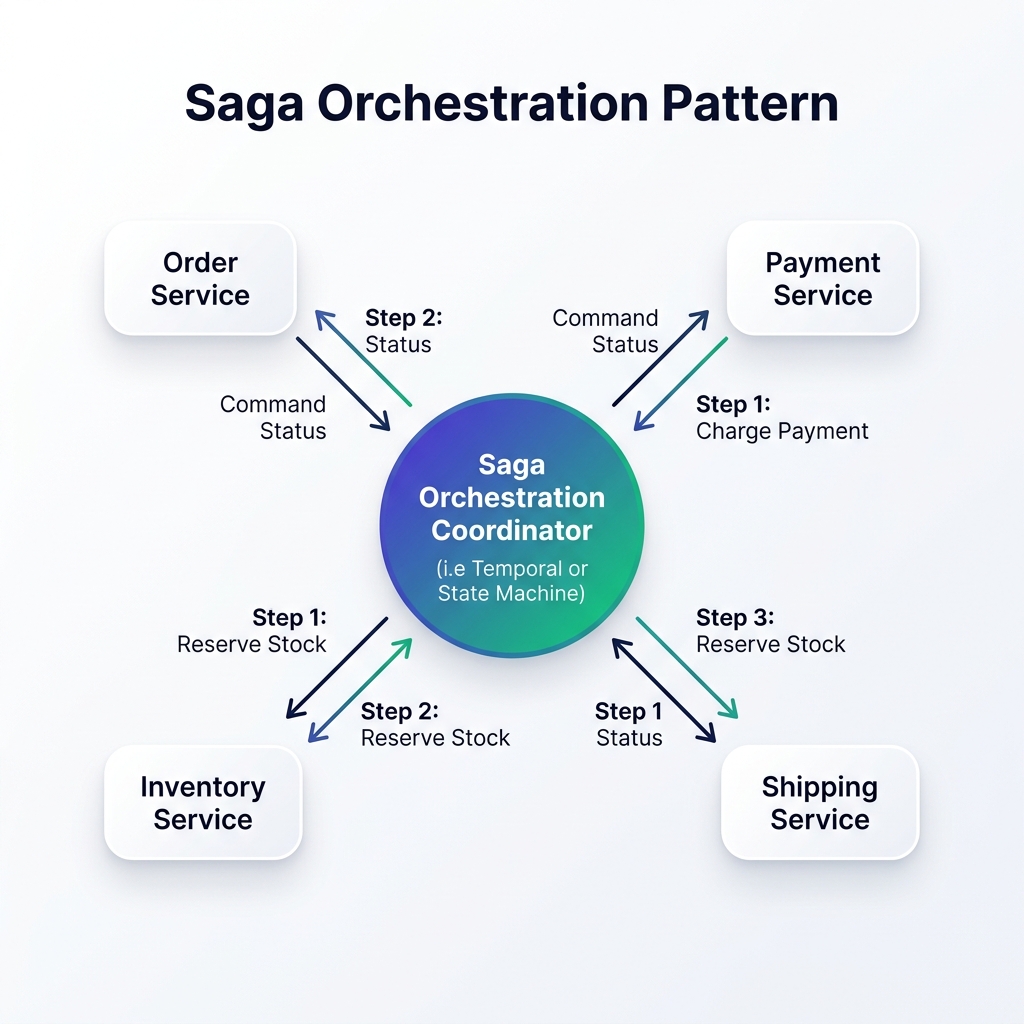
E-Commerce Flow under Orchestration
- Order Service / Saga Orchestrator: Receives the checkout request and instantiates an
OrderSagaCoordinatorworkflow instance in stateORDER_PENDING. - Step 1 (Payment Command): The Orchestrator calls
PaymentService.ExecutePayment(). Payment Service processes the payment and returnsSUCCESS. - Step 2 (Inventory Command): The Orchestrator receives
SUCCESSand callsInventoryService.ReserveStock(). Inventory Service reserves stock and returnsSUCCESS. - Step 3 (Shipping Command): The Orchestrator calls
ShippingService.CreateShipment(). Shipping Service returns tracking details. - Step 4 (Completion): The Orchestrator updates the order status in its state store to
ORDER_COMPLETED.
If InventoryService.ReserveStock() fails during Step 2, the Orchestrator executes rollback commands sequentially:
- Invokes
PaymentService.RefundPayment()to undo Step 1. - Updates the Saga state to
ORDER_CANCELLED.
Advantages of Orchestration
- Explicit & Centralized Workflow Visibility: The entire business process is clearly visible in a single state machine definition or workflow DSL (e.g., Temporal workflow definition).
- Simplified Failure Management: If a step fails, the Orchestrator directly invokes compensating transactions for all previously completed steps without relying on indirect event chains.
- Prevents Cyclic Dependencies: Worker services communicate back and forth with the Orchestrator rather than calling each other directly.
- Easier Testing & Auditing: You can test workflow state transitions deterministically by mocking service responses in unit tests.
Disadvantages of Orchestration
- Risk of Over-Centralization (“God Service”): If developers push domain business logic into the Orchestrator, worker microservices risk turning into “dumb CRUD services,” recreating a monolithic core.
- Tighter API Coupling: The Orchestrator must be explicitly aware of the API contracts and endpoints of all participant microservices.
- Potential Scalability Bottleneck: The central Orchestrator handles state persistence for every active transaction. High throughput systems require horizontally scalable state engine backends.
3. Comprehensive Architectural Comparison
To evaluate Choreography vs. Orchestration side-by-side, consider their key operational characteristics:
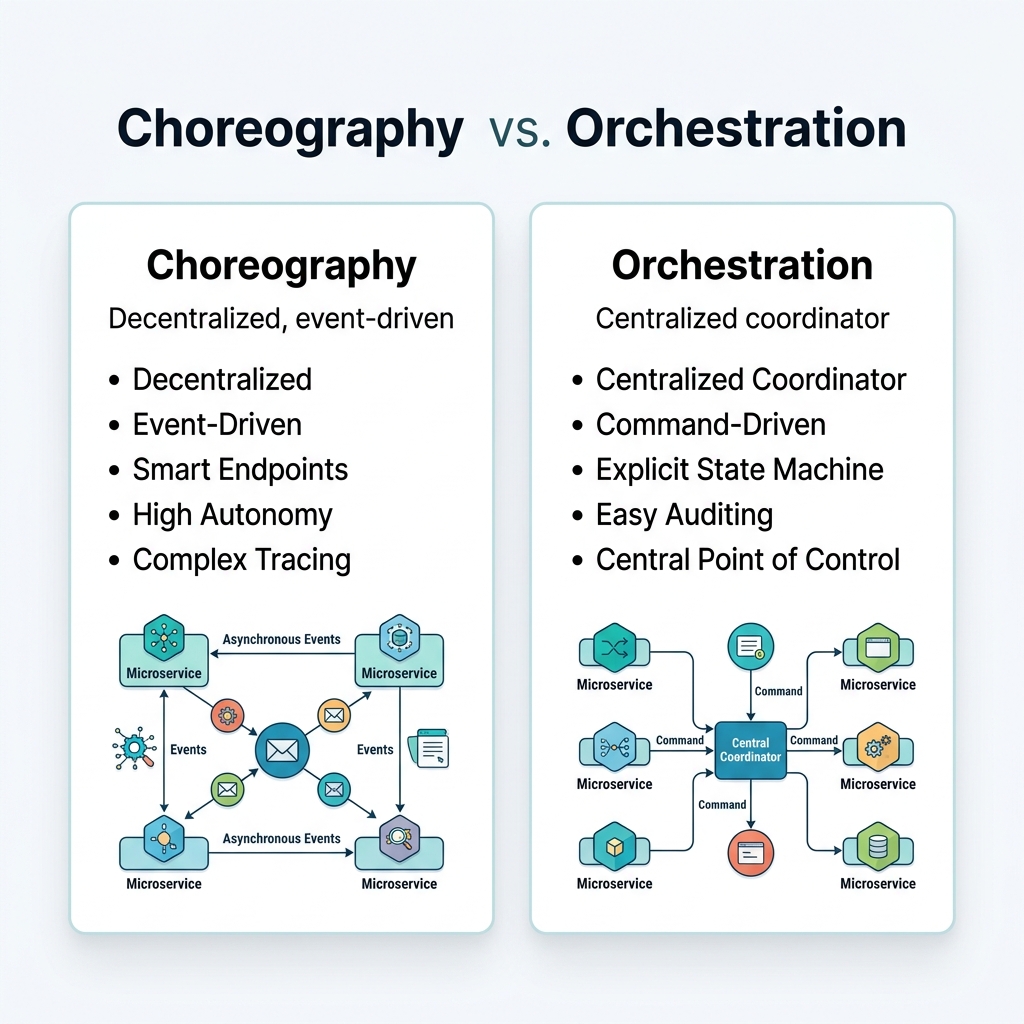
| Dimension | Choreography (Event-Driven) | Orchestration (Command-Driven) |
|---|---|---|
| Communication Style | Asynchronous Pub/Sub (Event broadcast) |
Point-to-Point / RPC (Command + Response) |
| Service Coupling | Very Low (Services only know domain events) | Medium (Orchestrator knows worker APIs) |
| State Management | Distributed across service databases | Centralized inside Orchestrator state engine |
| Workflow Visibility | Implicit (Spread across handlers) | Explicit (Centralized state machine code) |
| Failure Recovery | Complex (Cascade of compensating events) | Straightforward (Orchestrator manages rollbacks) |
| Distributed Tracing | Requires correlation IDs across all topics | Simplified tracing through Orchestrator logs |
| Ideal Team Size | Large engineering orgs with autonomous teams | Medium/Large teams managing complex enterprise flows |
| Best Suited For | High-throughput, simple linear workflows | Complex multi-branch workflows with heavy business rules |
4. The Hybrid Approach: Macro Choreography + Micro Orchestration
Modern enterprise architecture rarely forces an all-or-nothing choice. Instead, leading engineering teams employ a Hybrid Architecture:
- Macro Level (Choreography): High-level bounded contexts (e.g., Sales Bounded Context, Supply Chain Bounded Context, Customer Support) communicate using Event-Driven Choreography via Kafka or NATS.
- Micro Level (Orchestration): Within a specific bounded context (e.g., inside the Payment bounded context handling multi-gateway retries, fraud validation, and ledger entries), a local Orchestrator coordinates fine-grained service execution.
                  [EVENT BROKER: KAFKA]
             /              |              \
   (OrderCreated)     (PaymentSuccess)   (StockReserved)
           /                |                \
  [Order Domain]   [Payment Domain]   [Inventory Domain]
         |                  |                 |
  (Local Saga        (Local Saga       (Local Saga
  Orchestrator)      Orchestrator)     Orchestrator)
This hybrid pattern yields the loose coupling of Choreography across domain boundaries while maintaining the state visibility of Orchestration within individual service teams.
5. Production Code Examples
Let’s look at how to implement both patterns in production environments using Go and Java (Spring Boot).
Go Implementation: Choreography Event Consumer vs. Saga Orchestrator
1. Choreography in Go (Kafka Event Consumer)
In Choreography, the Inventory Service listens reactively to PaymentProcessedEvent from Kafka:
package main

import (
	"context"
	"encoding/json"
	"fmt"
	"log"

	"github.com/segmentio/kafka-go"
)

type PaymentProcessedEvent struct {
	OrderID string  `json:"order_id"`
	Amount  float64 `json:"amount"`
	Status  string  `json:"status"`
}

type InventoryReservedEvent struct {
	OrderID string `json:"order_id"`
	Status  string `json:"status"`
}

func main() {
	reader := kafka.NewReader(kafka.ReaderConfig{
		Brokers: []string{"localhost:9092"},
		Topic:   "payment-events",
		GroupID: "inventory-service-group",
	})
	defer reader.Close()

	writer := kafka.NewWriter(kafka.WriterConfig{
		Brokers: []string{"localhost:9092"},
		Topic:   "inventory-events",
	})
	defer writer.Close()

	fmt.Println("Inventory Service listening for payment events...")

	for {
		msg, err := reader.ReadMessage(context.Background())
		if err != nil {
			log.Fatalf("Error reading message: %v", err)
		}

		var event PaymentProcessedEvent
		if err := json.Unmarshal(msg.Value, &event); err != nil {
			log.Printf("Invalid message payload: %v", err)
			continue
		}

		if event.Status == "SUCCESS" {
			log.Printf("[Choreography] Reserved stock for Order: %s", event.OrderID)

			// Publish downstream domain event reactively
			resEvent := InventoryReservedEvent{
				OrderID: event.OrderID,
				Status:  "RESERVED",
			}
			payload, _ := json.Marshal(resEvent)

			err = writer.WriteMessages(context.Background(), kafka.Message{
				Key:   []byte(event.OrderID),
				Value: payload,
			})
			if err != nil {
				log.Printf("Failed to publish inventory event: %v", err)
			}
		}
	}
}
2. Orchestration in Go (Central State Machine Coordinator)
In Orchestration, an explicit state machine executes steps and handles compensations:
package main

import (
	"context"
	"errors"
	"fmt"
	"log"
)

type OrderSagaOrchestrator struct {
	paymentClient *PaymentClient
	stockClient   *StockClient
}

func NewOrderSagaOrchestrator(p *PaymentClient, s *StockClient) *OrderSagaOrchestrator {
	return &OrderSagaOrchestrator{paymentClient: p, stockClient: s}
}

func (o *OrderSagaOrchestrator) ExecuteSaga(ctx context.Context, orderID string, amount float64) error {
	log.Printf("[Orchestrator] Starting Saga execution for Order ID: %s", orderID)

	// Step 1: Charge Payment
	if err := o.paymentClient.Charge(ctx, orderID, amount); err != nil {
		log.Printf("[Orchestrator] Payment failed for Order %s: %v", orderID, err)
		return err
	}
	log.Printf("[Orchestrator] Step 1 Complete: Payment Charged")

	// Step 2: Reserve Inventory
	if err := o.stockClient.Reserve(ctx, orderID); err != nil {
		log.Printf("[Orchestrator] Inventory reservation failed: %v. Initiating Compensation...", err)

		// Compensation Step: Refund Payment
		if refundErr := o.paymentClient.Refund(ctx, orderID, amount); refundErr != nil {
			log.Printf("[CRITICAL] Compensation failed! Manual intervention required for Order %s", orderID)
		}
		return errors.New("saga aborted: inventory unavailable")
	}

	log.Printf("[Orchestrator] Saga Completed Successfully for Order ID: %s", orderID)
	return nil
}

type PaymentClient struct{}
func (p *PaymentClient) Charge(ctx context.Context, id string, amt float64) error { return nil }
func (p *PaymentClient) Refund(ctx context.Context, id string, amt float64) error { return nil }

type StockClient struct{}
func (s *StockClient) Reserve(ctx context.Context, id string) error { return errors.New("out of stock") }

func main() {
	saga := NewOrderSagaOrchestrator(&PaymentClient{}, &StockClient{})
	_ = saga.ExecuteSaga(context.Background(), "ORD-9982", 149.99)
}
Java (Spring Boot) Implementation
1. Choreography in Java (Spring Cloud Stream / Kafka Listener)
package com.ghaznix.microservices.choreography;

import org.springframework.context.annotation.Bean;
import org.springframework.context.annotation.Configuration;
import java.util.function.Function;

public record PaymentProcessedEvent(String orderId, String status, double amount) {}
public record InventoryReservedEvent(String orderId, String status) {}

@Configuration
public class InventoryChoreographyProcessor {

    @Bean
    public Function<PaymentProcessedEvent, InventoryReservedEvent> processPaymentEvent() {
        return paymentEvent -> {
            System.out.println("[Choreography Java] Processing payment event for order: " + paymentEvent.orderId());

            if ("SUCCESS".equals(paymentEvent.status())) {
                // Reserve stock in database...
                System.out.println("[Choreography Java] Reserved inventory for: " + paymentEvent.orderId());
                return new InventoryReservedEvent(paymentEvent.orderId(), "SUCCESS");
            } else {
                return new InventoryReservedEvent(paymentEvent.orderId(), "FAILED");
            }
        };
    }
}
2. Orchestration in Java (Declarative State Coordinator)
package com.ghaznix.microservices.orchestration;

import org.springframework.stereotype.Service;

@Service
public class OrderSagaOrchestratorService {

    private final PaymentServiceClient paymentClient;
    private final InventoryServiceClient inventoryClient;
    private final ShippingServiceClient shippingClient;

    public OrderSagaOrchestratorService(PaymentServiceClient p, InventoryServiceClient i, ShippingServiceClient s) {
        this.paymentClient = p;
        this.inventoryClient = i;
        this.shippingClient = s;
    }

    public boolean processCheckoutSaga(String orderId, double totalAmount) {
        System.out.println("[Orchestrator Java] Initiating Saga Workflow for Order: " + orderId);

        // Step 1: Execute Payment
        boolean paymentSuccess = paymentClient.processPayment(orderId, totalAmount);
        if (!paymentSuccess) {
            System.err.println("[Orchestrator Java] Step 1 Failed: Aborting Saga.");
            return false;
        }

        // Step 2: Reserve Inventory
        boolean inventorySuccess = inventoryClient.reserveStock(orderId);
        if (!inventorySuccess) {
            System.err.println("[Orchestrator Java] Step 2 Failed: Triggering Compensation.");
            paymentClient.refundPayment(orderId, totalAmount);
            return false;
        }

        // Step 3: Trigger Shipping
        boolean shippingSuccess = shippingClient.createShipment(orderId);
        if (!shippingSuccess) {
            System.err.println("[Orchestrator Java] Step 3 Failed: Compensating Step 2 & Step 1.");
            inventoryClient.releaseStock(orderId);
            paymentClient.refundPayment(orderId, totalAmount);
            return false;
        }

        System.out.println("[Orchestrator Java] Saga Executed Successfully.");
        return true;
    }
}
6. Popular Industry Tooling Landscape
Depending on which architectural direction you choose, the open-source and cloud ecosystem offers dedicated infrastructure engines:
Choreography Ecosystem
- Message Streaming: Apache Kafka, Apache Pulsar, RabbitMQ, NATS JetStream.
- Cloud Event Routers: AWS EventBridge, Azure Event Grid, Google Cloud Eventarc.
- Schema Registries: Confluent Schema Registry (for Avro/Protobuf governance).
Orchestration Ecosystem
- Workflow Code Engines: Temporal.io (Go/Java/TypeScript durable execution engine), Cadence.
- Cloud Managed Coordinators: AWS Step Functions, Azure Logic Apps, GCP Workflows.
- BPMN & Enterprise Engines: Camunda 8 (Zeebe), Netflix Conductor.
7. Decision Matrix: How to Choose?
When deciding between Choreography and Orchestration for your microservice platform, use this decision rule matrix:
                              [Start: System Architecture Assessment]
                                                |
                              Is the workflow complex with >4 steps
                              or strict business auditing rules?
                                           /         \
                                     (YES)             (NO)
                                     /                   \
               [Choose: Saga Orchestration]    Does the system require
               (e.g., Temporal / Camunda)      ultra-high event streaming velocity?
                                                   /              \
                                             (YES)                  (NO)
                                             /                        \
                            [Choose: Event Choreography]      [Choose: Simple Choreography]
                            (e.g., Apache Kafka / NATS)       (e.g., RabbitMQ Pub/Sub)
Choose Choreography if:
- Your workflow consists of 2–4 simple, linear steps.
- High event streaming throughput and sub-millisecond delivery latency are top priorities.
- Your engineering team is organized into autonomous domain squads that build and deploy services independently.
- You already possess robust distributed tracing and APM tooling (OpenTelemetry, Datadog).
Choose Orchestration if:
- Your business processes involve complex state transitions, multi-branch conditional logic, or temporal delays (e.g., “Wait 3 days for customer approval”).
- Your compliance and auditing requirements demand a centralized log of every transaction’s exact state.
- You need robust, automated compensation rollbacks for failed steps without writing custom event chaining logic.
- You are managing enterprise financial transactions (e.g., banking, insurance claim processing).
Conclusion
Neither Choreography nor Orchestration is universally superior. Choreography maximizes loose coupling, event throughput, and service autonomy at the cost of implicit workflow visibility and complex distributed tracing. Orchestration delivers explicit state management, centralized auditability, and deterministic failure recovery at the expense of tighter API coupling and orchestrator infrastructure management.
By understanding the strengths of both patterns—and leveraging Hybrid Macro Choreography with Micro Orchestration where appropriate—you can build resilient, scalable microservice architectures that gracefully handle distributed transactions across cloud environments.
Tags
Empower Your Digital Presence & Workflows
Explore top-tier tools built by Ghaznix to streamline your links, surveys, and brand growth.