Can AI Replace Software Engineers? The Future of Collaborative Development
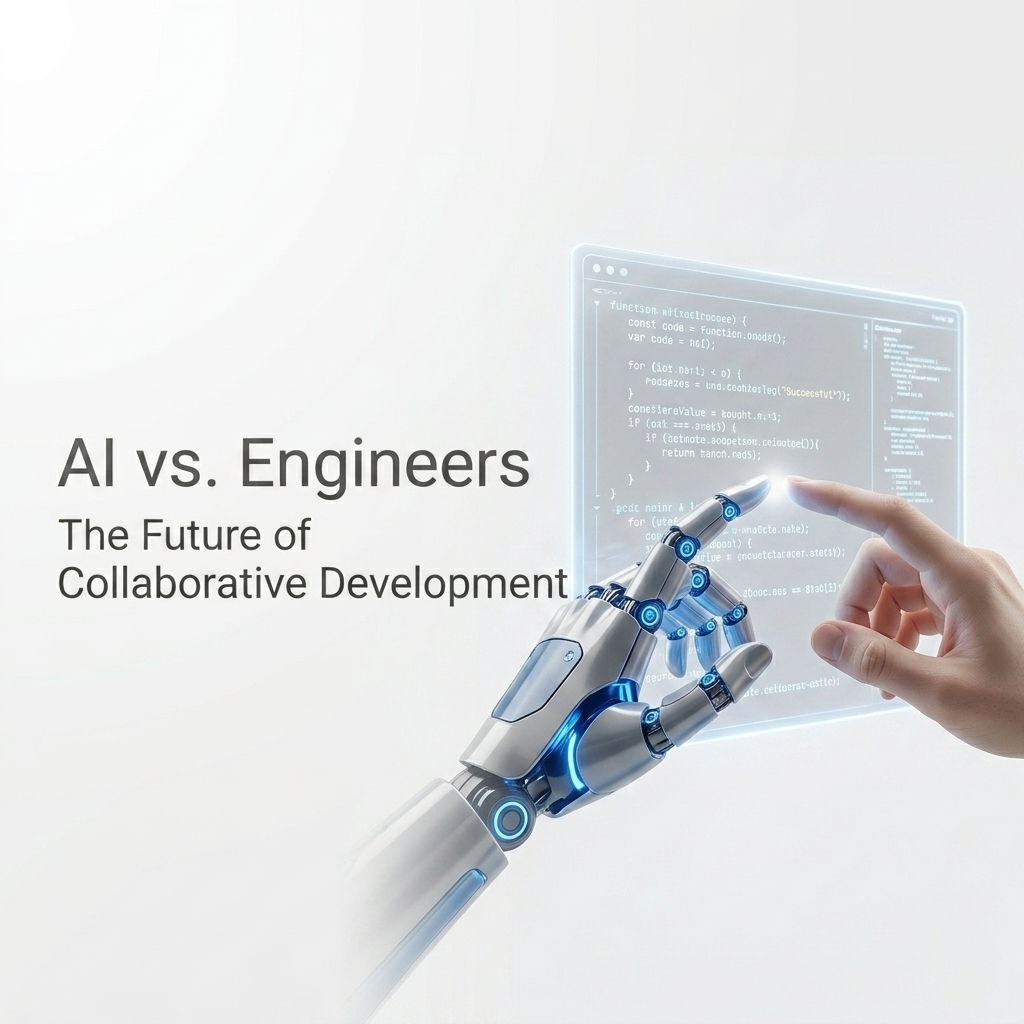
The year 2026 has brought a pivotal question to the forefront of the technology industry: Can AI replace software engineers? With the rise of autonomous coding agents and hyper-intelligent large language models, the anxiety is real. However, a deeper look into the nature of software development reveals a more nuanced and exciting reality.
Here is why AI isn’t coming for your job, but rather transforming it into something more powerful.
1. Beyond the Hype: The Reality of AI Coding
AI tools like GitHub Copilot and newer autonomous agents have become incredibly proficient at writing boilerplate code, refactoring simple functions, and generating unit tests. In 2026, we see AI handling the “manual labor” of coding with near-perfect accuracy. This has drastically reduced the time developers spend on repetitive tasks, but writing code is only a fraction of what a software engineer actually does.
2. The “Cutter” vs. The “Architect”
If you view a software engineer as someone who simply “cuts” code (translating requirements into syntax), then that specific role is indeed being automated. However, software engineering is primarily about System Architecture and Problem Solving.
AI can write a function to sort a list, but it cannot yet understand the complex business trade-offs required to choose between a microservices architecture or a monolith for a specific global enterprise. It lacks the long-term vision to design systems that are scalable, maintainable, and cost-effective over a decade.
3. The Human Edge: Empathy and Context
Software is built for humans, by humans. One of the most critical parts of an engineer’s job is understanding user needs and business context. AI lacks empathy. It doesn’t understand the “why” behind a feature request. It cannot sit in a room with stakeholders, navigate conflicting requirements, and negotiate a solution that balances technical feasibility with business value.
4. Debugging the “Unknown Unknowns”
AI is excellent at fixing bugs it has seen before. However, the most challenging issues in software engineering are the “unknown unknowns”—the strange, edge-case bugs that emerge from the interaction of dozens of different services, legacy codebases, and unpredictable user behavior. Solving these requires a level of intuition and creative deduction that AI models, which are fundamentally predictive, still struggle to replicate.
5. The Rise of the AI Orchestrator
In 2026, the job description of a software engineer is shifting from “Coder” to “AI Orchestrator.” Tomorrow’s top engineers are those who know how to leverage AI to build systems 10x faster. They focus on high-level design, security protocols, and ethical AI implementation, while the AI handles the line-by-line implementation.
6. Security and Ethics: The New Frontier
As AI generates more code, the need for human oversight has never been higher. AI-generated code can introduce subtle security vulnerabilities or replicate biases found in its training data. Software engineers in 2026 are the vital “gatekeepers” who ensure that the code being deployed is secure, ethical, and aligned with company standards.
7. Conclusion: The Force Multiplier
AI is not a replacement for software engineers; it is the ultimate force multiplier. Just as the transition from assembly language to high-level languages (like Python or Java) didn’t kill the developer role—it just allowed us to build more complex things—AI is the next level of abstraction.
The software engineers of the future will spend less time wrestling with syntax and more time solving the world’s most complex problems.
Stay ahead of the curve with more insights on the Ghaznix Blog →
Empower Your Digital Presence & Workflows
Explore top-tier tools built by Ghaznix to streamline your links, surveys, and brand growth.