Named Entity Recognition (NER): From Classical NLP to AI-Powered Extraction
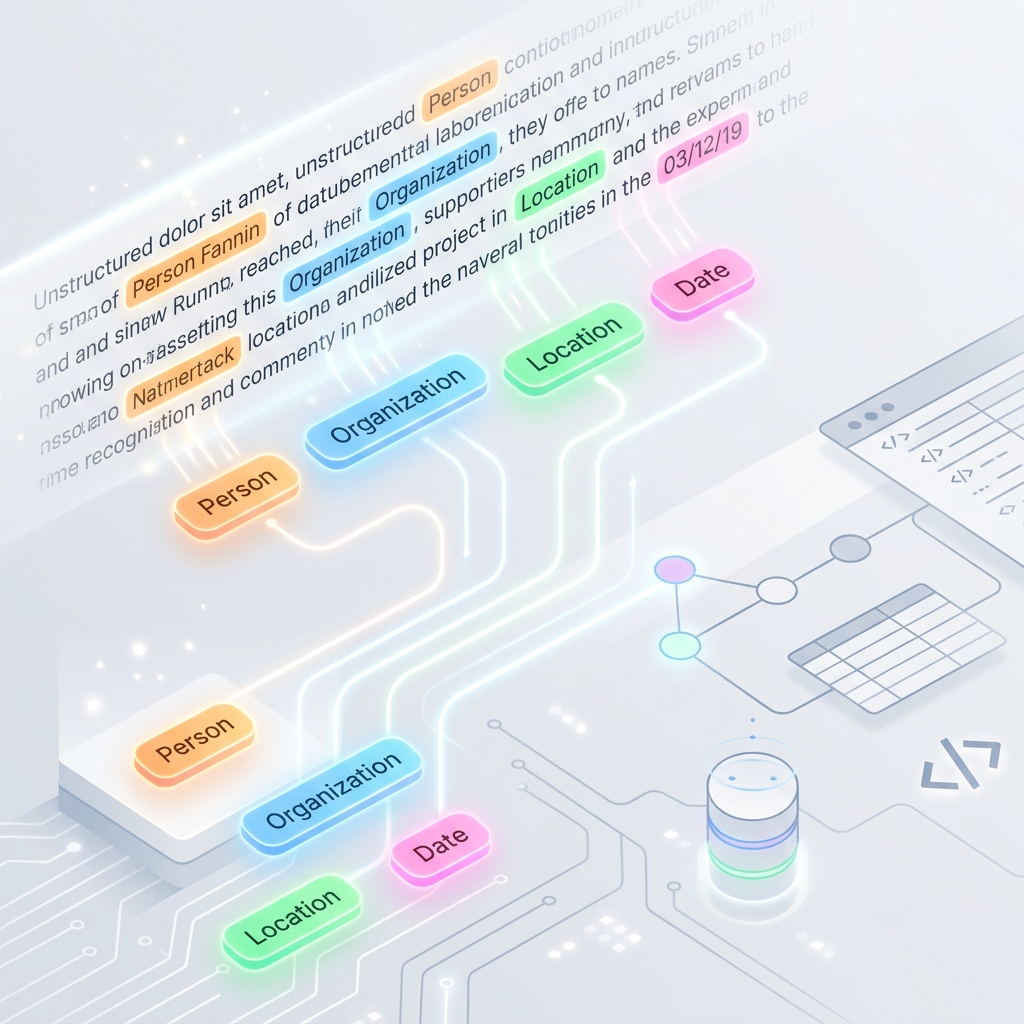
Named Entity Recognition (NER) is a cornerstone of Natural Language Processing (NLP). It is the process of automatically identifying and classifying key elements in unstructured text into predefined categories—such as names of people, organizations, locations, dates, monetary values, and product names.
Without NER, search engines, recommendation engines, and automated document analysis systems would struggle to understand who, what, where, and when within text.
Here is a comprehensive guide to understanding NER, how the technology has evolved, and why modern generative AI has completely transformed entity extraction.
1. The Evolution of NER Techniques
To understand why AI-based NER is so revolutionary, we must look at how entity extraction has evolved over the last few decades.
Stage 1: Rule-Based and Dictionary-Based Systems
Early NER relied on regular expressions (regex) and curated dictionaries (gazetteers).
- How it worked: If a word was in a database of locations, or matched a pattern like
[3-digit]-[3-digit]-[4-digit](phone number), it was extracted. - Limitations: Highly brittle. It could not capture misspelled words, new entities, or handle context. For example, it could not distinguish if “Apple” referred to the fruit or the tech company.
Stage 2: Classical Machine Learning (CRF & SVM)
In the 2000s, statistical machine learning models like Conditional Random Fields (CRFs) and Support Vector Machines (SVMs) became the standard.
- How it worked: Engineers hand-engineered features (e.g., prefix, suffix, capitalization patterns) and trained models on labeled data to predict the probability of a token being part of an entity.
- Limitations: Required massive labeled datasets and tedious manual feature engineering.
Stage 3: Deep Learning (BiLSTM-CRF & BERT)
With the rise of deep learning, bidirectional long short-term memory (BiLSTM) networks paired with CRFs, and later Transformer models like BERT, revolutionized NLP.
- How it worked: Word embeddings captured semantic meaning, and deep neural networks understood context. BERT-based models could identify “Apple” as an organization in “Apple launched a new iPhone” based on surrounding context.
- Limitations: Still required supervised fine-tuning on domain-specific datasets and lacked the flexibility to extract new, undefined categories without retraining.
Stage 4: Generative AI and LLM-based NER
Today, Large Language Models (LLMs) like Gemini, GPT-4, and Llama 3 handle NER using semantic understanding and instruction-following.
- How it works: Using Zero-shot or Few-shot prompting, a user can instruct an LLM to extract any arbitrary entity type and return it in a structured format (like JSON).
- Why it wins: It understands complex syntax, handles spelling errors, reasons through ambiguous context, and requires zero training data to start.
2. Comparing AI-Based NER vs. Classical NER
| Feature | Classical NER (BERT / CRF) | AI-Based NER (LLMs) |
|---|---|---|
| Training Data Required | High (Thousands of labeled examples) | Zero to Very Low (Zero-shot / Few-shot) |
| Flexibility | Rigid (Only extracts pre-trained categories) | Extremely High (Define any entity in the prompt) |
| Context Understanding | Moderate (Local context window) | Deep (Understands global document context & intent) |
| Out-of-Vocabulary (OOV) Handling | Poor (Struggles with unseen words) | Excellent (Uses semantic reasoning) |
| Execution Latency & Cost | Fast & Cheap (Runs locally on small CPUs/GPUs) | Slower & Higher Cost (Requires large model inference) |
3. Key Applications of AI-Based NER
AI-based Named Entity Recognition goes beyond simple text highlighting. By converting unstructured text into structured, actionable JSON data, it enables powerful automation:
Document Parsing & Information Extraction
Enterprises process thousands of invoices, resumes, contracts, and RFPs daily. AI-based NER can extract:
- Invoices: Tax IDs, line items, total amounts, billing addresses.
- Resumes: Candidate names, years of experience, specific skills, universities.
- Contracts: Termination dates, liability limits, governing laws, signatory names.
Knowledge Graph Construction
By extracting entities and the relationships between them (e.g., [Jennifer Lee] -> [works at] -> [Acme Innovations]), AI-based NER serves as the foundational ingestion engine for Knowledge Graphs, which are increasingly paired with GraphRAG for advanced enterprise search.
Enhanced RAG & Metadata Tagging
In Retrieval-Augmented Generation (RAG) systems, indexing documents with metadata tags (like author, product version, country, and technology) significantly improves retrieval accuracy. AI-based NER automatically generates these tags at scale during document ingestion.
Clinical & Medical NLP
Healthcare providers use NER to extract patient symptoms, drug dosages, medical histories, and diagnoses from doctor notes while automatically redacting Personal Health Information (PHI) to comply with privacy regulations.
4. How AI-Based NER Works (The Workflow)
Modern AI-based NER relies on prompting an LLM with a system instruction and a target schema to enforce structured outputs.
[Unstructured Text] ──> [LLM + System Instructions + JSON Schema] ──> [Structured JSON Output]
- Input Text: The raw text to process.
- System Prompt & Schema: We define the entities we want to extract (e.g., Name, Company, Date) and the exact format we need (like JSON).
- LLM Extraction: The model performs semantic analysis, identifies the entities, resolves ambiguity, and formats the output.
- Structured JSON: The output is ready to be stored directly in a database or passed to an API.
5. Implementation Example: AI-Based NER in Python
Here is a simple python example of how to perform AI-based NER using structured JSON output schemas:
import json
from google import genai
from google.genai import types
from pydantic import BaseModel

# Initialize the Gemini client
client = genai.Client()

# Define the target structure using Pydantic
class EntityExtraction(BaseModel):
    people: list[str]
    organizations: list[str]
    locations: list[str]
    dates: list[str]

text_content = """
On March 14, 2024, Jennifer Lee was appointed as the new VP of Engineering at
Acme Innovations Inc., located in Kyoto, Japan. She will succeed David Miller.
"""

# Request structured output from Gemini
response = client.models.generate_content(
    model='gemini-2.5-flash',
    contents=text_content,
    config=types.GenerateContentConfig(
        system_instruction="Extract all people, organizations, locations, and dates from the text.",
        response_mime_type="application/json",
        response_schema=EntityExtraction,
    ),
)

# Parse and print the clean JSON result
entities = json.loads(response.text)
print(json.dumps(entities, indent=2))
Output:
{
  "people": ["Jennifer Lee", "David Miller"],
  "organizations": ["Acme Innovations Inc."],
  "locations": ["Kyoto", "Japan"],
  "dates": ["March 14, 2024"]
}
Conclusion
Named Entity Recognition has evolved from static dictionary lookups to a dynamic, semantic capability powered by AI. Today, organizations can extract complex domain-specific entities from messy documents with zero training data. By integrating AI-based NER into your workflows, you can turn unstructured text files into structured database entries, unlocking new levels of automation and business intelligence.
Empower Your Digital Presence & Workflows
Explore top-tier tools built by Ghaznix to streamline your links, surveys, and brand growth.