How Go Handles Concurrency Better Than Traditional Threading Models

In modern software engineering, building applications that can perform multiple tasks simultaneously is no longer a luxury—it is a core requirement. From high-throughput web servers to real-time streaming services, concurrency is at the heart of performance.
For decades, traditional programming languages like C++, Java, and Python relied on the operating system’s native threading models to handle concurrent tasks. However, when Google designed Go (Golang) in the late 2000s, they took a radically different path. Instead of exposing raw OS threads, Go introduced Goroutines and a specialized M:N Scheduler.
In this article, we will examine the architectural limitations of traditional threading models and explore why Go’s concurrency design is significantly more efficient, scalable, and developer-friendly.
1. The Bottlenecks of Traditional Threading (The 1:1 Model)
Most traditional runtime systems use a 1:1 threading model. In this model, every thread created in the user-space code maps directly to one kernel-space thread managed by the Operating System (OS).
While simple, this 1:1 mapping introduces three critical bottlenecks:
A. Memory Overhead (Large Stack Sizes)
An OS thread is a heavy resource. By default, operating systems allocate a fixed, contiguous stack size to each thread (typically 1MB to 8MB).
- If you want to handle 10,000 concurrent connections, allocating 10,000 OS threads would require between 10GB and 80GB of RAM just for thread stack memory alone.
- This makes handling high concurrency under high connection counts extremely expensive and virtually impossible on standard server hardware.
B. High Context-Switching Costs
When the OS switches execution from one thread to another, it performs a context switch. Because OS threads are managed by the kernel, a context switch requires crossing the user-kernel boundary. The CPU must:
- Save the state of current registers.
- Flush CPU cache lines and update Page Tables (Translation Lookaside Buffers).
- Jump into kernel mode, select the next thread, and load its saved state.
- Transition back to user mode.
This entire round-trip takes about 1 to 2 microseconds, which represents hundreds or thousands of CPU cycles spent purely on administrative overhead rather than executing actual business logic.
C. OS Scheduling Limits
The OS scheduler is general-purpose. It treats database threads, UI threads, and lightweight network connections with the same scheduling heuristics. Because it does not understand application-level context, it cannot optimize scheduling based on whether a thread is blocked on a network socket, waiting for an internal lock, or performing active computation.
2. Go’s Solution: The M:N Scheduler (Goroutines)
Go bypasses the limitations of OS threading by introducing Goroutines and implementing its own runtime scheduler. Rather than mapping threads 1:1, Go uses an M:N scheduling model where M lightweight goroutines are multiplexed onto N physical OS threads.
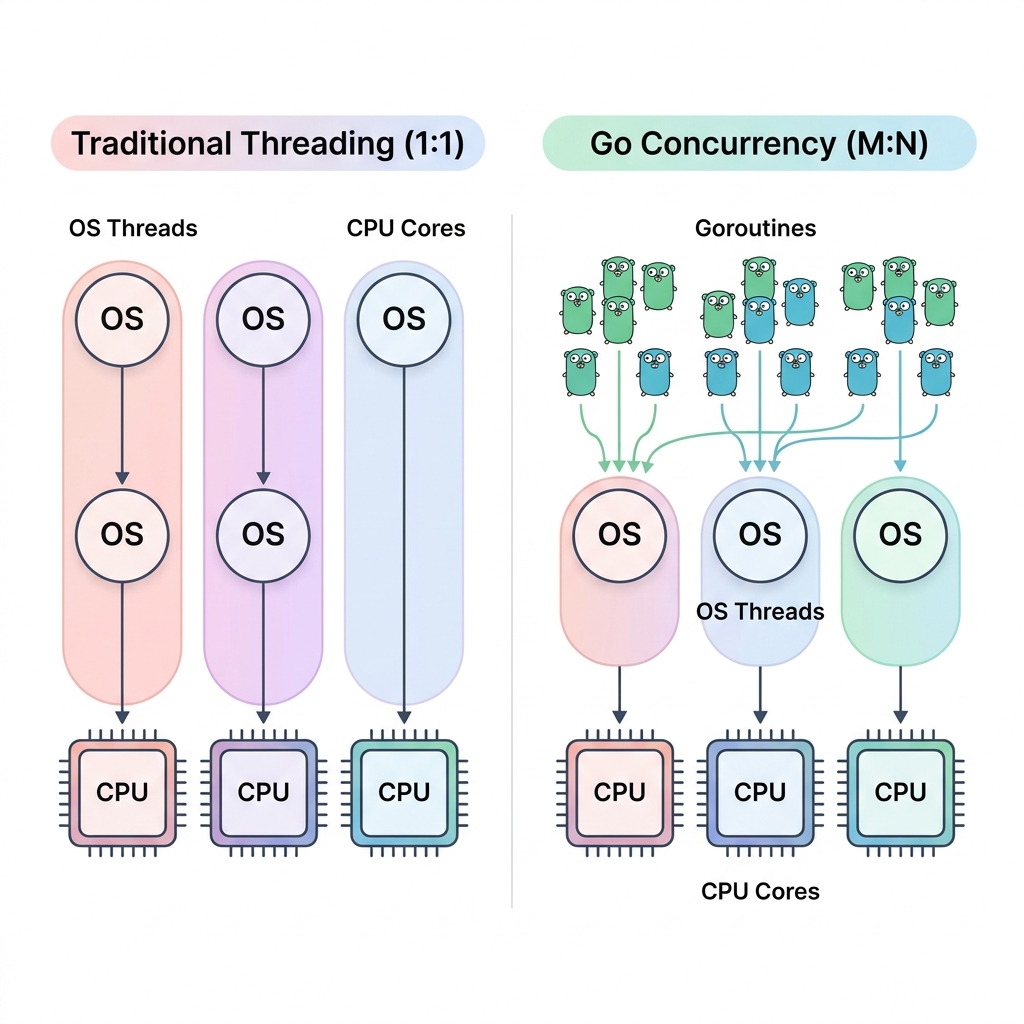
This architecture is governed by three primary structural elements, often referred to as the GMP model:
- G (Goroutine): Represents a single goroutine. It includes the goroutine’s execution stack, program counter, and state. A
Gis not an OS thread; it is a simple Go struct that costs only about 2KB of memory to initialize. - M (Machine): Represents a physical OS/kernel thread. It is managed by the OS scheduler and is responsible for executing the machine code instructions of the goroutines.
- P (Processor): Represents a logical processor or execution context. The number of
Pinstances defaults to the number of logical CPU cores on the host machine (controlled byGOMAXPROCS). A machineMmust acquire a logical processorPto run Go code.
Why the GMP Model is Superior
Because goroutines are managed entirely in user-space by the Go runtime:
- Dynamic Stacks: A goroutine starts with a tiny stack of 2KB. As execution demands, the stack dynamically grows (allocating larger contiguous memory segments in the heap) and shrinks. This allows Go to run hundreds of thousands of goroutines simultaneously on a single laptop.
- Fast Context Switches: Switching between goroutines occurs entirely in user-space without invoking kernel context switches. Only the program counter and a few CPU registers are saved. This user-space context switch takes only 10 to 100 nanoseconds—roughly 10x to 100x faster than an OS thread switch.
3. Work Stealing and Non-Blocking I/O
The Go runtime uses two advanced scheduling mechanisms to ensure physical CPU cores are never underutilized: Work Stealing and Syscall Hand-off.
A. The Work-Stealing Algorithm
Each logical processor P maintains its own local run queue of goroutines. Additionally, there is a global run queue for overflow.
If a processor P exhausts all goroutines in its local run queue, it does not go to sleep. Instead, it performs work stealing: it checks other logical processors and steals half of their queued goroutines to balance the workload across all CPU cores.
Local Queue P1: [ G1, G2, G3 ]  ---> Running on Thread M1
Local Queue P2: [ ]            ---> Running on Thread M2 (Idle)
                                     P2 steals G3 and G2 from P1!
B. Network Poller and Non-Blocking I/O
When a goroutine performs network I/O (e.g., reading from a database connection or making an HTTP call), Go does not block the underlying OS thread M.
Instead, the Go runtime registers the block with a dedicated Network Poller (which uses efficient OS-specific multiplexing APIs like epoll on Linux, kqueue on macOS, or IOCP on Windows). The blocked goroutine G is detached from the thread M and parked in the network poller.
The thread M immediately picks up another runnable goroutine from the queue. Once the I/O event completes, the network poller moves G back to an active run queue to resume execution.
4. Channels vs. Shared Memory (The CSP Model)
Traditional threading models coordinate concurrent tasks by sharing memory (e.g., passing pointers between threads). To prevent data races, developers must manually manage locks, mutexes, and condition variables:
// Traditional Java Shared Memory Approach
synchronized(lock) {
    sharedResource.updateState();
}
This model is notoriously error-prone, frequently resulting in deadlocks, race conditions, and cache coherency bottlenecks.
Go implements the Communicating Sequential Processes (CSP) formal model, summarized by the famous Golang proverb:
“Do not communicate by sharing memory; instead, share memory by communicating.”
Go provides Channels as first-class primitives. Channels act as type-safe queues that allow goroutines to send and receive messages to synchronize execution and transfer ownership of data.
5. Practical Implementation: Goroutines & Channels in Action
Here is a practical Go program demonstrating how multiple worker goroutines can process tasks concurrently and return results through a channel, managing data flow safely without locks.
package main

import (
	"fmt"
	"time"
)

// Task represents a unit of work
type Task struct {
	ID       int
	Duration time.Duration
}

// Result represents the outcome of a processed task
type Result struct {
	TaskID int
	Value  string
}

// worker processes incoming tasks from the jobs channel and sends results
func worker(id int, jobs <-chan Task, results chan<- Result) {
	for job := range jobs {
		fmt.Printf("Worker %d: Started processing job %d\n", id, job.ID)
		time.Sleep(job.Duration) // Simulate CPU/IO delay

		results <- Result{
			TaskID: job.ID,
			Value:  fmt.Sprintf("Processed by worker %d in %v", id, job.Duration),
		}
	}
}

func main() {
	// Create tasks
	tasks := []Task{
		{ID: 101, Duration: 200 * time.Millisecond},
		{ID: 102, Duration: 400 * time.Millisecond},
		{ID: 103, Duration: 100 * time.Millisecond},
		{ID: 104, Duration: 300 * time.Millisecond},
	}

	// Buffered channels prevent sender blocking
	jobs := make(chan Task, len(tasks))
	results := make(chan Result, len(tasks))

	// Spawn 3 concurrent worker goroutines
	for w := 1; w <= 3; w++ {
		go worker(w, jobs, results)
	}

	// Feed tasks into the job channel
	for _, task := range tasks {
		jobs <- task
	}
	close(jobs) // Closing tells workers no more jobs are coming

	// Collect and aggregate results
	for i := 0; i < len(tasks); i++ {
		res := <-results
		fmt.Printf("[RESULT] Job %d: %s\n", res.TaskID, res.Value)
	}
	close(results)
}
6. Architecture Comparison: OS Threads vs. Goroutines
| Metric / Feature | Traditional OS Threads (1:1 Model) | Go Goroutines (M:N Model) |
|---|---|---|
| Startup Memory | Fixed (typically 1MB - 8MB) | Dynamic (starts at ~2KB) |
| Context Switch Time | Slow (1,000 - 2,000 nanoseconds) | Fast (10 - 100 nanoseconds) |
| Switching Space | Kernel-space (heavy context switch) | User-space (runtime scheduler) |
| Creation Cost | Expensive (involves OS system calls) | Extremely cheap (simple allocation) |
| Communication | Shared memory (Mutexes, Semaphore) | Channels (CSP message passing) |
| Deadlock Risk | High (difficult to trace manually) | Mitigated by channel design & compile runtime detection |
Conclusion
By decoupling concurrency from the operating system’s raw threading model, Go solved the fundamental scaling problems of modern backend architectures.
Goroutines enable massive concurrency with minimal memory overhead, the M:N scheduler optimizes CPU utilization via work stealing without kernel context-switching costs, and channels provide a safe, expressive concurrency paradigm.
Whether you are building microservices or large distributed systems, Go’s built-in concurrency architecture ensures your application remains responsive, resource-efficient, and easy to maintain.
Explore more software development and backend engineering insights on the Ghaznix Blog →
Empower Your Digital Presence & Workflows
Explore top-tier tools built by Ghaznix to streamline your links, surveys, and brand growth.