Domain-Driven Design (DDD) in Microservices
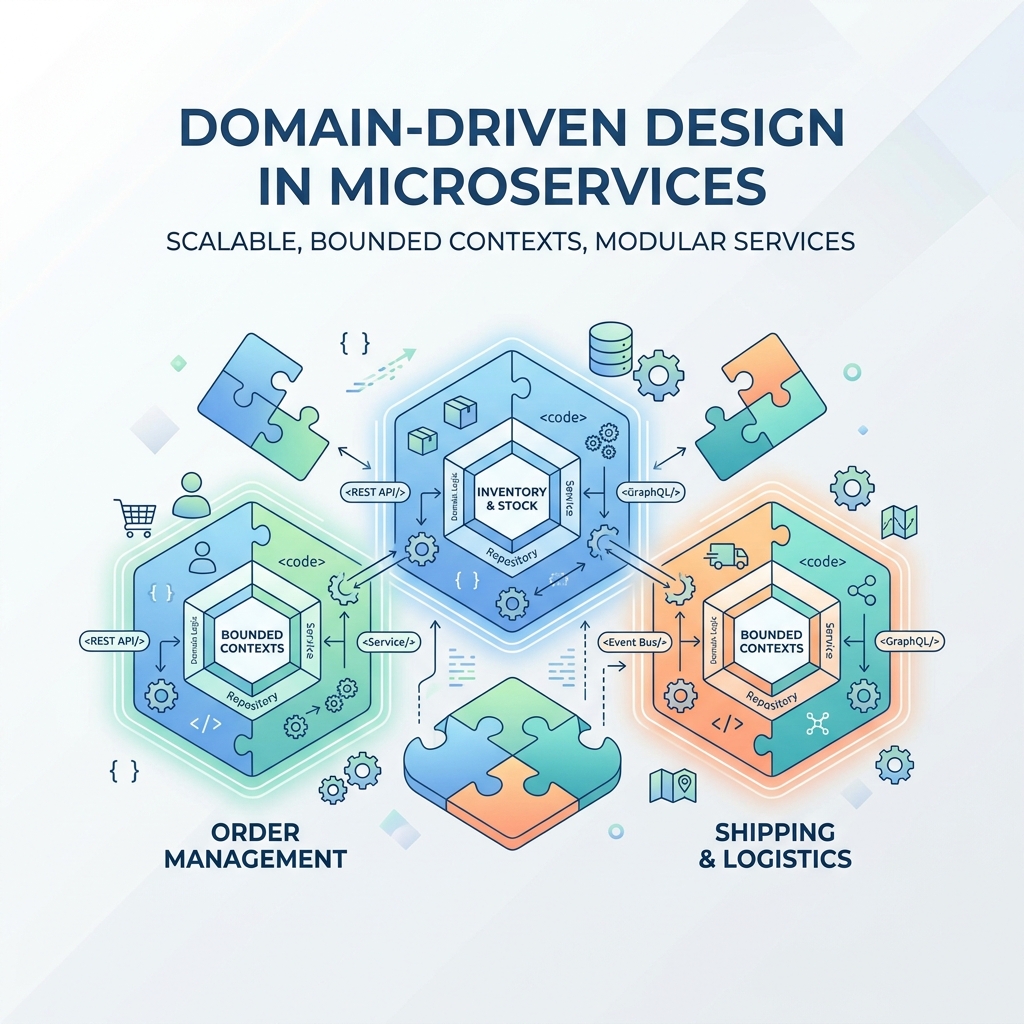
When organizations transition from a monolithic architecture to microservices, they face a critical, high-stakes question: How do we draw the boundaries of our services?
In theory, microservices should be loose, decoupled units that can be developed, deployed, and scaled independently. In practice, however, many teams end up building a distributed monolith—a system where services are so tightly coupled that a single business change requires modifying and deploying multiple services simultaneously, compounding network latency and deployment gridlocks.
To avoid this pitfall, software architects turn to Domain-Driven Design (DDD). First introduced by Eric Evans in 2003, DDD is a software development methodology that aligns code structures with the complex business domains they represent.
In this article, we will explore how DDD provides the strategic and tactical blueprints for designing clean, decoupled, and highly maintainable microservices.
1. The Strategic Blueprint: Drawing the Service Boundaries
DDD is divided into two primary phases: Strategic Design and Tactical Design. Strategic design is about modeling business contexts and defining service boundaries. It provides the “macro” view of the architecture.
A. Ubiquitous Language
Within a business, different departments use the same words to mean completely different things. For example:
- To the Sales team, a “User” is a lead or a potential customer.
- To the Security team, a “User” is a set of login credentials.
- To the Shipping team, a “User” is a physical recipient address.
Trying to build a single, unified database model for a “User” that satisfies everyone results in a massive, tangled codebase. DDD solves this by establishing a Ubiquitous Language—a shared vocabulary defined and used by both business domain experts and developers within a specific boundary.
B. Bounded Contexts
A Bounded Context is the explicit boundary within which a domain model applies. Inside the boundary, all terms in the Ubiquitous Language have a single, unambiguous meaning.
Instead of a single “User” model, we define separate models within their respective Bounded Contexts:
- In the Order Context, we have an
Ordermodel containing customer contact info. - In the Identity Context, we have a
Credentialsmodel. - In the Shipping Context, we have a
DeliveryAddressmodel.
The Golden Rule of Microservices: One Bounded Context maps directly to one Microservice.
By partitioning the system into Bounded Contexts, we ensure that the microservices are loosely coupled and represent distinct business capabilities.
C. Context Mapping: How Services Communicate
Bounded Contexts do not exist in isolation; they must interact. A Context Map defines the relationships and translation mechanisms between contexts. Key patterns include:
- Shared Kernel: Two contexts share a small subset of the domain model and database (usually discouraged in microservices due to coupling).
- Customer-Supplier: One context (supplier) must provide data to another (customer). The supplier must coordinate release schedules with the customer.
- Anti-Corruption Layer (ACL): A translation layer that translates incoming data from an external system into the client’s internal domain model, preventing external models from polluting the internal architecture.
2. The Tactical Blueprint: Structuring the Microservice Codebase
Once the service boundaries are drawn using strategic design, Tactical Design provides a set of design patterns to structure the code within a single microservice.
A. Entities and Value Objects
Inside a microservice, models are split into two categories:
- Entities: Objects that have a unique identity that persists over time, even if their attributes change. Examples include
OrderorProduct. - Value Objects: Objects that have no unique identity and are defined entirely by their attributes. They are immutable. Examples include
ShippingAddressorProductDimensions. If two value objects have the same attributes, they are considered equal.
B. Aggregates and Aggregate Roots
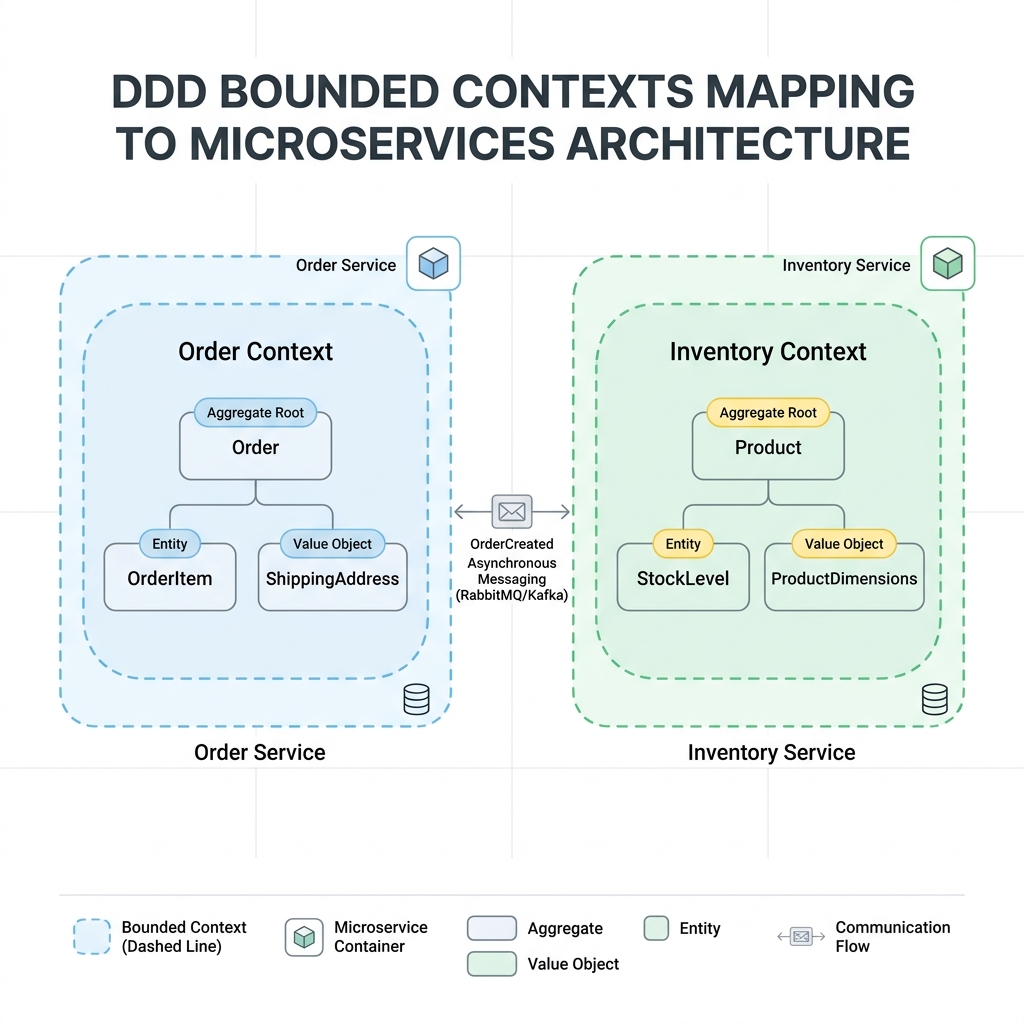
An Aggregate is a cluster of associated Entities and Value Objects that are treated as a single unit for data changes. Every aggregate has an Aggregate Root, which is the only entry point through which external objects can interact with the aggregate. The root ensures that all business invariants (rules) are enforced.
For example, in the diagram above:
- In the Order Service, the
Orderis the Aggregate Root. It containsOrderItem(Entity) andShippingAddress(Value Object). External services cannot modifyOrderItemdirectly; they must call a method on theOrderroot (e.g.,order.AddItem()), which validates that the order isn’t already shipped.
C. Domain Events
A Domain Event is something that happened in the domain that business experts care about. It is used to communicate changes across Bounded Contexts asynchronously.
When an Aggregate executes a command, it publishes a Domain Event (e.g., OrderCreated). Other services listen to this event and update their state accordingly, ensuring eventual consistency without synchronous API dependencies.
3. A Concrete Example: Order Service vs. Inventory Service
Let us look at a simplified implementation of tactical DDD in Go for the Order Service, showing how the Aggregate Root coordinates business rules.
package domain

import (
	"errors"
	"time"
)

// Value Object (Immutable, identity-less)
type ShippingAddress struct {
	Street  string
	City    string
	ZipCode string
}

// Entity (Has identity, mutable)
type OrderItem struct {
	ProductID string
	Quantity  int
	Price     float64
}

// Aggregate Root (Enforces transactional boundaries)
type Order struct {
	ID        string
	Items     []OrderItem
	Address   ShippingAddress
	Status    string
	CreatedAt time.Time
}

// NewOrder creates a new Order Aggregate Root
func NewOrder(id string, address ShippingAddress) *Order {
	return &Order{
		ID:        id,
		Items:     []OrderItem{},
		Address:   address,
		Status:    "PENDING",
		CreatedAt: time.Now(),
	}
}

// AddItem enforces business rules before mutating state
func (o *Order) AddItem(productID string, qty int, price float64) error {
	if o.Status != "PENDING" {
		return errors.New("cannot add items to a finalized or cancelled order")
	}
	if qty <= 0 {
		return errors.New("quantity must be greater than zero")
	}

	o.Items = append(o.Items, OrderItem{
		ProductID: productID,
		Quantity:  qty,
		Price:     price,
	})
	return nil
}
When the order is successfully saved, the service publishes an event to a message broker:
{
  "event_id": "evt_98231",
  "event_type": "OrderCreated",
  "timestamp": "2026-06-26T00:15:00Z",
  "payload": {
    "order_id": "ord_5521",
    "items": [
      { "product_id": "prod_88", "quantity": 2 }
    ]
  }
}
The Inventory Service listens to this event, updates its local StockLevel entity, and completes the flow asynchronously.
4. Strategic vs. Tactical DDD in Microservices
| Phase / Aspect | Strategic DDD | Tactical DDD |
|---|---|---|
| Scope | Global system architecture (macro) | Inside a single service codebase (micro) |
| Primary Goal | Draw clean, decoupled service boundaries | Model rich business logic & enforce invariants |
| Key Concepts | Bounded Contexts, Ubiquitous Language, Context Map | Entities, Value Objects, Aggregates, Domain Events |
| Audience | Architects, Product Managers, Developers | Software Developers, Code Reviewers |
| Impact on Microservices | Determines the number and scope of services | Determines database transactions and directory structure |
Conclusion: Start with Strategic DDD First
Applying Domain-Driven Design to microservices is a powerful way to ensure your architecture matches your business structure. However, teams often make the mistake of focusing too much on tactical patterns (like writing repository interfaces and value objects) while ignoring strategic design.
If you don’t get the boundaries right, no amount of clean tactical code will save your system from turning into a distributed monolith. Always start with strategic mapping—define your Ubiquitous Language, group logic into Bounded Contexts, map the communication flows, and let your microservices boundaries naturally emerge from those definitions.
Explore more software architecture, design patterns, and engineering insights on the Ghaznix Blog →
Empower Your Digital Presence & Workflows
Explore top-tier tools built by Ghaznix to streamline your links, surveys, and brand growth.