Benefits and Challenges of Microservices in Modern Applications
In the early days of web development, building a software application was straightforward: you wrote code, packaged it into a single executable or deployable archive, and ran it on a server. This approach, known as the Monolithic Architecture, served the industry well for decades.
However, as applications grew into massive enterprise platforms with hundreds of developers and millions of concurrent users, monoliths began to show their limits. Deployments became slow and risky, databases became bottlenecks, and codebases grew too complex for any single developer to comprehend.
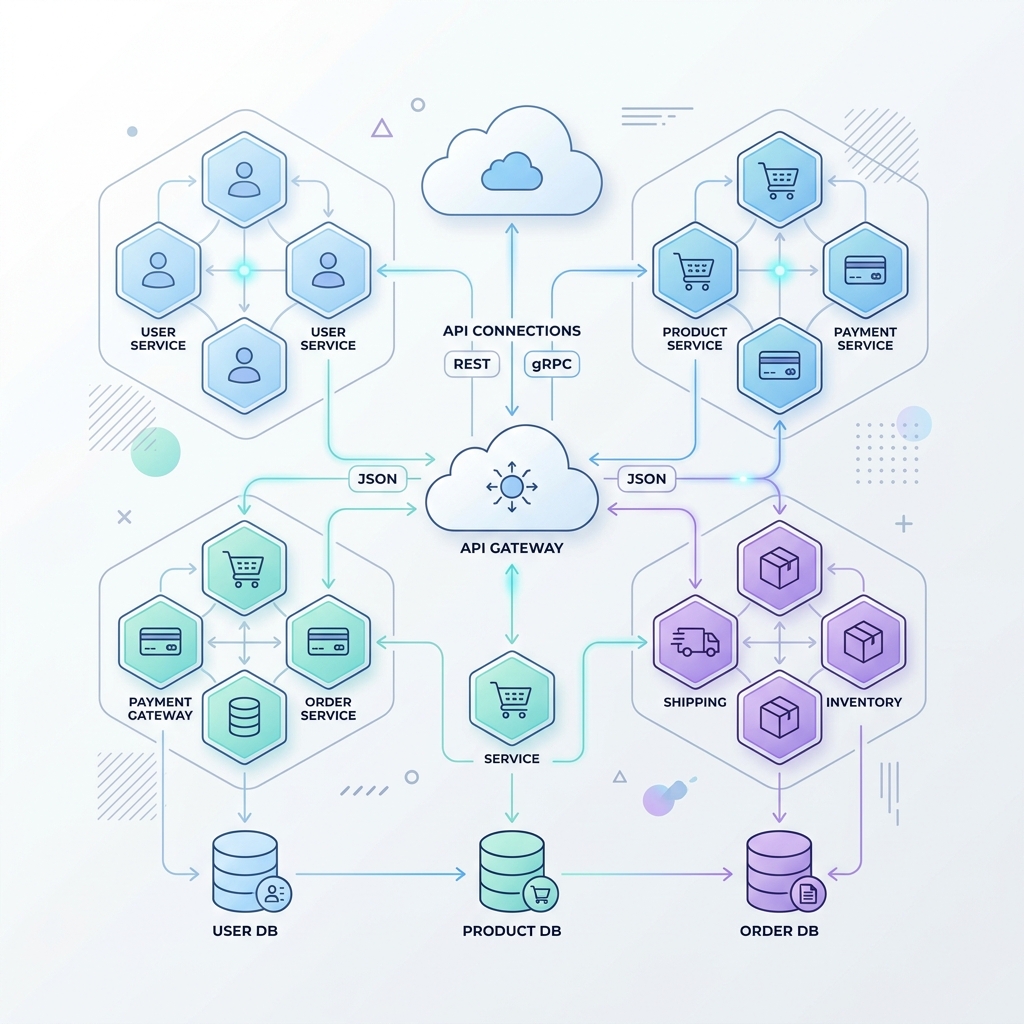
To solve these scaling bottlenecks, the industry shifted toward Microservices Architecture. Instead of building a single giant application, developers break the system down into a collection of small, independent, and loosely coupled services that communicate over lightweight protocols like HTTP/REST, gRPC, or message brokers.
In this article, we will analyze the key benefits that microservices bring to modern applications, the serious challenges they introduce, and how to decide if this architecture is right for your next project.
1. Monolithic vs. Microservices Architecture
Before diving into the details, let us visualize the fundamental difference between these two design paradigms.
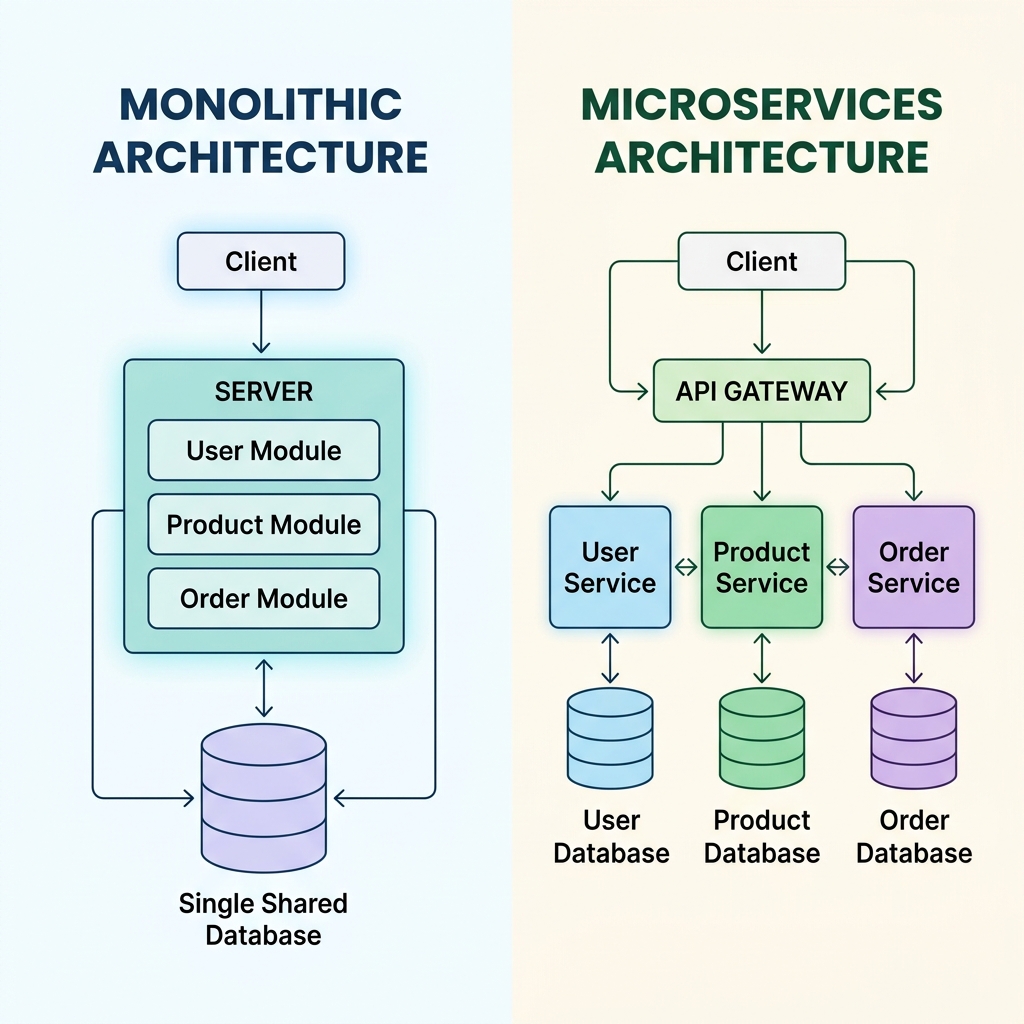
In a monolith, all modules (e.g., User management, Product catalog, Order processing) share the same execution space and write to a single, shared database. In a microservices setup, each service runs in its own process, manages its own private database, and exposes a clean API. An API Gateway acts as the single entry point for clients, routing requests to the appropriate backend service.
2. The Benefits of Microservices
Adopting a microservices architecture offers several compelling advantages that make it the preferred choice for large-scale, modern systems:
A. Independent Deployability and Release Velocity
In a monolith, deploying a tiny change to the checkout system requires rebuilding and redeploying the entire application. If one team’s feature is broken, the entire release is blocked. With microservices, each service has its own independent CI/CD pipeline. The Shipping service team can deploy updates ten times a day without coordinating with the Inventory or Payment teams, drastically increasing feature delivery speed.
B. Fine-Grained Scalability
In a monolithic application, if the checkout process experiences a massive traffic spike during Black Friday, the entire application must be scaled horizontally. This consumes unnecessary CPU and memory for idle modules. Microservices allow for targeted scaling. You can spin up 50 instances of the Order and Payment services to handle the load while keeping the User or Notification services running on minimal resources, saving substantial cloud hosting costs.
C. Technology Flexibility (Polyglot Programming)
Since microservices communicate via standardized API protocols (REST, gRPC), teams are not locked into a single technology stack:
- The User Service can be written in Go for high-performance memory management.
- The Recommendation Engine can use Python for its rich machine learning libraries.
- The Payment Gateway can be written in Java for enterprise stability. Each team can choose the best tool for their specific problem.
D. Fault Isolation and System Resilience
If a memory leak occurs in a monolithic application, the entire process crashes, causing a total system outage. In a microservices architecture, if the Recommendation service crashes due to a bug, the rest of the application remains fully functional. Users can still browse products, add items to their carts, and complete payments. The failure is isolated.
E. Team Alignment and Autonomy (Conway’s Law)
Conway’s Law states that organizations design systems that mimic their communication structures. Large monoliths often result in massive, cross-functional teams that step on each other’s toes. Microservices allow organizations to break down engineering departments into small, autonomous “two-pizza teams.” Each team owns a single service end-to-end—from design and writing code to deployment and database maintenance.
3. The Challenges of Microservices
While the benefits are attractive, microservices are not a free lunch. They introduce significant complexity and operational challenges:
A. Distributed System Complexity and Latency
Moving from in-memory function calls to network calls introduces two major challenges:
- Network Latency: A single user action might trigger a chain of service-to-service requests, compounding network latency and slowing down response times.
- Network Failures: Networks are unreliable. Services must implement resilient communication patterns like retries with exponential backoff, timeouts, and circuit breakers (using tools like Resilience4j or a service mesh like Istio).
B. Data Consistency and the Death of ACID Transactions
In a monolith, maintaining data integrity is easy. You wrap operations in a single database transaction:
BEGIN TRANSACTION;
  UPDATE inventory SET stock = stock - 1 WHERE item_id = 101;
  INSERT INTO orders (user_id, item_id) VALUES (1, 101);
COMMIT; -- If either fails, the database rolls back automatically
In microservices, the Inventory database and Order database are completely separate. You cannot use a local database transaction across physical network boundaries.
Instead, developers must implement the Saga Pattern, using event-driven workflows where services publish messages to a broker (like Apache Kafka or RabbitMQ) and execute compensating transactions to roll back state if a step down the chain fails. This introduces eventual consistency, which is much harder to design and debug.
C. Operational and Infrastructure Overhead
Managing a microservices ecosystem requires a robust infrastructure platform. Organizations must adopt:
- Containerization: Wrapping services in Docker containers.
- Orchestration: Managing hundreds of containers using Kubernetes.
- Service Discovery: Letting services dynamically find each other’s IP addresses (Consul, Eureka).
- API Gateways: Managing security, rate limiting, and request routing at the edge (Kong, AWS API Gateway).
D. Distributed Observability and Debugging
When a user encounters an error in a monolith, checking the server logs is simple. In a microservices system, a request might traverse ten different services. Finding where a failure occurred or why a request is slow requires distributed tracing tools (like Jaeger, OpenTelemetry, or Zipkin) to attach a unique Correlation ID to every incoming request.
4. Monolith vs. Microservices: At-a-Glance Comparison
| Metric / Dimension | Monolithic Architecture | Microservices Architecture |
|---|---|---|
| Complexity | Low at the start, high as codebase grows | High from day one |
| Deployment | Single artifact, simple | Multiple independent pipelines, complex |
| Scaling | Scale the entire application | Scale individual services on demand |
| Data Integrity | Strong ACID transactions | Eventual consistency (Saga Pattern) |
| Technology Stack | Single, unified stack | Flexible (Polyglot) |
| Local Debugging | Easy, run everything on a laptop | Difficult, requires Docker Compose / K8s |
| Organizational Alignment | Best for small teams | Best for large, partitioned engineering groups |
Conclusion: How to Choose?
Microservices are an architectural solution to organizational and scaling problems, not functional ones.
If you are a startup building a Minimum Viable Product (MVP), starting with microservices is almost always a mistake. The operational overhead and distributed complexity will slow down your development speed. A clean, modular monolith is the best starting point.
However, if your application has grown to the point where teams are blocking each other’s deployments, scaling costs are skyrocketing, or database bottlenecks are unavoidable, migrating to a microservices architecture is a powerful way to unlock the next level of growth and delivery velocity.
Explore more software architecture, design patterns, and engineering insights on the Ghaznix Blog →
Empower Your Digital Presence & Workflows
Explore top-tier tools built by Ghaznix to streamline your links, surveys, and brand growth.