Advanced Retrieval Techniques for High-Performance RAG: Optimizing LLM-Powered Systems
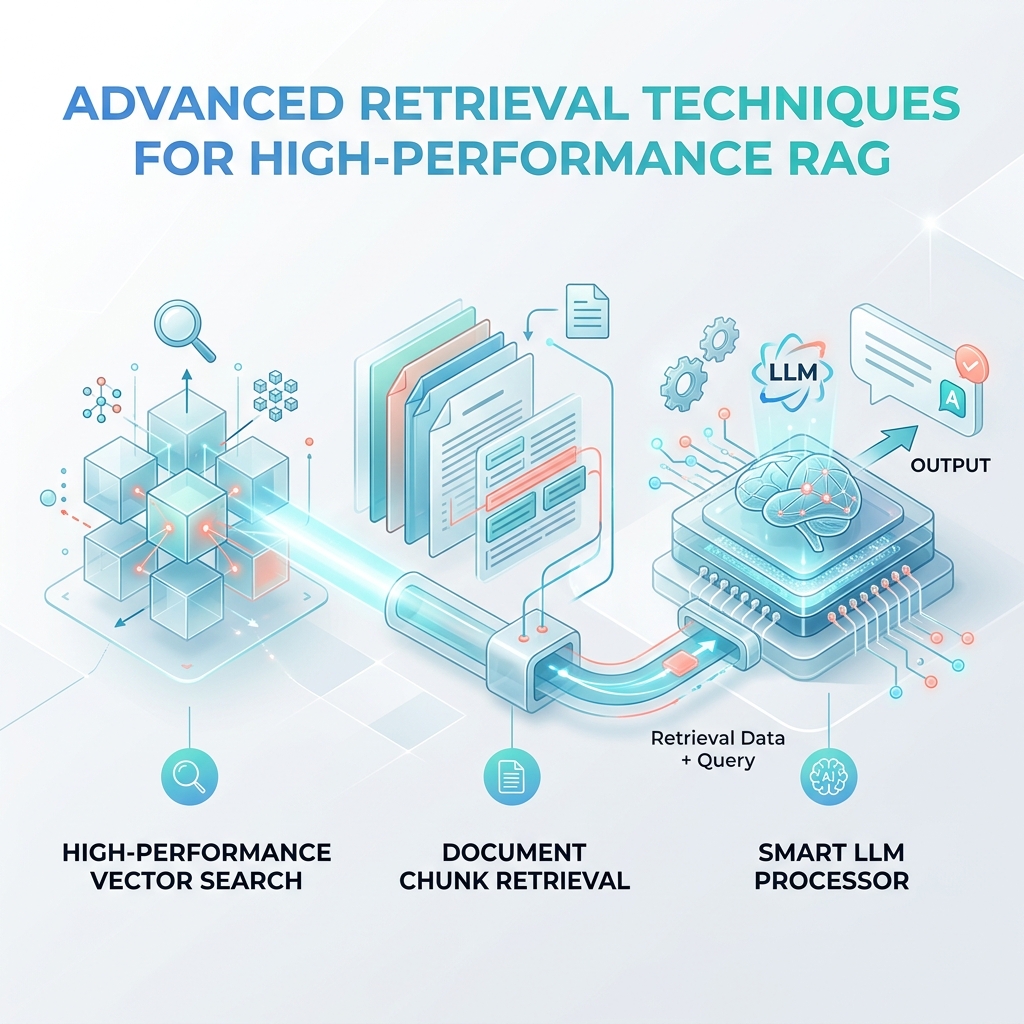
Retrieval-Augmented Generation (RAG) has become the backbone of enterprise AI applications, but as systems scale and queries become more complex, basic retrieval methods fall short. The difference between a slow, inaccurate RAG system and a high-performance one often comes down to the retrieval strategy.
This comprehensive guide explores advanced retrieval techniques that dramatically improve RAG performance, accuracy, and scalability. Whether you’re building customer support bots, knowledge assistants, or enterprise search systems, these strategies will transform your RAG pipeline.
1. Understanding the Retrieval Bottleneck
Before optimizing, let’s identify where RAG systems typically fail:
- Low Recall: Missing relevant documents because the vector search didn’t find them.
- Poor Ranking: Finding documents but ranking irrelevant ones first.
- Latency Issues: Slow vector similarity searches over large datasets.
- Context Mismatch: Retrieved chunks lack sufficient context for the LLM to generate accurate responses.
- Query-Document Semantic Gap: The user’s query doesn’t align well with document embeddings.
These problems compound at scale. A system with 90% retrieval accuracy retrieving 5 documents might miss critical information that changes the LLM’s response entirely.
2. Hybrid Search: Combining Vector and Keyword Retrieval
The most impactful improvement for production RAG is hybrid search, which combines:
- Vector Search: Semantic similarity (what the query means)
- Keyword Search (BM25): Exact term matching (what the query says)
Why Hybrid Search Works
Imagine searching for “Python machine learning libraries.” A pure vector search might miss documents about “scikit-learn” or “TensorFlow” if the documents don’t emphasize the term “Python.” Conversely, BM25 will find exact matches but fail on synonymous queries like “ML frameworks in Python.”
Implementation Strategy
[User Query]
    │
    ├──> [Vector Search] ──> [Top K results]
    │                              │
    │                              ▼
    └──> [BM25 Search] ──> [Top K results] ──> [Merge & Rerank]
                                                    │
                                                    ▼
                                            [Final Ranked Results]
Steps:
- Execute vector search in the embedding space → retrieve top K results
- Execute BM25 (keyword) search using inverted indices → retrieve top K results
- Merge the two result sets, removing duplicates
- Apply a ranking algorithm (e.g., Reciprocal Rank Fusion) to produce the final ranked list
Practical Impact: Hybrid search typically improves recall by 15-40% compared to vector-only search, especially on factual and domain-specific queries.
3. Query Rewriting and Expansion
Raw user queries are often poorly phrased for retrieval. Query rewriting and expansion techniques transform queries to improve retrieval accuracy.
Technique 1: Query Rewriting with LLMs
Use a lightweight LLM to rephrase the user’s query into multiple semantically equivalent forms:
Original Query: “How do I debug async code?”
Rewritten Variants:
- “Debugging asynchronous programming”
- “Troubleshooting async/await issues”
- “Finding bugs in concurrent code”
- “Async debugging tools and techniques”
Implementation:
User Query
    │
    ▼
[LLM Rewriter Prompt]
    "Given this query: '{query}'
     Generate 3 alternative phrasings that capture the same intent."
    │
    ▼
[Multiple Query Variants]
    │
    ▼
[Parallel Vector Searches]
    │
    ▼
[Merge & Deduplicate Results]
Technique 2: Query Decomposition
Break complex multi-part queries into simpler sub-queries:
Original Query: “What are the latency implications of microservices vs. monolithic architecture in high-traffic scenarios?”
Decomposed Queries:
- “Microservices latency characteristics”
- “Monolithic architecture performance”
- “High-traffic system design patterns”
Search separately, then synthesize results for the LLM.
Technique 3: Query-Document Vocabulary Alignment
Embed domain-specific synonyms and aliases in your knowledge base:
- Link “neural network” ↔ “deep learning model” ↔ “NN”
- Link “GPU” ↔ “graphics processing unit” ↔ “NVIDIA CUDA device”
This ensures semantic closeness even when terminology differs.
4. Dense Passage Retrieval (DPR) and Cross-Encoders
Simple vector similarity (using cosine distance) often ranks documents sub-optimally. Advanced ranking models significantly improve results.
Cross-Encoder Reranking
After vector search retrieves candidate documents, a cross-encoder reranks them:
Architecture Difference:
- Bi-encoders (like Sentence-BERT): Encode query and document separately, then compute similarity
- Cross-encoders: Encode the query-document pair jointly, outputting a relevance score directly
Why Cross-Encoders Excel: Cross-encoders can capture interaction patterns between query and document that bi-encoders miss. They’re computationally more expensive but highly accurate for reranking.
Implementation Pipeline:
[User Query]
    │
    ▼
[Vector Search: Fast, Recall-Optimized]
    ├─> Top 100 candidates (trade-off: some noise)
    │
    ▼
[Cross-Encoder Reranking: Accurate, Precision-Optimized]
    │
    ├─> Score each candidate individually
    │
    ▼
[Return Top 5-10 Reranked Results to LLM]
Trade-off: Vector search is O(1) for encoding but O(n) for similarity computation. Cross-encoders are O(n) for encoding but provide superior ranking. Use vector search for recall, cross-encoders for precision.
Example: A dataset with 1M documents might be filtered to 50 candidates via vector search, then reranked by a cross-encoder in ~100ms.
5. Hierarchical Chunking and Chunk Management
The way you chunk and organize documents dramatically impacts retrieval and LLM reasoning.
The Chunking Problem
Fixed-size chunking (e.g., “split every 500 tokens”) loses semantic boundaries:
- A 600-token chunk might contain 2 unrelated topics
- Critical context boundaries are cut artificially
Solution: Hierarchical Chunking
Organize documents in layers:
[Document Level: Full context]
    │
    ├─> [Section Level: Logical grouping]
    │   │
    │   └─> [Paragraph Level: Semantic units]
    │       │
    │       └─> [Chunk Level: Retrieval granularity]
Retrieval Strategy:
- Retrieve small chunks for precise vector search hits
- Traverse upward to include parent context (sections, full document)
- Pass expanded context to the LLM
Example:
- Retrieve: “Machine learning is the subset of AI…” (small chunk, 100 tokens)
- Expand: Include parent section “Fundamentals of AI” and subsections on neural networks
- Pass to LLM: Full context (500+ tokens) with clear hierarchical relationships
Metadata-Rich Chunking
Tag chunks with metadata for smarter retrieval:
{
  "chunk_id": "doc_42_section_3_para_5",
  "content": "...",
  "metadata": {
    "document_title": "Machine Learning Fundamentals",
    "section": "Supervised Learning",
    "subsection": "Classification Algorithms",
    "document_type": "tutorial",
    "creation_date": "2026-01-15",
    "author": "Dr. Jane Smith",
    "keywords": ["classification", "supervised learning", "algorithms"],
    "source_url": "https://..."
  }
}
This enables metadata filtering: “Show results from tutorial documents written in 2026” before vector search, reducing search space and improving relevance.
6. Adaptive Chunk Sizing and Semantic Splitting
Fixed chunk sizes are inefficient. Adaptive strategies adjust chunk boundaries based on content semantics.
Semantic Chunking Algorithm
- Compute Sentence Embeddings: Convert each sentence into a vector
- Measure Gaps: Calculate embedding similarity between consecutive sentences
- Identify Boundaries: Where similarity drops below a threshold, create a chunk boundary
- Variable-Size Chunks: Chunks naturally align with semantic boundaries
Benefit: Chunks stay within topic boundaries, improving vector search accuracy by 5-15%.
Implementation Pseudocode
sentences = split_into_sentences(document)
embeddings = encode_all_sentences(sentences)

chunks = []
current_chunk = [sentences[0]]

for i in range(1, len(sentences)):
    similarity = cosine_similarity(embeddings[i], embeddings[i-1])

    if similarity < THRESHOLD:  # Topic boundary
        chunks.append(current_chunk)
        current_chunk = [sentences[i]]
    else:
        current_chunk.append(sentences[i])

chunks.append(current_chunk)
7. Iterative Refinement and Feedback Loops
High-performance RAG systems don’t retrieve statically—they adapt based on feedback.
Technique 1: Multi-Turn Query Refinement
After the LLM generates a response, evaluate its quality:
[Initial Query]
    │
    ├─> [Retrieval & Generation]
    │
    ├─> [Evaluate Response Quality]
    │   - Does LLM cite sources?
    │   - Does response match query intent?
    │   - Is confidence high?
    │
    └─> [If quality is low]
        │
        ├─> [Identify failure reason]
        │   - Retrieve missed relevant docs?
        │   - Retrieved wrong docs?
        │   - LLM reasoning error?
        │
        └─> [Refine & Retry]
            - Rewrite query
            - Adjust search parameters
            - Retrieve additional context
Technique 2: Negative Sampling and Ranking Model Optimization
Train ranking models to distinguish relevant from irrelevant documents:
- Positive Examples: Query + relevant document pairs (from user feedback, click logs)
- Negative Examples: Query + irrelevant document pairs
This continuously improves the cross-encoder or ranking model.
8. Contextual Compression and Prompt Engineering
Even with excellent retrieval, passing raw retrieved chunks to the LLM is inefficient. Advanced compression and prompt design maximize performance.
Context Compression
Instead of passing entire retrieved documents, compress them to essential information:
[Retrieved Documents]
    │
    ▼
[Compression Model]
    (Summarize, extract key facts, remove filler)
    │
    ▼
[Compressed Context: 30% original size, 95% information retained]
    │
    ▼
[Pass to LLM]
Benefit: Reduced prompt tokens, faster inference, lower costs.
Optimized Prompt Templates
Structure prompts to maximize LLM reasoning:
You are a knowledgeable assistant. Answer the following question
using ONLY the provided context. If the context doesn't contain
the answer, say "I don't know."

Context:
---
[COMPRESSED RETRIEVED DOCUMENTS]
---

Question: [USER QUERY]

Answer:
Include explicit instructions:
- “Use ONLY the provided context”
- “Cite sources for facts”
- “Indicate confidence level”
- “Flag ambiguities”
9. Batch Processing and Parallel Retrieval
At scale, sequential retrieval becomes a bottleneck. Advanced systems parallelize retrieval operations.
Parallel Search Execution
[Query Batch: 1000 queries]
    │
    ├─ [Thread 1] ──> [Vector Search] ──> [Results]
    ├─ [Thread 2] ──> [BM25 Search] ──> [Results]
    ├─ [Thread 3] ──> [Metadata Filter] ──> [Results]
    └─ [Thread 4] ──> [Cross-Encoder Rerank] ──> [Results]
    │
    ▼
[Merge & Deduplicate]
    │
    ▼
[Final Results: 100-1000x faster than sequential]
Caching and Index Optimization
- Query Result Caching: Store frequent query results
- Index Optimization: Use approximate nearest neighbor (ANN) algorithms like HNSW (Hierarchical Navigable Small World) instead of exact nearest neighbor search
- Batch Index Updates: Accumulate document changes, then batch-update indices
10. Embedding Model Selection and Fine-Tuning
The embedding model is the foundation of vector search. Choosing or training the right model dramatically impacts performance.
Embedding Model Comparison
| Model | Dimensions | Speed | Quality | Use Case |
|---|---|---|---|---|
| text-embedding-3-small (OpenAI) | 512 | Fast | Very High | General-purpose, balanced |
| text-embedding-3-large (OpenAI) | 3072 | Medium | Highest | Precision-critical applications |
| bge-large-en-v1.5 (BAAI) | 1024 | Fast | High | Open-source, cost-effective |
| jina-embeddings-v2 | 768 | Fast | High | Multilingual, long-context |
Domain-Specific Fine-Tuning
Pre-trained embeddings are generic. Fine-tune them on your specific domain:
[Curated Domain Data Pairs]
- (Query, Relevant Document)
- (Query, Irrelevant Document)
    │
    ▼
[Embedding Model Fine-Tuning]
    ├─ Minimize distance: Query ↔ Relevant Docs
    ├─ Maximize distance: Query ↔ Irrelevant Docs
    │
    ▼
[Domain-Specialized Embeddings]
Impact: 10-30% improvement in retrieval accuracy on domain-specific tasks.
11. Handling Long-Context Queries and Documents
RAG systems often struggle with lengthy documents or multi-part queries. Advanced techniques handle this gracefully.
Technique 1: Sliding Window Retrieval
For long documents, retrieve overlapping segments:
[Long Document: 5000 tokens]
    │
    ├─ [Chunk 1: Tokens 0-500] (overlaps with Chunk 2)
    ├─ [Chunk 2: Tokens 400-900] (overlaps with Chunks 1, 3)
    ├─ [Chunk 3: Tokens 800-1300] (overlaps with Chunks 2, 4)
    └─ ...
Overlap ensures critical context isn’t lost at chunk boundaries.
Technique 2: Query Expansion for Multi-Intent Queries
Complex queries often express multiple intents. Decompose and retrieve for each:
Query: “Compare Python vs. Rust for systems programming, including performance and learning curve.”
Intents:
- Python for systems programming
- Rust for systems programming
- Performance comparison (Python vs. Rust)
- Learning difficulty comparison
Retrieve documents for each intent, then synthesize.
12. Monitoring and Performance Metrics
Advanced RAG systems require rigorous monitoring to maintain performance.
Key Metrics
| Metric | Definition | Target |
|---|---|---|
| Retrieval Recall | % of relevant docs in top-K results | >85% |
| Retrieval Precision | % of retrieved docs that are relevant | >70% |
| LLM Response Accuracy | % of responses rated accurate by humans | >90% |
| Latency (p99) | 99th percentile response time | <2s |
| Cost per Query | Total inference + retrieval cost | <$0.01 |
Observability
- Query Logs: Track frequent queries and failures
- Retrieval Traces: Log which documents were retrieved, ranked, and selected
- LLM Outputs: Store responses for human evaluation and feedback
- Embedding Drift: Monitor if incoming queries diverge from training distribution
13. Production-Grade Architecture
Bringing advanced retrieval techniques together requires a robust architecture:
┌─────────────────┐
│  User Interface │
└────────┬────────┘
         │
    ┌────▼─────────────────────┐
    │  Query Router & Parser   │
    │  (Intent Detection)      │
    └────┬────────────┬────────┘
         │            │
    ┌────▼──────┐ ┌───▼─────────┐
    │Query Cache│ │Query Rewriter│
    └────┬──────┘ └───┬─────────┘
         │            │
    ┌────▼──────────────▼───────┐
    │  Hybrid Search Executor   │
    │  ├─ Vector Search (ANN)   │
    │  ├─ BM25 Search           │
    │  └─ Metadata Filter       │
    └────┬──────────────────────┘
         │
    ┌────▼─────────────────────┐
    │ Cross-Encoder Reranker   │
    └────┬─────────────────────┘
         │
    ┌────▼─────────────────────┐
    │  Context Compression     │
    └────┬─────────────────────┘
         │
    ┌────▼──────────────────────┐
    │  LLM Generation Pipeline  │
    │  ├─ Prompt Engineering    │
    │  ├─ LLM Call              │
    │  └─ Post-Processing       │
    └────┬──────────────────────┘
         │
    ┌────▼──────────────────────┐
    │  Response Evaluation      │
    │  & Feedback Collection    │
    └────┬──────────────────────┘
         │
    ┌────▼─────────┐
    │ User Response│
    └──────────────┘
14. Common Pitfalls and How to Avoid Them
Pitfall 1: Forgetting to Evaluate Retrieval Separately from Generation
Many teams only track end-to-end accuracy but don’t isolate retrieval performance. This makes debugging impossible.
Solution: Maintain separate metrics for retrieval and generation stages.
Pitfall 2: Over-Optimizing for Latency
Cutting corners on retrieval quality to save milliseconds hurts accuracy.
Solution: Establish acceptable latency SLOs (e.g., p99 < 2s), then optimize quality within those bounds.
Pitfall 3: Not Handling Out-of-Distribution Queries
Production queries often diverge from training queries. Generic embedding models degrade on edge cases.
Solution: Fine-tune embeddings on your query distribution. Monitor and retrain regularly.
Pitfall 4: Insufficient Context Provided to LLM
Retrieving 5 documents doesn’t mean passing all 5 in full. Compression and selection are critical.
Solution: Implement context compression and validate that the LLM receives sufficient but not excessive context.
15. Real-World Implementation Example
Here’s a simplified pseudocode example combining several techniques:
def advanced_rag_retrieval(user_query: str) -> List[Document]:
    # 1. Rewrite query
    query_variants = llm_rewrite_query(user_query)

    # 2. Hybrid search
    vector_results = vector_search(query_variants, top_k=50)
    bm25_results = bm25_search(query_variants, top_k=50)
    merged_results = merge_and_deduplicate(
        vector_results, bm25_results
    )

    # 3. Metadata filtering
    filtered_results = apply_metadata_filters(
        merged_results,
        date_range="2024-2026",
        doc_type="official_docs"
    )

    # 4. Cross-encoder reranking
    reranked_results = cross_encoder_rerank(
        user_query,
        filtered_results,
        top_k=10
    )

    # 5. Hierarchical context expansion
    expanded_results = expand_with_parent_context(
        reranked_results
    )

    # 6. Context compression
    compressed_context = compress_context(
        expanded_results,
        max_tokens=2000
    )

    return compressed_context
Conclusion
High-performance RAG systems combine multiple advanced techniques: hybrid search for recall, cross-encoders for precision, query rewriting for robustness, and hierarchical chunking for context richness. No single technique dominates—instead, they work together synergistically.
The ROI is substantial: moving from basic RAG to advanced retrieval often improves accuracy by 20-40%, reduces latency by 50-80%, and cuts costs by 30-50%.
Start with hybrid search and cross-encoder reranking (highest impact, moderate complexity). Then layer in query rewriting, contextual compression, and embedding fine-tuning as your system scales. Monitor continuously, validate improvements rigorously, and iterate relentlessly.
The future of enterprise AI isn’t just about better language models—it’s about smarter retrieval systems that deliver the right information at the right time.
Empower Your Digital Presence & Workflows
Explore top-tier tools built by Ghaznix to streamline your links, surveys, and brand growth.