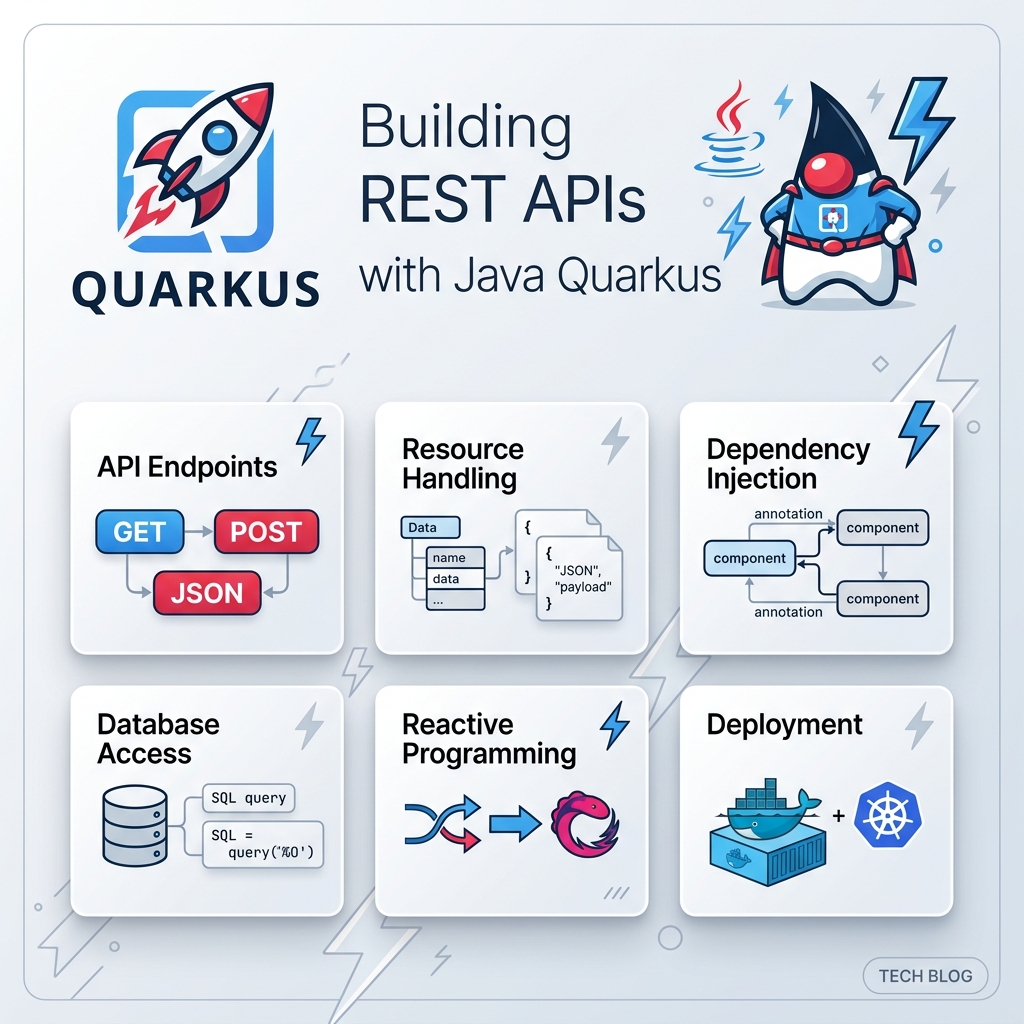
Création d'API REST avec Java Quarkus : Guide haute performance, réactif et Cloud-Native
Dans l’ingénierie logicielle d’entreprise moderne, la création d’API RESTful constitue la pierre angulaire du développement des systèmes backend. Pendant des décennies, les développeurs Java se sont appuyés sur des frameworks traditionnels tels que Spring Boot ou Jakarta EE.
Voici Quarkus—le framework Supersonic Subatomic Java conçu sur mesure pour OpenJDK HotSpot et GraalVM.
1. Pourquoi choisir Quarkus pour vos API REST Java ? A. Le paradigme réactif RESTEasy B. Dev Services & Live Coding sans configuration 2. Architecture d’une API REST Quarkus 3. Initialisation du projet et dépendances mvn io.quarkus.platform:quarkus-maven-plugin:3.15.0:create \ -DprojectGroupId=com.ghaznix.api \ -DprojectArtifactId=quarkus-product-api \ -DclassName="com.ghaznix.api.ProductResource" \ -Dpath="/api/products" \ -Dextensions="resteasy-reactive-jackson,hibernate-orm-panache,jdbc-postgresql,hibernate-validator,smallrye-openapi" 4. Configuration des propriétés de l’application # Application Configuration quarkus.application.name=quarkus-product-api quarkus.http.port=8080 # Database Configuration (Dev Services will override in dev mode automatically) quarkus.datasource.db-kind=postgresql quarkus.datasource.username=postgres quarkus.datasource.password=secret quarkus.datasource.jdbc.url=jdbc:postgresql://localhost:5432/product_db # Hibernate ORM Configuration quarkus.hibernate-orm.database.generation=drop-and-create quarkus.hibernate-orm.log.sql=true # Swagger UI & OpenAPI Path quarkus.swagger-ui.always-include=true quarkus.swagger-ui.path=/swagger-ui 5. Modèle de domaine et Active Record avec Panache package com.ghaznix.api; import io.quarkus.hibernate.orm.panache.PanacheEntity; import jakarta.persistence.Column; import jakarta.persistence.Entity; import jakarta.persistence.Table; import jakarta.validation.constraints.Min; import jakarta.validation.constraints.NotBlank; import jakarta.validation.constraints.NotNull; import java.math.BigDecimal; import java.util.List; @Entity @Table(name = "products") public class Product extends PanacheEntity { @NotBlank(message = "Product name cannot be blank") @Column(nullable = false) public String name; @Column(length = 1000) public String description; @NotNull(message = "Price is required") @Min(value = 0, message = "Price must be non-negative") @Column(nullable = false) public BigDecimal price; @Column(nullable = false) public Integer stockQuantity; public String category; // Static Finder Utility Methods powered by Panache public static List<Product> findByCategory(String category) { return list("category", category); } public static List<Product> findAvailableProducts() { return list("stockQuantity > 0"); } } 6. Création de contrôleurs REST pour la production package com.ghaznix.api; import io.quarkus.panache.common.Page; import io.quarkus.panache.common.Sort; import jakarta.transaction.Transactional; import jakarta.validation.Valid; import jakarta.ws.rs.*; import jakarta.ws.rs.core.MediaType; import jakarta.ws.rs.core.Response; import org.eclipse.microprofile.openapi.annotations.Operation; import org.eclipse.microprofile.openapi.annotations.responses.APIResponse; import org.eclipse.microprofile.openapi.annotations.tags.Tag; import java.net.URI; import java.util.List; @Path("/api/products") @Produces(MediaType.APPLICATION_JSON) @Consumes(MediaType.APPLICATION_JSON) @Tag(name = "Product REST API", description = "Operations for managing catalog products") public class ProductResource { @GET @Operation(summary = "Get all products with pagination") @APIResponse(responseCode = "200", description = "List of products retrieved successfully") public List<Product> getAllProducts( @QueryParam("page") @DefaultValue("0") int pageIndex, @QueryParam("size") @DefaultValue("10") int pageSize, @QueryParam("sort") @DefaultValue("name") String sortBy) { return Product.findAll(Sort.by(sortBy)) .page(Page.of(pageIndex, pageSize)) .list(); } @GET @Path("/{id}") @Operation(summary = "Get product by ID") @APIResponse(responseCode = "200", description = "Product details found") @APIResponse(responseCode = "404", description = "Product not found") public Product getProductById(@PathParam("id") Long id) { Product product = Product.findById(id); if (product == null) { throw new NotFoundException("Product with ID " + id + " does not exist."); } return product; } @POST @Transactional @Operation(summary = "Create a new product") @APIResponse(responseCode = "201", description = "Product created successfully") @APIResponse(responseCode = "400", description = "Invalid request payload") public Response createProduct(@Valid Product product) { product.persist(); return Response.created(URI.create("/api/products/" + product.id)) .entity(product) .build(); } @PUT @Path("/{id}") @Transactional @Operation(summary = "Update an existing product") @APIResponse(responseCode = "200", description = "Product updated") @APIResponse(responseCode = "404", description = "Product ID not found") public Product updateProduct(@PathParam("id") Long id, @Valid Product updatedProduct) { Product entity = Product.findById(id); if (entity == null) { throw new NotFoundException("Product with ID " + id + " not found."); } entity.name = updatedProduct.name; entity.description = updatedProduct.description; entity.price = updatedProduct.price; entity.stockQuantity = updatedProduct.stockQuantity; entity.category = updatedProduct.category; return entity; } @DELETE @Path("/{id}") @Transactional @Operation(summary = "Delete a product by ID") @APIResponse(responseCode = "204", description = "Product deleted successfully") @APIResponse(responseCode = "404", description = "Product ID not found") public Response deleteProduct(@PathParam("id") Long id) { boolean deleted = Product.deleteById(id); if (!deleted) { throw new NotFoundException("Product with ID " + id + " not found."); } return Response.noContent().build(); } } 7. Points de terminaison réactifs vs Exécution bloquante import io.smallrye.mutiny.Uni; import io.smallrye.mutiny.Multi; @GET @Path("/reactive/{id}") public Uni<Product> getProductReactive(@PathParam("id") Long id) { return Product.<Product>findByIdAsync(id) .onItem().ifNull().failWith(new NotFoundException("Product not found")); } @GET @Path("/stream") @Produces(MediaType.SERVER_SENT_EVENTS) public Multi<Product> streamProducts() { return Product.streamAll(); } 8. Gestion globale des exceptions package com.ghaznix.api.exception; import jakarta.ws.rs.NotFoundException; import jakarta.ws.rs.core.MediaType; import jakarta.ws.rs.core.Response; import jakarta.ws.rs.ext.ExceptionMapper; import jakarta.ws.rs.ext.Provider; import java.time.Instant; import java.util.HashMap; import java.util.Map; @Provider public class GlobalExceptionMapper implements ExceptionMapper<Exception> { @Override public Response toResponse(Exception exception) { Map<String, Object> errorPayload = new HashMap<>(); errorPayload.put("timestamp", Instant.now().toString()); if (exception instanceof NotFoundException) { errorPayload.put("status", 404); errorPayload.put("error", "Not Found"); errorPayload.put("message", exception.getMessage()); return Response.status(Response.Status.NOT_FOUND) .entity(errorPayload) .type(MediaType.APPLICATION_JSON) .build(); } errorPayload.put("status", 500); errorPayload.put("error", "Internal Server Error"); errorPayload.put("message", exception.getMessage()); return Response.status(Response.Status.INTERNAL_SERVER_ERROR) .entity(errorPayload) .type(MediaType.APPLICATION_JSON) .build(); } } 9. Tests automatisés avec @QuarkusTest & REST Assured package com.ghaznix.api; import io.quarkus.test.junit.QuarkusTest; import io.restassured.http.ContentType; import org.junit.jupiter.api.Test; import static io.restassured.RestAssured.given; import static org.hamcrest.CoreMatchers.*; @QuarkusTest public class ProductResourceTest { @Test public void testGetAllProductsEndpoint() { given() .when().get("/api/products") .then() .statusCode(200) .contentType(ContentType.JSON); } @Test public void testCreateAndGetProduct() { Product product = new Product(); product.name = "Gaming Laptop"; product.description = "High-performance GPU laptop"; product.price = new java.math.BigDecimal("1499.99"); product.stockQuantity = 15; product.category = "Electronics"; // Test POST Endpoint Integer createdId = given() .contentType(ContentType.JSON) .body(product) .when().post("/api/products") .then() .statusCode(201) .body("name", equalTo("Gaming Laptop")) .extract().path("id"); // Test GET Endpoint by ID given() .pathParam("id", createdId) .when().get("/api/products/{id}") .then() .statusCode(200) .body("category", equalTo("Electronics")); } } ./mvnw test 10. Emballage et compilation native GraalVM ./mvnw quarkus:dev ./mvnw package java -jar target/quarkus-app/quarkus-run.jar ./mvnw package -Dnative -Dquarkus.native.container-build=true ./target/quarkus-product-api-1.0.0-runner 2026-09-21 22:30:00,014 INFO [io.quarkus] (main) quarkus-product-api 1.0.0-runner native (powered by Quarkus 3.15.0) started in 0.018s. Listening on: http://0.0.0.0:8080 11. Benchmarks de performance : Quarkus vs Spring Boot Métrique de benchmark Spring Boot (JVM) Quarkus (OpenJDK JVM) Quarkus (GraalVM Native) Amélioration Temps de démarrage (à froid) 3,82 secondes 1,18 seconde 0,015 seconde 254x plus rapide Empreinte mémoire (RSS) 184 Mo 108 Mo 28 Mo 84% d’économie mémoire 12. Conclusion & Bonnes Pratiques Ghaznix Blog.
Java
Quarkus
REST API
Microservices
GraalVM
Programmation Réactive
Hibernate Panache
Cloud Native
Architecture Logicielle