The Sidecar Pattern: Extending Microservices Without Modifying Code

In modern cloud-native systems, microservices are expected to do much more than run business logic. They must handle logging, manage SSL/TLS certificates, collect metrics, implement retry mechanisms, and coordinate secure communications with other services.
If we embed all of this cross-cutting functionality directly inside each application’s codebase, we end up with code bloat, tight coupling, and language lock-in.
This is where the Sidecar Pattern comes in. In this guide, we will break down what the Sidecar pattern is, why it is essential for modern microservice architectures, and how it works using simple analogies and Kubernetes configuration examples.
The Real-World Analogy: The Motorcycle Sidecar
The easiest way to understand this pattern is to think of a motorcycle with a sidecar.
Imagine you have a high-performance motorcycle. It is designed to do one thing exceptionally well: transport one rider quickly. Now, suppose you need to carry passenger luggage or add an extra seat.
You could completely redesign the motorcycle’s frame, engine, and wheels to turn it into a car. However, that requires massive effort, ruins the simplicity of the bike, and makes it hard to maintain.
Instead, you attach a sidecar.
The sidecar is a separate, self-contained unit that connects to the motorcycle. It shares the motorcycle’s journey, goes wherever the bike goes, and operates in close tandem. Yet, the motorcycle’s core engine remains untouched.
In software architecture:
- The Motorcycle is your primary application container (running your core business logic, like checkout or user auth).
- The Sidecar is a separate helper container (running utility tasks, like SSL termination, monitoring, or log shipping).
- The Journey is the lifecycle of the deployment (e.g., a Kubernetes Pod).
The Problem: Cross-Cutting Concerns and Code Bloat
Before sidecars, developers had to include helper libraries directly in their application code. For example, if you wanted to send logs to a central server, you imported a logging library. If you needed metrics, you added a metrics SDK.
This library-based approach created several significant challenges:
- Language Lock-in: If a monitoring library is only written in Go, you cannot easily use it in a Python or Java microservice. You have to find or build a library for every language in your stack.
- Code Pollution: Business logic becomes cluttered with infrastructure-specific code for retries, service discovery, encryption, and logging.
- Complex Upgrades: If a security vulnerability is found in the communication library, every single microservice must update its dependency, recompile, and redeploy.
- Resource Contention: The helper code runs in the same runtime process as the main application, meaning a memory leak in the logger can crash your entire core application.
The Solution: The Sidecar Pattern
The Sidecar Pattern solves these problems by moving helper tasks out of the main application process and placing them into a separate, independent process running right next to the application.
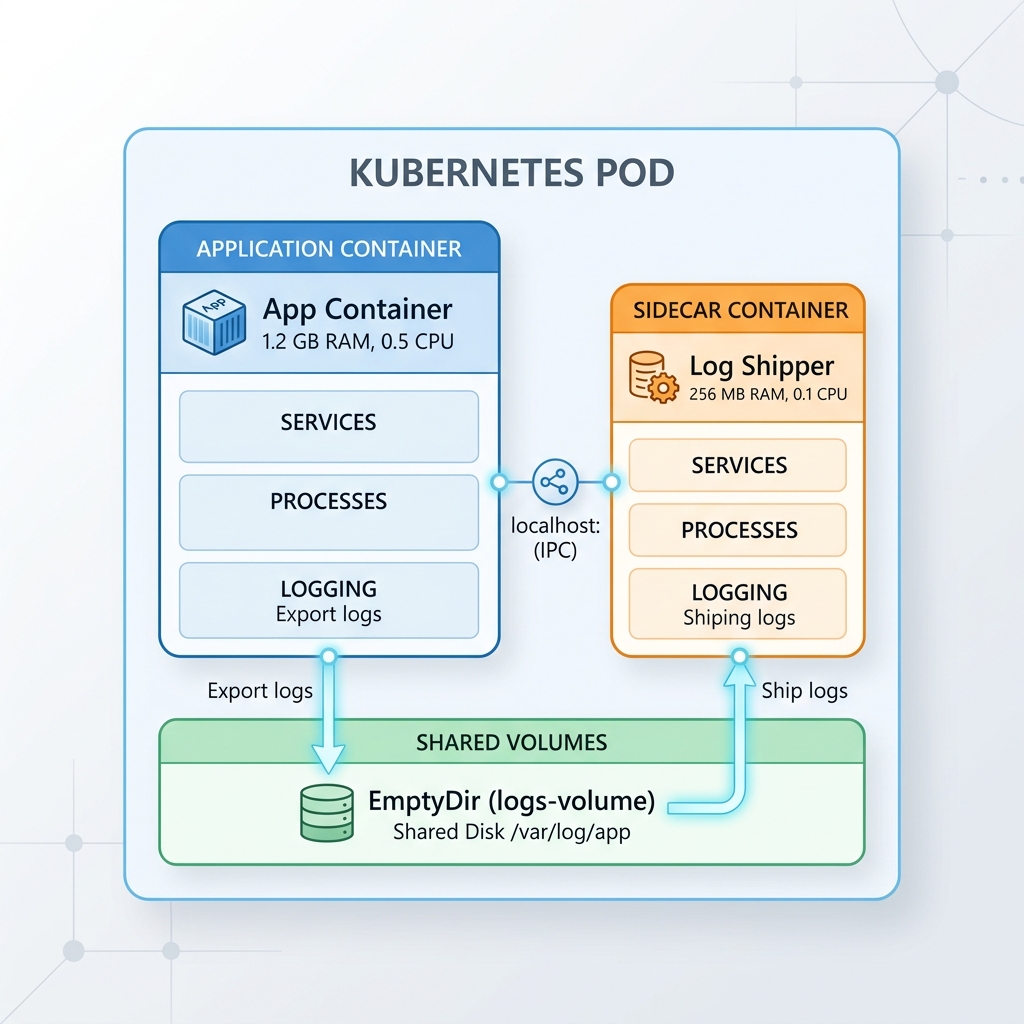
In containerized environments like Kubernetes, the application container and the sidecar container run inside the same Pod. Because they share the same Pod:
- Same Network Namespace: They share the same IP address and network ports. They can talk to each other instantly over
localhostwith virtually zero latency. - Shared Storage Volumes: They can access the exact same disk storage, allowing the sidecar to read log files or load configuration files written by the main application.
- Identical Lifecycle: The sidecar is deployed, started, stopped, and scaled alongside the primary application.
Key Use Cases of the Sidecar Pattern
Sidecars are incredibly versatile. Some of the most common applications include:
1. Service Mesh Proxying (e.g., Envoy, Linkerd)
Instead of your application making direct HTTP calls to other services, it sends requests to its local sidecar proxy. The sidecar proxy handles routing, retries, load balancing, circuit breaking, and mutual TLS (mTLS) encryption, then forwards the request. The application remains completely unaware of these network complexities.
2. Log Collection & Forwarding (e.g., Fluent Bit)
Your application simply writes its log statements to standard output or a local log file. A sidecar container monitors that file, parses the logs, and forwards them to a central analytics engine like Elasticsearch or Datadog.
3. Configuration & Secret Reloading
A sidecar can watch a remote server (like Consul or Vault) for configuration updates or cryptographic key rotations. When a change is detected, it downloads the new files to a shared volume and signals the main application to reload them, without needing a restart.
Kubernetes Implementation Example
Setting up a sidecar is straightforward in Kubernetes. Here is a simple YAML configuration showing an application container writing logs to a shared volume, and a Fluent Bit sidecar container reading and shipping those logs:
apiVersion: v1
kind: Pod
metadata:
  name: app-with-logging-sidecar
  labels:
    app: billing-service
spec:
  containers:
    # 1. Primary Application Container
    - name: web-app
      image: node:18-alpine
      command: ["/bin/sh", "-c"]
      args:
        - >
          while true; do
            echo "$(date) [INFO] Transaction processed successfully" >> /var/log/app/output.log;
            sleep 5;
          done
      volumeMounts:
        - name: shared-logs
          mountPath: /var/log/app

    # 2. Sidecar Container (Log Shipper)
    - name: log-shipper
      image: fluent/fluent-bit:latest
      volumeMounts:
        - name: shared-logs
          mountPath: /var/log/app
      # In a real setup, Fluent Bit config would read /var/log/app/output.log
      # and forward it to an external logging system.

  # Shared disk storage accessible by both containers
  volumes:
    - name: shared-logs
      emptyDir: {}
Pros and Cons of the Sidecar Pattern
Like any design pattern, sidecars come with trade-offs:
| Advantage (Pro) | Disadvantage (Con) |
|---|---|
| Language Agnostic: The sidecar runs in its own environment. You can use the same sidecar helper next to Go, Java, Python, or Ruby apps. | Resource Overhead: Running multiple containers per pod increases CPU and memory consumption. |
| Decoupled Lifecycle: Infrastructure teams can update the sidecar’s security patches without touching application code. | Increased Complexity: Managing twice as many containers complicates deployment configurations, debugging, and scheduling. |
| Independent Failure Isolation: If the sidecar container crashes, Kubernetes can restart it automatically without taking down the main application. | Slight Network Latency: Traffic routing through a local proxy sidecar adds a tiny hop, though it is usually negligible (< 1ms). |
Conclusion
The Sidecar Pattern is a fundamental building block of modern cloud-native architectures. By isolating cross-cutting concerns—such as network proxying, security, logging, and configuration management—into a separate companion process, it allows developers to focus purely on building business value.
While it introduces extra resource overhead and requires container orchestration platforms like Kubernetes to manage effectively, the benefits of cleaner codebases, language flexibility, and independent scaling make it an indispensable pattern for enterprise microservices.
Explore more software development and backend engineering insights on the Ghaznix Blog →
Empower Your Digital Presence & Workflows
Explore top-tier tools built by Ghaznix to streamline your links, surveys, and brand growth.