Secure File Sharing with Blockchain: The Future of Decentralized Data Integrity
Traditional file-sharing methods rely on centralized servers. When you upload a file to cloud providers, you entrust them with your private data. Centralized architectures create single points of failure, making them lucrative targets for hackers. Moreover, unauthorized access by administrators, service outages, and opaque privacy policies raise significant security concerns.
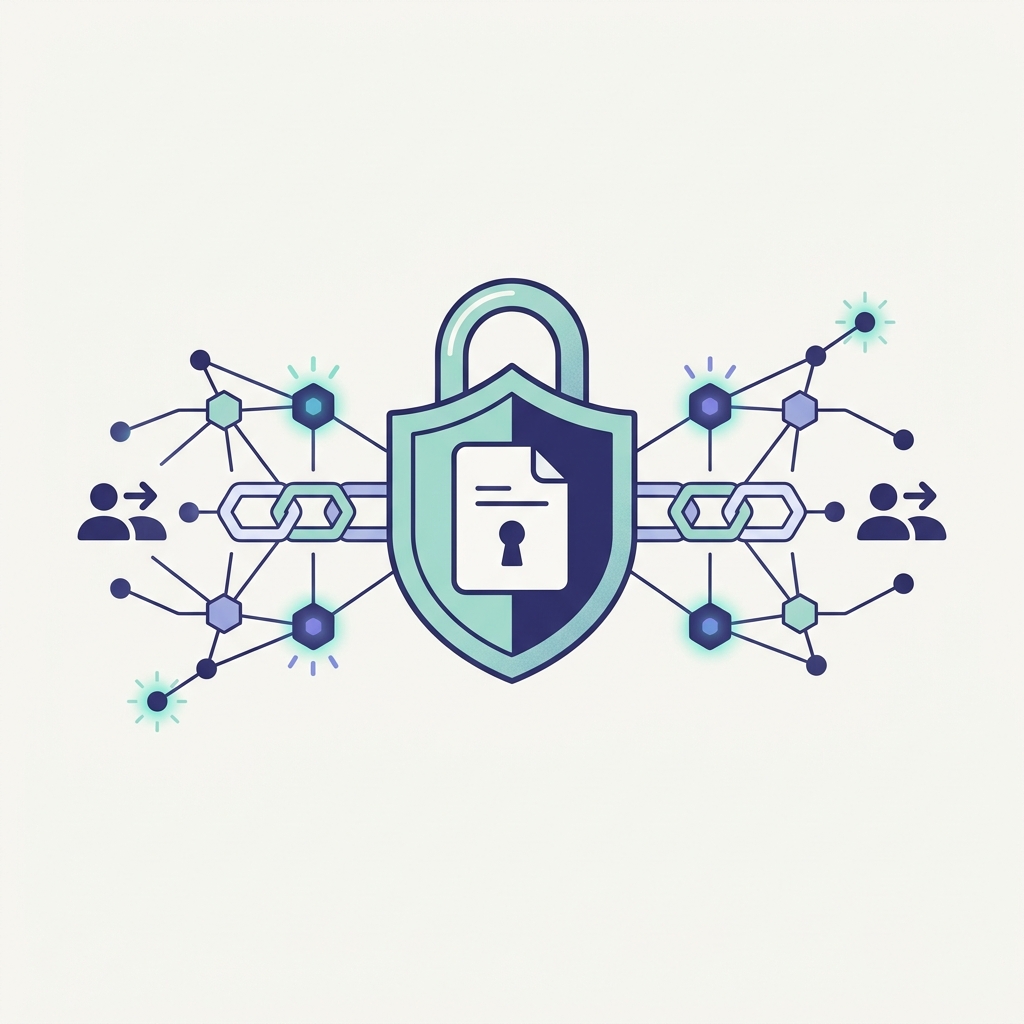
Blockchain technology offers a paradigm shift. By combining decentralized ledgers, cryptographic access control, and peer-to-peer storage networks, we can share files securely without relying on third-party intermediaries.
1. Centralization vs. Decentralization: The Core Problem
Under traditional cloud infrastructures, service providers hold the decryption keys and control access permissions. This architecture introduces critical vulnerabilities:
- Single Point of Failure (SPOF): A successful attack on a central database exposes all users’ data.
- Privacy Violations: Providers can scan files for advertising or hand them to third parties without consent.
- Data Tampering: Files can be altered or deleted silently without user knowledge.
A decentralized approach replaces trust in centralized corporations with mathematical proof and cryptographic verification.
2. Core Pillars of Blockchain File Sharing
A secure, blockchain-based file-sharing system relies on three core technologies working in harmony:
A. Decentralized Storage Networks (IPFS, Filecoin, Arweave)
Blockchains are optimized for transaction ledgers, not large files. Storing megabytes or gigabytes of data directly on a blockchain is prohibitively expensive and slows down the network. Instead, files are uploaded to peer-to-peer storage networks:
- IPFS (InterPlanetary File System): A peer-to-peer hypermedia protocol where files are content-addressed. Instead of pointing to a location (URL), a file is identified by its unique cryptographic hash, called a Content Identifier (CID).
- Filecoin and Arweave: Protocols that incentivize node operators to store data reliably over time using proof-of-spacetime and proof-of-access consensus mechanisms.
B. Client-Side Cryptographic Access Control
To guarantee absolute privacy, files must be encrypted on the user’s device (client-side) before they are uploaded to the network.
- Symmetric Encryption (AES-256): Used to encrypt the file contents rapidly. Only individuals holding the unique symmetric key can decrypt the file.
- Asymmetric Encryption (RSA or ECC): Used to securely share the symmetric key between users. The file owner encrypts the symmetric key using the recipient’s public key, ensuring that only the recipient’s private key can unlock it.
- Proxy Re-Encryption (PRE): An advanced cryptographic scheme where a semi-trusted proxy (e.g., a node in the storage network) transforms ciphertext encrypted under one public key into ciphertext that can be decrypted by another public key, without ever learning the underlying plaintext or decryption keys.
C. Smart Contracts as Access Controllers
Smart contracts are self-executing programs that run on the blockchain. In a file-sharing system, smart contracts act as autonomous access controllers:
- They store the mapping between the file’s CID and the owner’s identity.
- They maintain a secure Access Control List (ACL) defining which public keys are authorized to request access.
- They execute permissions dynamically, enabling owners to grant or revoke access instantly.
3. The Step-by-Step Data Lifecycle
Understanding how files are shared securely involves tracing the data from encryption to retrieval:
- Encryption & Chunking: The file owner’s client application encrypts the file locally using a randomly generated AES-256 symmetric key. Large files are split into smaller chunks.
- Uploading to IPFS: The encrypted chunks are uploaded to IPFS. IPFS returns a unique Content Identifier (CID) for each chunk and a root CID representing the complete file.
- Registering on the Blockchain: The owner sends a transaction to a smart contract containing the file’s root CID, metadata (encrypted), and initial access control permissions.
- Access Request: A recipient initiates a request to access the file, signing the request with their private key to prove identity.
- Decryption Key Exchange: The smart contract verifies the recipient’s authorization. If authorized, the owner’s client encrypts the file’s symmetric key using the recipient’s public key (or uses Proxy Re-Encryption to delegate transformation) and registers the encrypted key on-chain or via a secure channel.
- Retrieval & Decryption: The recipient downloads the encrypted file chunks from IPFS using the CID, decrypts the symmetric key with their private key, and reconstructs the original file.
4. Real-World Applications
- Healthcare & EHR: Medical practitioners can securely exchange patient health records between systems while ensuring HIPAA compliance and preventing unauthorized profiling.
- Legal & Chain of Custody: Contracts, depositions, and evidence files are registered with cryptographic hashes, proving they have not been tampered with since creation.
- Financial Services: Sharing sensitive corporate audits, financial records, and client portfolios without risk of central server leaks or administrative espionage.
- Enterprise Collaboration: Secure collaboration on trade secrets, research documents, and intellectual property.
5. Challenges and Future Outlook
While highly secure, blockchain file sharing faces several hurdles before mass adoption:
- User Experience (UX): Managing private cryptographic keys is complex for average users. Lost keys mean permanent loss of access.
- Network Latency: Retrieval times from peer-to-peer networks like IPFS can be slower than centralized Content Delivery Networks (CDNs).
- Scalability and Fees: High blockchain transaction (gas) fees can make frequent updates to access permissions expensive.
However, advancements in Layer-2 scaling solutions, zero-knowledge proofs, and custodial key recovery systems are rapidly addressing these limitations, paving the way for a truly secure and private digital future.
Empower Your Digital Presence & Workflows
Explore top-tier tools built by Ghaznix to streamline your links, surveys, and brand growth.