How Enterprises Are Combining AI and Blockchain for Smarter Automation

In modern enterprise architecture, two technology paradigms are rapidly converging to redefine how business processes are automated: Artificial Intelligence (AI) and Blockchain.
AI brings advanced cognitive abilities, pattern recognition, and unstructured data processing—representing the “brain” of enterprise applications. Blockchain brings absolute transparency, cryptographic verification, and decentralized consensus—representing the “backbone of trust”.
By merging AI reasoning with blockchain security, enterprises can build autonomous workflows that are not only highly intelligent but also completely auditable, secure, and capable of executing financial and logistically complex transactions without central intermediaries.
1. The Synergy: Reasoning Meets Cryptographic Trust
When deployed in isolation, both AI and blockchain have distinct limitations in enterprise environments:
- The AI Trust Deficit: Large Language Models and neural networks are probabilistic. They can hallucinate, produce inconsistent outputs, and act as a “black box” where tracing the exact step-by-step reasoning is difficult.
- The Blockchain Rigidity: Smart contracts are deterministic, binary, and rigid. They cannot process unstructured data (like emails, PDFs, or images) or make decisions under uncertainty without external inputs.
Combining them creates a powerful, self-correcting feedback loop:
| Technology | Core Strength | Solves the Other’s Weakness |
|---|---|---|
| Artificial Intelligence | Cognitive reasoning, unstructured data parsing, flexible decision-making. | Feeds smart contracts with processed, intelligent real-world data and structured outputs. |
| Blockchain | Immutable state recording, cryptographic proofs, trustless execution. | Logs AI decisions, prompts, and actions on an unalterable ledger for auditing and verification. |
2. Key Enterprise Use Cases
A. Intelligent Smart Contracts
Traditional smart contracts execute automatically based on simple parameter inputs (e.g., “if current date > delivery date, pay penalty”). However, real-world contracts are rarely that simple. They require qualitative evaluations (e.g., “verify if the goods arrived in good condition based on a photographic inspection report”).
By wrapping an AI agent in a blockchain oracle, the contract can evaluate complex inputs. The AI reviews the photographic evidence or logistics bill of lading, generates a structured classification (e.g., Passed Quality Control), and writes that verification status directly to the smart contract, triggering the payment.
B. Auditable and Compliant AI (The Audit Trail)
In highly regulated sectors like finance, insurance, and healthcare, deploying autonomous AI agents is restricted by compliance requirements. If an AI agent decides to reject an insurance claim, the enterprise must be able to prove exactly why and how that decision was made.
By hashing and writing the LLM’s system prompts, user inputs, tool execution outputs, and final agent decisions directly onto an immutable blockchain ledger, companies create a tamper-proof audit trail. This enables auditors to verify that the AI operated within defined policy boundaries.
C. Secure Decentralized Data Marketplaces
Training enterprise-grade AI models requires massive amounts of high-quality data. However, companies are hesitant to share proprietary data due to privacy concerns.
Using blockchain-based token-gated access combined with Federated Learning and Zero-Knowledge Proofs (ZKPs), enterprises can contribute data to train shared industry models without exposing their raw proprietary data. The blockchain serves as the coordination layer, rewarding data contributors with tokens or royalty shares based on model performance metrics.
3. The On-Chain AI Agent Architecture
To integrate an AI workflow with a blockchain system, we separate the architecture into three primary layers: the Cognitive Layer (the LLM agent), the Middleware/Oracle Layer (translating AI output to blockchain calls), and the Ledger Layer (smart contract execution).
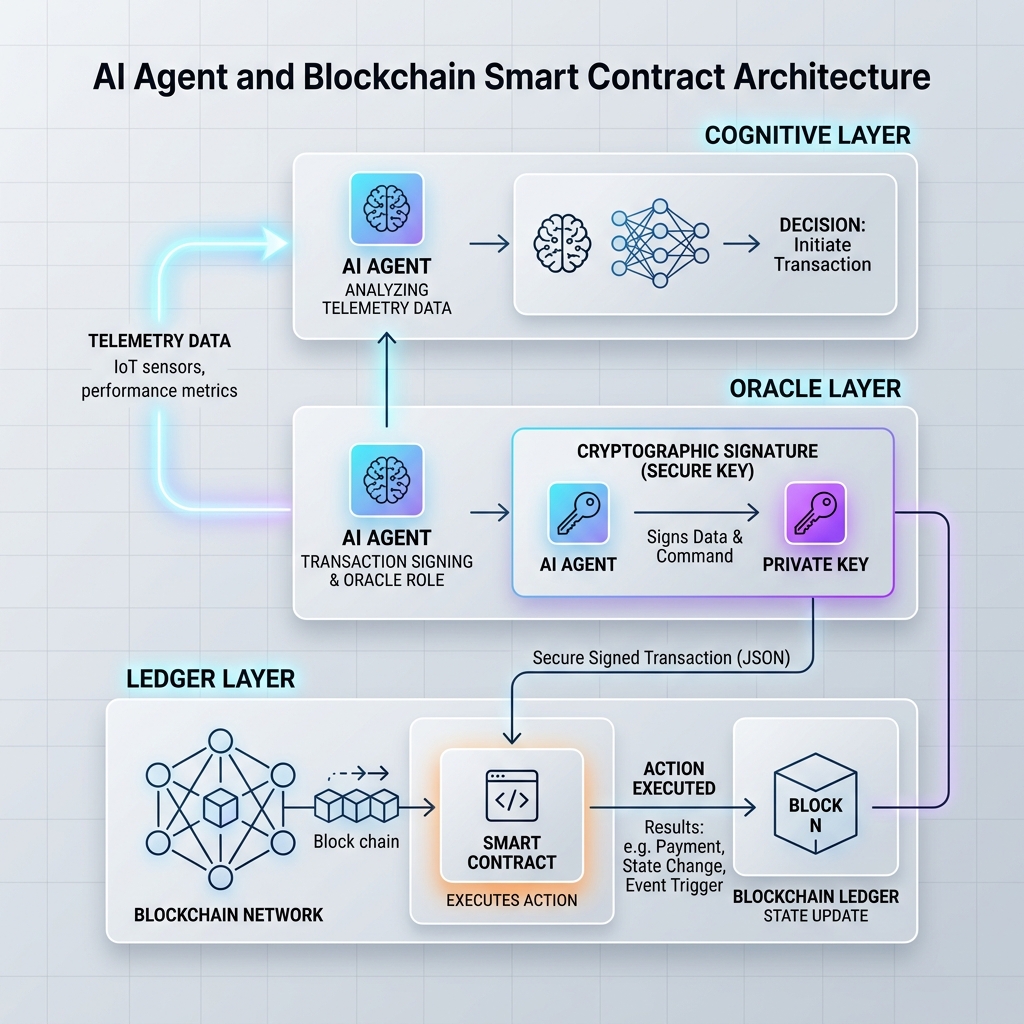
- Cognitive Layer: The AI agent processes incoming unstructured data (such as emails or documents) and evaluates it against rules.
- Oracle Layer: The agent reformats its reasoning into a structured transaction payload and signs it using a cryptographic key held securely in a hardware security module (HSM).
- Ledger Layer: The smart contract validates the signature, performs state checks, and executes the on-chain action (e.g., asset distribution).
4. Implementation: AI Agent Triggering an On-Chain Payout
Here is a Python implementation demonstrating how an autonomous AI agent can parse shipping telemetry data, determine if a contract condition is met (e.g., temperature threshold for cold-chain pharmaceutical logistics), and trigger a smart contract transaction using Web3.py.
import json
from web3 import Web3
from openai import OpenAI

# Initialize web3 provider and client
w3 = Web3(Web3.HTTPProvider("https://sepolia.infura.io/v3/YOUR_PROJECT_ID"))
openai_client = OpenAI(api_key="YOUR_OPENAI_API_KEY")

# Smart Contract details
CONTRACT_ABI = json.loads('[{"inputs":[{"internalType":"string","name":"milestone","type":"string"},{"internalType":"bool","name":"approved","type":"bool"}],"name":"triggerPayout","outputs":[],"stateMutability":"nonpayable","type":"function"}]')
CONTRACT_ADDRESS = "0xdeADBeef74222222222222222222222222222222"
agent_contract = w3.eth.contract(address=CONTRACT_ADDRESS, abi=CONTRACT_ABI)

# Private key stored in HSM/KMS for signing transactions
SENDER_ADDRESS = "0x1234567890123456789012345678901234567890"
PRIVATE_KEY = "0xYOUR_SECURE_AGENT_PRIVATE_KEY"

def analyze_telemetry_and_payout(telemetry_data: str):
    """
    Step 1: Use LLM to analyze unstructured cold-chain telemetry data.
    """
    prompt = f"""
    Analyze the following logistics telemetry log for a cold-chain pharmaceutical shipment.
    Determine if the temperature remained strictly below 8 degrees Celsius at all times.

    Telemetry Log:
    {telemetry_data}

    Output your decision as a valid JSON object with the keys:
    - 'passed_compliance': true/false
    - 'highest_recorded_temp': float
    - 'justification': string (brief summary)
    """

    response = openai_client.chat.completions.create(
        model="gpt-4o-mini",
        messages=[{"role": "user", "content": prompt}],
        response_format={"type": "json_object"}
    )

    analysis = json.loads(response.choices[0].message.content)
    print("AI Analysis Result:", json.dumps(analysis, indent=2))

    # Step 2: If compliance passes, trigger the blockchain smart contract payout
    if analysis["passed_compliance"]:
        trigger_blockchain_transaction("Milestone_Delivery_1", True)
    else:
        trigger_blockchain_transaction("Milestone_Delivery_1", False)

def trigger_blockchain_transaction(milestone: str, approved: bool):
    """
    Step 3: Construct, sign, and broadcast the transaction to the Ethereum network.
    """
    print(f"Constructing transaction: Milestone={milestone}, Approved={approved}...")

    # Build transaction dictionary
    tx = agent_contract.functions.triggerPayout(milestone, approved).build_transaction({
        'chainId': 11155111,  # Sepolia Testnet
        'gas': 100000,
        'maxFeePerGas': w3.to_wei('50', 'gwei'),
        'maxPriorityFeePerGas': w3.to_wei('2', 'gwei'),
        'nonce': w3.eth.get_transaction_count(SENDER_ADDRESS),
    })

    # Sign transaction with agent's private key
    signed_tx = w3.eth.account.sign_transaction(tx, private_key=PRIVATE_KEY)

    # Broadcast the transaction to the blockchain
    tx_hash = w3.eth.send_raw_transaction(signed_tx.raw_transaction)
    print(f"Transaction successfully broadcast! TX Hash: {w3.to_hex(tx_hash)}")

    # Wait for block confirmation
    receipt = w3.eth.wait_for_transaction_receipt(tx_hash)
    print(f"Transaction confirmed in block {receipt['blockNumber']} with status {receipt['status']}")

# Mock cold-chain telemetry payload
telemetry_log = """
[2026-06-21 12:00:00] Temp: 4.2 C - Status: OK
[2026-06-21 14:00:00] Temp: 5.1 C - Status: OK
[2026-06-21 16:00:00] Temp: 6.8 C - Status: OK
[2026-06-21 18:00:00] Temp: 7.2 C - Status: OK
"""

if __name__ == "__main__":
    analyze_telemetry_and_payout(telemetry_log)
5. Security & Operational Guardrails
Integrating autonomous intelligence with immutable finance requires bulletproof guardrails:
A. Key Management and Custody
Never store agent private keys in plain text files or environment variables. Enterprises must use hardware security modules (HSMs) or cloud Key Management Services (like AWS KMS or HashiCorp Vault) that support Ethereum signing algorithms (ECDSA secp256k1). This ensures that the private key never leaves the secure hardware boundary.
B. Multi-Signature and Threshold Cryptography
For high-value transactions, the AI agent should not have sole authority to sign. Instead, use a multi-signature wallet (like Safe) where the AI’s signature counts as one key, but a human manager or a separate compliance microservice must provide the secondary signature before the transaction executes.
C. Oracle Circuit Breakers
Always implement transaction validation rules in the smart contract itself rather than relying entirely on the AI oracle. For example, if the AI agent attempts to trigger a payment that exceeds a daily limit, the contract must reject the call, trigger an emergency pause, and request manual human override.
Conclusion
Combining AI and blockchain represents the next logical step in enterprise automation. By allowing AI to serve as the flexible, reasoning engine that navigates complex, unstructured business scenarios, and blockchain to serve as the secure, deterministic settlement layer, companies can deploy automation with unprecedented confidence and auditable integrity.
As we move forward, the organizations that succeed won’t just build faster workflows—they will build workflows that are both smart enough to act autonomously and secure enough to be fully trusted.
Explore more articles on AI and Blockchain at the Ghaznix Blog →
Empower Your Digital Presence & Workflows
Explore top-tier tools built by Ghaznix to streamline your links, surveys, and brand growth.