Understanding RAG Models: Grounding LLMs with Real-World Knowledge
Large Language Models (LLMs) like GPT-4 or Gemini are incredibly powerful, but they have a few critical weaknesses: they hallucinate, they don’t know about information after their training cutoff date, and they lack access to your private domain data.
To solve these limitations, developers use Retrieval-Augmented Generation (RAG). RAG is a framework that retrieves relevant information from an external database and provides it to the LLM to generate accurate, context-aware responses.
Here is a comprehensive guide to understanding RAG models, how they work, and why they are essential for enterprise AI.
1. What is Retrieval-Augmented Generation (RAG)?
At its core, RAG combines two distinct processes:
- Retrieval: Finding relevant documents or text chunks from a knowledge base based on a user’s query.
- Generation: Feeding the retrieved documents along with the user’s query to an LLM so it can generate an accurate response.
Think of an open-book exam. Instead of relying solely on what the LLM memorized during training (a closed-book exam), the model is allowed to search a reference book (the knowledge base) before answering.
2. The Step-by-Step RAG Pipeline
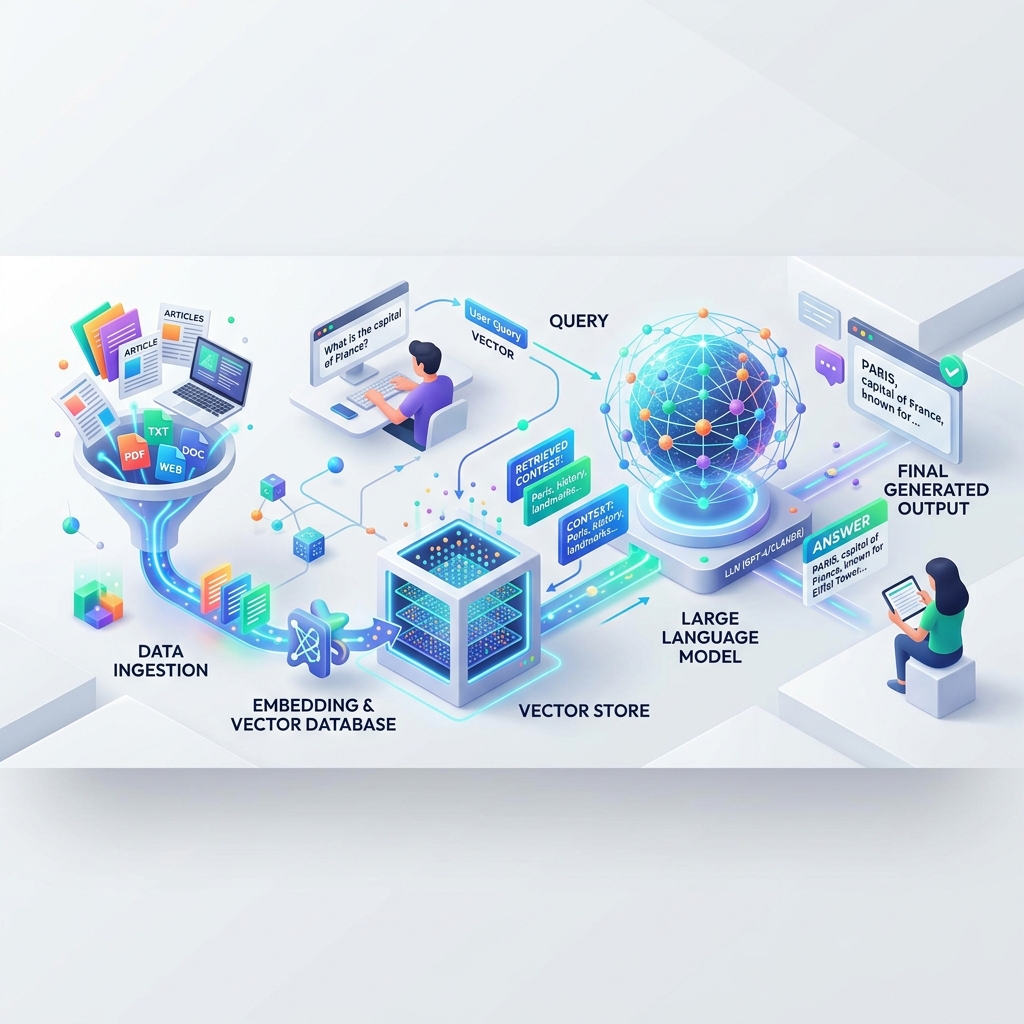
A standard RAG pipeline consists of three main phases: Ingestion, Retrieval, and Generation.
Phase 1: Ingestion (Data Preparation)
Before the system can retrieve information, the raw data must be processed:
- Loading: Documents (PDFs, Markdown, Web pages, etc.) are gathered.
- Chunking: Large files are split into smaller, manageable text chunks (e.g., 500 characters).
- Embedding: An embedding model converts these text chunks into dense mathematical vectors that represent their semantic meaning.
- Storage: These vector representations are stored in a specialized Vector Database (such as Milvus, Pinecone, or Qdrant).
Phase 2: Retrieval (Finding the Answer)
When a user asks a question:
- The user’s query is converted into a vector using the same embedding model.
- The system performs a vector similarity search (like Cosine Similarity) in the vector database to find the text chunks most relevant to the query.
- The top matching chunks are retrieved.
Phase 3: Generation (Synthesizing the Response)
- The retrieved text chunks are combined with the user’s original query into a detailed prompt template.
- This prompt is sent to the LLM.
- The LLM reads the context, extracts the relevant facts, and generates a natural language response grounded in the provided documents.
3. How Embeddings Are Created
Embeddings are the mathematical backbone of RAG. They convert human language into dense numerical vectors that capture semantic meaning.
- The Embedding Process:
- Tokenization: The text chunk is broken down into smaller pieces called tokens.
- Encoder Model: A specialized Transformer-based encoder (like BERT or OpenAI’s text-embedding-3) processes the tokens.
- High-Dimensional Vector: The model outputs a list of numbers (typically 384, 768, or 1536 dimensions). Each dimension represents a different semantic feature or concept.
- Semantic Mapping: In this vector space, words or phrases with similar meanings are positioned close to one another. For example, the vector for “cat” will be closer to “kitten” than to “car”.
- Distance Metrics: Vector databases find relevant context by measuring the distance between query and document vectors using mathematical formulas like Cosine Similarity (angle between vectors), Dot Product, or Euclidean Distance.
4. The Complete RAG Workflow Walkthrough
Here is a step-by-step walkthrough of how a request moves through a RAG system:
[User Query] ──> [Embedding Model] ──> [Query Vector]
                                            │
                                            ▼
[LLM Response] <── [LLM] <── [Prompt] <── [Vector DB Search]
                             (Context + Query)
- User Input: A user submits a query (e.g., “What was our Q3 revenue?”).
- Query Vectorization: The query is converted into a vector by the embedding model.
- Database Search: The vector database compares the query vector against all document vectors and retrieves the top-K closest matching text chunks.
- Context Fusion: The retrieved chunks are injected into a prompt template alongside the user’s original query.
- LLM Inference: The LLM reads the context-infused prompt and generates a natural, factually accurate response.
5. RAG vs. Fine-Tuning: Which is Better?
When adapting an LLM to custom data, developers often choose between RAG and Fine-Tuning. Here is how they compare:
| Feature | RAG (Retrieval-Augmented) | Fine-Tuning |
|---|---|---|
| Primary Purpose | Grounding with factual external knowledge | Adapting behavior, style, or specific task formatting |
| Setup Cost | Low to Moderate | High (requires GPUs and training pipelines) |
| Real-time Updates | High (just add/edit documents in the vector DB) | Low (requires retraining or continuous fine-tuning) |
| Hallucination Risk | Very Low (responses are grounded in source documents) | Moderate to High (model can still hallucinate facts) |
| Data Privacy | Easy (access control is handled at the database level) | Difficult (hard to restrict access once data is baked in) |
6. Advanced RAG Techniques
Basic RAG is easy to build, but production-grade RAG requires advanced techniques to handle complex queries:
- Query Rewriting: Rephrasing the user’s query to improve vector search accuracy.
- Re-ranking: Using a secondary model (like a cross-encoder) to re-evaluate and re-order the retrieved documents, ensuring the most relevant ones are positioned first.
- Hybrid Search: Combining keyword search (BM25) with vector search to capture both exact matches and semantic meanings.
- Hierarchical Chunking: Storing small chunks for precise retrieval but linking them to larger parent chunks to provide broader context to the LLM.
Conclusion
RAG has become the industry standard for building production AI applications. By grounding LLMs with real-world knowledge, it bridges the gap between static model weights and dynamic, domain-specific data. Whether you are building an internal company wiki assistant or an automated customer support bot, RAG models ensure your AI remains accurate, up-to-date, and secure.
Empower Your Digital Presence & Workflows
Explore top-tier tools built by Ghaznix to streamline your links, surveys, and brand growth.