The Saga Pattern: Distributed Transactions in Microservices Architecture
In traditional monolithic applications, maintaining data consistency across multiple entities is straightforward. Relational database engines provide ACID (Atomicity, Consistency, Isolation, Durability) guarantees wrapped inside local SQL transactions. If an order placement, payment deduction, or inventory reserve fails halfway through, calling ROLLBACK reverts every database modification instantaneously.
However, when migrating to a modern Microservices Architecture, data management shifts fundamentally. To ensure domain autonomy and independent scalability, each microservice owns its private database. A single business operation—such as processing an e-commerce checkout—now spans multiple service boundaries and database engines (e.g., PostgreSQL for Orders, DynamoDB for Payments, Redis for Inventory).
Because distributed microservices cannot rely on a single database transaction, maintaining data consistency across network boundaries becomes one of the most challenging problems in distributed systems engineering.
To solve this without sacrificing system availability or performance, software architects rely on the Saga Pattern.
In this deep dive, we will explore why traditional distributed transactions fail, break down the core mechanics of the Saga Pattern, compare Choreography vs. Orchestration, analyze isolation countermeasures, examine production code implementations in Go and Java, and learn how to handle real-world failure rollbacks safely.
The Root Problem: Why Two-Phase Commit (2PC) Fails in Microservices
Before adopting the Saga Pattern, engineers often ask: Why can’t we use traditional Two-Phase Commit (2PC / XA) across our microservices?
The Mechanics of 2PC
Two-Phase Commit coordinates a distributed transaction across multiple database nodes using a central Transaction Manager in two phases:
- Prepare Phase: The Transaction Manager asks all participating database nodes to prepare and lock the required rows. Participants vote
YESorNO. - Commit Phase: If all participants voted
YES, the Manager issues aCOMMITcommand to all nodes. If any node votedNOor timed out, it issues aROLLBACK.
Client ----> Transaction Manager
                   |
     +-------------+-------------+
     | (Prepare)   | (Prepare)   | (Prepare)
     v             v             v
 Order DB     Payment DB    Inventory DB
Why 2PC is an Anti-Pattern for Microservices
While 2PC guarantees strong consistency, it breaks down in cloud-native microservice environments due to several architectural flaws:
- Blocking & Resource Contention: Database rows remain locked throughout the multi-stage network handshake. If network latency increases or a service slows down, locks are held open, rapidly consuming connection pools and causing cascading system failure.
- Availability Bottleneck: In 2PC, system availability is bounded by the product of all participant availabilities ($A_{total} = A_1 \times A_2 \times \dots \times A_n$). If any single service or database node goes offline during the prepare phase, the entire global transaction blocks indefinitely.
- Loss of Service Autonomy: 2PC forces services to expose database-level XA protocols across network APIs, coupling their database engines directly.
- Broker Constraints: High-throughput message brokers like Apache Kafka or RabbitMQ do not natively participate in traditional XA 2PC transactions across relational databases.
According to the CAP Theorem, distributed systems must choose between Strong Consistency (C) and High Availability (A) under Network Partitions (P). Modern microservice systems prioritize Availability and Partition Tolerance, trading instant consistency for Eventual Consistency (BASE: Basically Available, Soft-state, Eventual consistency).
What is the Saga Pattern?
The Saga Pattern was originally proposed by Hector Garcia-Molina and Kenneth Salem in 1987 as a mechanism for handling long-lived transactions in database management systems. In modern microservices, a Saga represents a sequence of discrete local transactions.
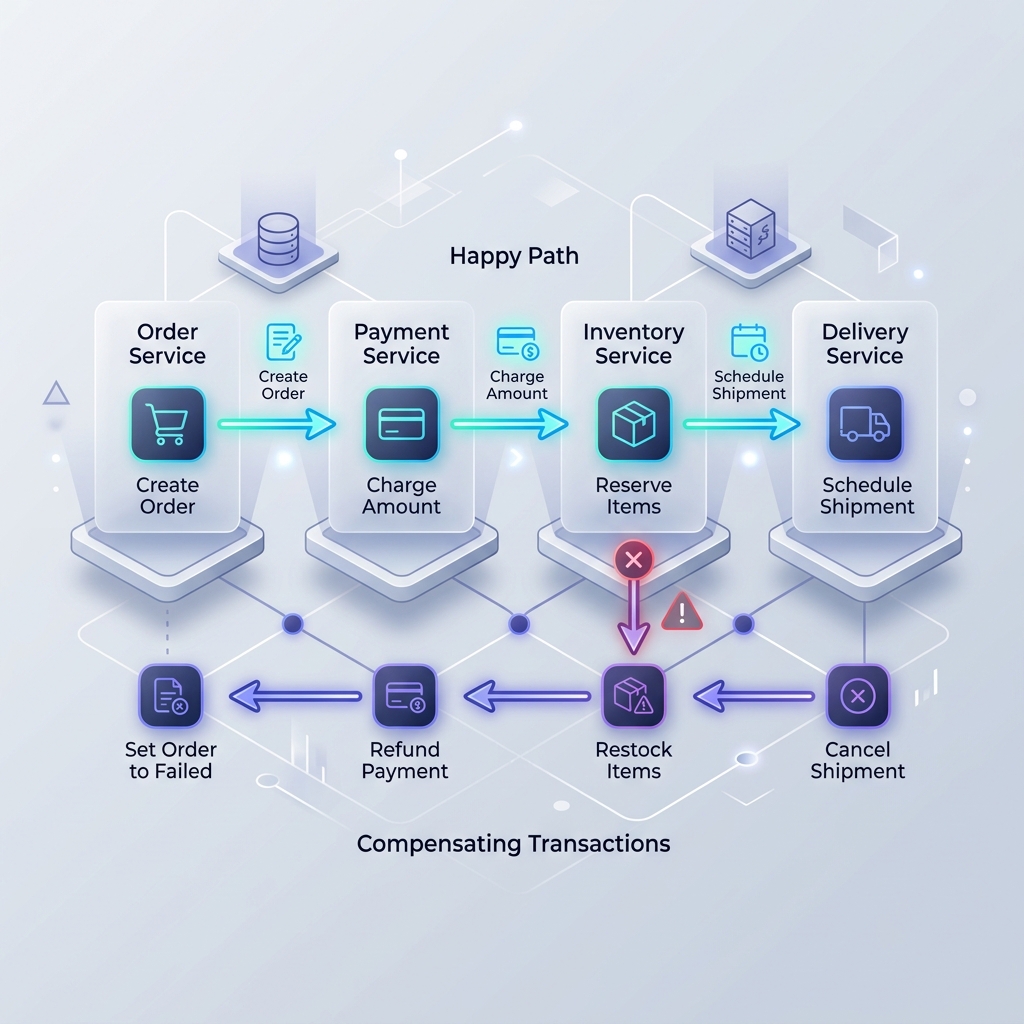
Instead of wrapping the entire multi-service flow inside a single global lock, a Saga executes a business process as a series of independent local database transactions ($T_1, T_2, \dots, T_n$).
Each local transaction updates data in a single microservice’s database and publishes a domain event or message. This event triggers the next local transaction ($T_{i+1}$) in the downstream service.
[Order Service]         [Payment Service]       [Inventory Service]
  Local Tx T1 -------------> Local Tx T2 -------------> Local Tx T3
(Create Order)              (Process Payment)            (Reserve Stock)
Forward Execution vs. Backward Compensation
If all local transactions succeed, the Saga completes successfully (Forward Execution).
However, if a local transaction fails halfway through (e.g., $T_3$ fails because an item is out of stock), the Saga cannot simply call a database ROLLBACK for previous steps ($T_1, T_2$) because those local transactions have already committed to their respective databases.
To undo already-committed local transactions, the Saga must execute Compensating Transactions ($C_{n-1}, \dots, C_1$) in reverse order.
Forward Flow:    T1 (Create Order) ---> T2 (Charge Card) ---> T3 (Reserve Inventory - FAILS)
                                                                       |
Backward Rollback:  C1 (Cancel Order) <--- C2 (Refund Card) <----------+
Classification of Saga Transactions
To design a robust Saga workflow, every step in the transaction sequence must be categorized into one of three structural types:
| Transaction Type | Description | Idempotency & Rollback Requirement |
|---|---|---|
| Compensatable Transactions | Steps executed before the point of no return. They can be undone or reversed if a downstream step fails. | Must have a corresponding Compensating Transaction ($C_i$). |
| Pivot Transaction | The definitive step in the Saga. If the Pivot succeeds, the Saga is guaranteed to finish. If it fails, the Saga rolls back. | Neither compensatable nor retriable; it marks the boundary between rollback and forward completion. |
| Retriable Transactions | Steps executed after the Pivot transaction. They are guaranteed to succeed eventually and do not require compensation. | Must be strictly idempotent, as they will be retried automatically until successful. |
E-Commerce Checkout Example Breakdown
Consider an e-commerce order checkout consisting of four steps:
- $T_1$: Create Pending Order (Compensatable) $\to$ Undo via $C_1$: Cancel Order.
- $T_2$: Authorize Payment (Compensatable) $\to$ Undo via $C_2$: Refund Payment.
- $T_3$: Reserve Inventory (Pivot Transaction) $\to$ If stock allocation succeeds, the order is finalized. If it fails, trigger $C_2$ and $C_1$.
- $T_4$: Dispatch Shipping Request (Retriable) $\to$ Executed after the pivot; retried until delivered.
Saga Architectural Styles: Choreography vs. Orchestration
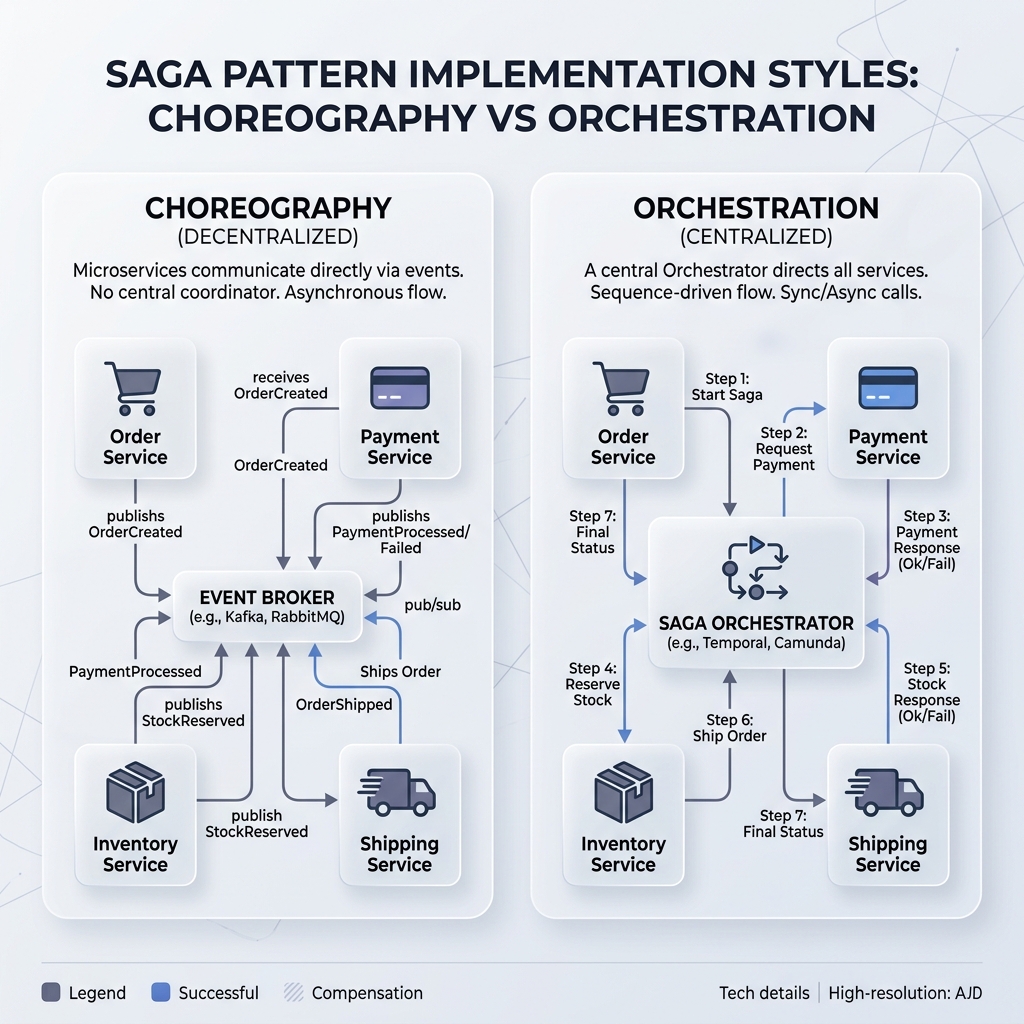
There are two primary architectural styles for implementing the Saga pattern in distributed systems: Choreography (Decentralized) and Orchestration (Centralized).
Style 1: Choreography (Event-Driven Decentralization)
In a Choreography-based Saga, there is no central controller or coordinator. Instead, microservices communicate asynchronously by listening to domain events published to a central event bus (such as Apache Kafka, NATS, or RabbitMQ).
Workflow Mechanics
- Order Service executes $T_1$ (creates pending order) and emits an
OrderCreatedevent to Kafka. - Payment Service listens to
OrderCreated, executes $T_2$ (charges credit card), and emits aPaymentCompletedevent (orPaymentFailed). - Inventory Service listens to
PaymentCompleted, executes $T_3$ (reserves items). If items are out of stock, it emitsInventoryReservationFailed. - Payment Service listens to
InventoryReservationFailedand executes $C_2$ (issues refund). - Order Service listens to
PaymentRefundedand executes $C_1$ (marks order as cancelled).
Advantages of Choreography
- Loose Coupling: Services only subscribe to event topics; they do not know about other service implementations.
- High Throughput & Decentralization: Direct event pub/sub eliminates central orchestrator bottlenecks.
- Simplicity for Short Workflows: Easy to set up for simple 2–3 step workflows.
Disadvantages of Choreography
- Cyclic Dependency Risk: Services can end up listening to each other’s events, creating complex cyclic dependencies.
- Difficult Code Traceability: Understanding the end-to-end business process requires tracing logic across multiple codebase repositories.
- Event Storming & Complexity: As the number of steps increases (e.g., 10+ services), managing error edge cases leads to event state explosion.
Style 2: Orchestration (Centralized Workflow Management)
In an Orchestration-based Saga, a dedicated microservice known as the Saga Orchestrator controls the entire lifecycle of the distributed transaction. The orchestrator acts as a central coordinator, issuing explicit commands to participating microservices and listening to their response events.
Workflow Mechanics
- The client sends an order request to the Saga Orchestrator.
- Orchestrator sends a
CreateOrdercommand to Order Service. Order Service returnsOrderCreated. - Orchestrator updates its state machine and sends a
ProcessPaymentcommand to Payment Service. Payment Service returnsPaymentSuccessful. - Orchestrator sends a
ReserveInventorycommand to Inventory Service. Inventory Service returnsInventoryFailed (Out of Stock). - Orchestrator detects failure, initiates compensation flow:
- Sends
RefundPaymentcommand to Payment Service. - Sends
CancelOrdercommand to Order Service.
- Sends
- Orchestrator marks the Saga execution as
FAILED.
Advantages of Orchestration
- Centralized Business Logic: Workflow state and business logic are localized in a single orchestrator service or state machine.
- No Cyclic Dependencies: Microservices respond to commands from the orchestrator; they do not depend on or know about other downstream services.
- Clear Monitoring & Debugging: End-to-end transaction state is explicitly stored in the orchestrator’s state store (e.g., PostgreSQL or workflow engines like Temporal / Camunda).
- Easier Error Handling: Adding new steps or changing rollback rules is managed entirely inside the orchestrator.
Disadvantages of Orchestration
- Orchestrator Complexity: Risk of placing too much domain logic into the orchestrator, turning it into a “smart orchestrator, dumb service” anti-pattern.
- Potential Single Point of Failure: The orchestrator must be rendered highly available and stateful.
Comparative Matrix: Choreography vs. Orchestration
| Feature | Choreography | Orchestration |
|---|---|---|
| Control Structure | Decentralized (Event Pub/Sub) | Centralized (Saga Coordinator / State Machine) |
| Coupling | Extremely Low (Services consume events) | Medium (Services accept commands from Coordinator) |
| Process Visibility | Low (Distributed across log files) | High (Single state store visualizes workflow) |
| Best Suited For | Simple workflows (2 to 4 service steps) | Complex enterprise workflows (5+ steps, branching logic) |
| Tooling / Frameworks | Kafka, RabbitMQ, NATS, AWS EventBridge | Temporal.io, AWS Step Functions, Camunda, Axon |
Isolation Challenges & Countermeasures (Handling “ACID minus I”)
Because local transactions in a Saga commit immediately to their local databases, the Saga pattern lacks Isolation (I) from traditional ACID guarantees.
If a client reads a database row modified by $T_1$ while the Saga is still running, they are reading uncommitted, intermediate state. If a downstream step fails and triggers compensation ($C_1$), the client has performed a Dirty Read.
Common Anomalies Caused by Lack of Isolation
- Lost Updates: Saga A updates a record. Before Saga A completes, Saga B overwrites the same record. If Saga A fails and executes compensation, it overwrites Saga B’s update.
- Dirty Reads: A customer reads available stock updated by Saga A ($T_1$). Saga A fails downstream ($T_3$) and restores stock ($C_1$), but the customer has already placed an order based on stale data.
- Non-Repeatable Reads: A service reads data at step $T_1$ and reads it again at step $T_3$, but another concurrent Saga modified the data in between.
Countermeasures & Mitigation Strategies
To maintain data integrity despite the lack of isolation, software architects implement specific isolation design patterns:
1. Semantic Lock (Pending / Flagged State)
When local transaction $T_1$ updates a database record, it sets a status field to PENDING or APPROVAL_REQUIRED (e.g., ORDER_PENDING_PAYMENT).
Other concurrent Sagas reading this record must check the semantic lock flag and block or alter their behavior until the state changes to COMMITTED or CANCELLED.
2. Committing Order
Design the sequence of local transactions so that high-risk or irreversible operations occur late in the Saga execution, minimizing the window of vulnerability.
3. Re-Read Validation (Optimistic Concurrency Control)
Before executing a critical step or compensation, re-read the target database record and verify version timestamps (version_id) to ensure no concurrent modification occurred.
4. Pessimistic View
Re-order the steps of a Saga to minimize economic exposure (e.g., place payment authorization as close to the pivot transaction as possible).
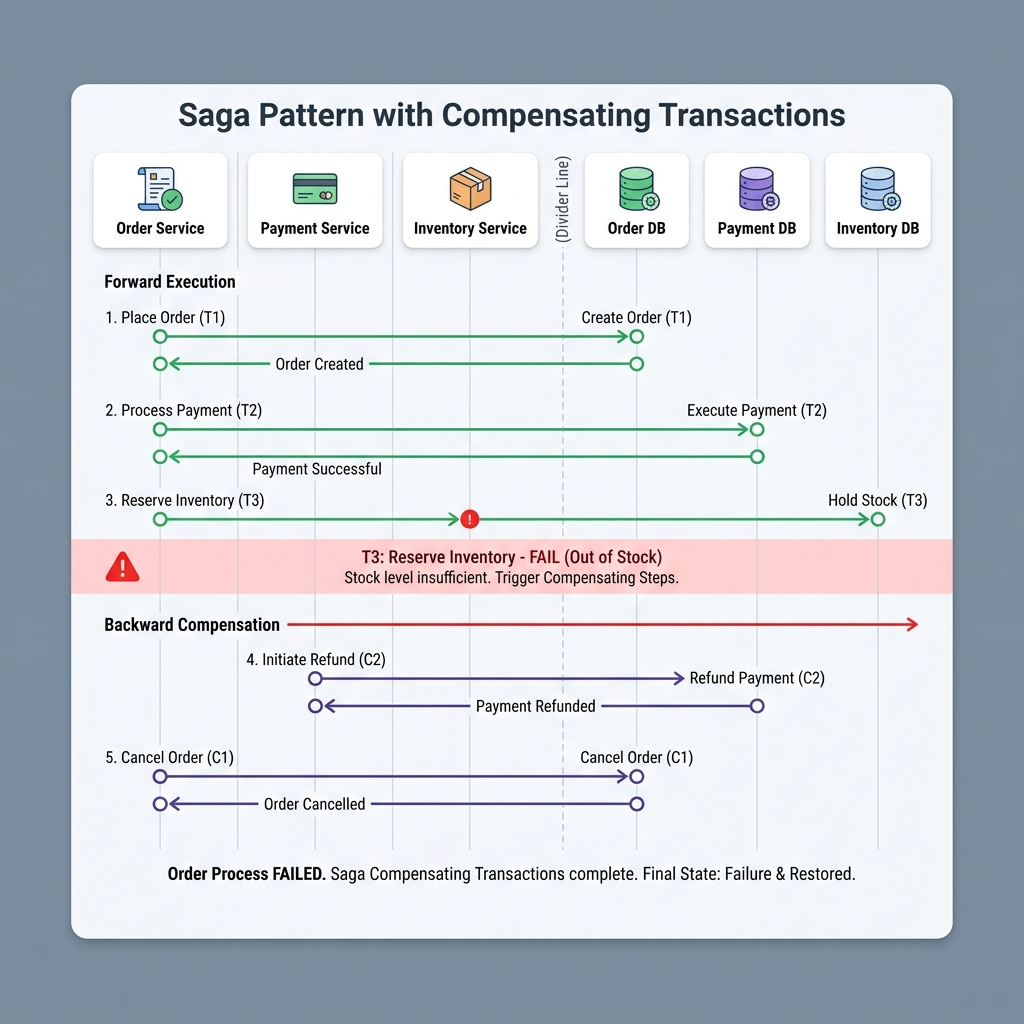
Production Sequence Flow: Compensating Transactions
Below is the complete sequence flow diagram illustrating a forward execution failure and the resulting backward compensation execution:
Hands-On Code Implementations
Let’s explore production-ready implementation examples for both Choreography (in Go) and Orchestration (in Java Spring Boot).
Implementation 1: Choreography-Based Saga in Go
In this Go example, we demonstrate an Order Service handling order creation and listening for payment failure events over an event broker to execute compensating rollback logic.
package saga

import (
	"context"
	"encoding/json"
	"fmt"
	"log"
	"time"
)

// Event definitions
type OrderCreatedEvent struct {
	OrderID   string  `json:"order_id"`
	CustomerID string `json:"customer_id"`
	Amount    float64 `json:"amount"`
}

type PaymentFailedEvent struct {
	OrderID string `json:"order_id"`
	Reason  string `json:"reason"`
}

// OrderRepository handles local DB operations
type OrderRepository interface {
	CreateOrder(ctx context.Context, orderID string, amount float64) error
	UpdateOrderStatus(ctx context.Context, orderID string, status string) error
}

// EventBus abstraction for message broker (e.g., Kafka / NATS)
type EventBus interface {
	Publish(topic string, payload []byte) error
	Subscribe(topic string, handler func(payload []byte)) error
}

type OrderSagaChoreographer struct {
	repo     OrderRepository
	eventBus EventBus
}

func NewOrderSagaChoreographer(repo OrderRepository, bus EventBus) *OrderSagaChoreographer {
	c := &OrderSagaChoreographer{repo: repo, eventBus: bus}
	c.registerSubscriptions()
	return c
}

// Step 1: Forward Transaction (T1)
func (s *OrderSagaChoreographer) StartOrderSaga(ctx context.Context, orderID, customerID string, amount float64) error {
	// Execute local database transaction
	err := s.repo.CreateOrder(ctx, orderID, amount)
	if err != nil {
		return fmt.Errorf("failed local DB transaction T1: %w", err)
	}

	// Emit domain event for downstream Payment Service
	event := OrderCreatedEvent{OrderID: orderID, CustomerID: customerID, Amount: amount}
	bytes, _ := json.Marshal(event)

	log.Printf("[SAGA][T1] Order %s created. Publishing OrderCreatedEvent...", orderID)
	return s.eventBus.Publish("orders.created", bytes)
}

// Register subscription for compensating events
func (s *OrderSagaChoreographer) registerSubscriptions() {
	_ = s.eventBus.Subscribe("payments.failed", func(payload []byte) {
		var event PaymentFailedEvent
		if err := json.Unmarshal(payload, &event); err != nil {
			log.Printf("[ERROR] Corrupt payment event: %v", err)
			return
		}

		// Execute Compensating Transaction (C1)
		s.handlePaymentFailed(context.Background(), event)
	})
}

// Step C1: Compensating Transaction
func (s *OrderSagaChoreographer) handlePaymentFailed(ctx context.Context, event PaymentFailedEvent) {
	log.Printf("[SAGA][C1] Payment failed for Order %s (Reason: %s). Rolling back local order...", event.OrderID, event.Reason)

	// Revert order status to CANCELLED in local DB
	err := s.repo.UpdateOrderStatus(ctx, event.OrderID, "CANCELLED_PAYMENT_FAILED")
	if err != nil {
		log.Printf("[CRITICAL] Failed to execute compensating transaction C1 for Order %s: %v", event.OrderID, err)
		// Trigger alert or write to Dead Letter Queue (DLQ)
		return
	}

	log.Printf("[SAGA][SUCCESS] Order %s successfully compensated and cancelled.", event.OrderID)
}
Implementation 2: Orchestration-Based Saga in Java (Spring Boot)
In this Java example, we build a Saga Orchestrator using a state machine pattern to coordinate forward commands and execute compensating rollbacks when a downstream step fails.
package com.ghaznix.saga.orchestrator;

import org.slf4j.Logger;
import org.slf4j.LoggerFactory;
import org.springframework.stereotype.Service;

import java.util.UUID;

public enum SagaState {
    STARTED,
    ORDER_CREATED,
    PAYMENT_PROCESSED,
    INVENTORY_RESERVED,
    COMPLETED,
    COMPENSATING_PAYMENT,
    COMPENSATING_ORDER,
    FAILED
}

@Service
public class OrderSagaOrchestrator {

    private static final Logger log = LoggerFactory.getLogger(OrderSagaOrchestrator.class);

    private final OrderServiceClient orderClient;
    private final PaymentServiceClient paymentClient;
    private final InventoryServiceClient inventoryClient;

    public OrderSagaOrchestrator(OrderServiceClient orderClient,
                                PaymentServiceClient paymentClient,
                                InventoryServiceClient inventoryClient) {
        this.orderClient = orderClient;
        this.paymentClient = paymentClient;
        this.inventoryClient = inventoryClient;
    }

    public boolean executeOrderSaga(String customerId, String productId, double amount, int quantity) {
        String sagaId = UUID.randomUUID().toString();
        log.info("[SAGA {}] Starting Order Saga Workflow...", sagaId);

        SagaState currentState = SagaState.STARTED;
        String orderId = null;
        String paymentId = null;

        try {
            // Step 1: Forward Local Tx T1 - Create Order
            log.info("[SAGA {}][T1] Sending CreateOrder command...", sagaId);
            orderId = orderClient.createOrder(customerId, productId, amount);
            currentState = SagaState.ORDER_CREATED;

            // Step 2: Forward Local Tx T2 - Process Payment
            log.info("[SAGA {}][T2] Sending ProcessPayment command for Order {}...", sagaId, orderId);
            paymentId = paymentClient.chargePayment(orderId, customerId, amount);
            currentState = SagaState.PAYMENT_PROCESSED;

            // Step 3: Forward Local Tx T3 (Pivot Step) - Reserve Inventory
            log.info("[SAGA {}][T3] Sending ReserveInventory command for Product {}...", sagaId, productId);
            boolean stockReserved = inventoryClient.reserveStock(productId, quantity);

            if (!stockReserved) {
                throw new InventoryAllocationException("Stock allocation failed: Item out of stock.");
            }

            currentState = SagaState.INVENTORY_RESERVED;
            log.info("[SAGA {}][SUCCESS] Saga completed successfully!", sagaId);
            return true;

        } catch (Exception ex) {
            log.error("[SAGA {}][FAILURE] Step failed during state {}. Triggering Compensation...", sagaId, currentState, ex);
            rollbackSaga(sagaId, currentState, orderId, paymentId);
            return false;
        }
    }

    private void rollbackSaga(String sagaId, SagaState failedState, String orderId, String paymentId) {
        log.info("[SAGA {}] Initiating backward compensating transactions from state: {}", sagaId, failedState);

        // Compensate Step 2 if payment was processed
        if (failedState == SagaState.PAYMENT_PROCESSED || failedState == SagaState.INVENTORY_RESERVED) {
            try {
                log.info("[SAGA {}][C2] Executing Payment Refund compensation for Payment {}...", sagaId, paymentId);
                paymentClient.refundPayment(paymentId);
            } catch (Exception e) {
                log.error("[CRITICAL][SAGA {}] Payment refund C2 failed! Manual intervention or DLQ required.", sagaId, e);
            }
        }

        // Compensate Step 1 if order was created
        if (failedState != SagaState.STARTED && orderId != null) {
            try {
                log.info("[SAGA {}][C1] Executing Order Cancel compensation for Order {}...", sagaId, orderId);
                orderClient.cancelOrder(orderId);
            } catch (Exception e) {
                log.error("[CRITICAL][SAGA {}] Order cancellation C1 failed!", sagaId, e);
            }
        }

        log.info("[SAGA {}] Saga compensation workflow finished. Final State: FAILED.", sagaId);
    }
}
Production Essentials: Pairing Saga with the Transactional Outbox Pattern
In both Choreography and Orchestration, executing a local transaction ($T_i$) requires publishing a domain event or command over the network.
If your service updates its SQL database and then publishes a message to Kafka, a network glitch after the database commit causes silent event loss. Conversely, publishing the message before the database commit leads to phantom event processing.
To solve this, Sagas must be paired with the Transactional Outbox Pattern:
[Service Database Transaction Boundary]
+-----------------------------------------------------+
| 1. INSERT INTO business_table (orders/payments)    |
| 2. INSERT INTO outbox_table (event_payload)        |
+-----------------------------------------------------+
                          |
             (CDC / Polling Message Relay)
                          |
                          v
               [Message Broker / Kafka]
By persisting the event payload into an outbox table inside the same local database transaction, atomicity is guaranteed. An asynchronous background process (like Debezium or a polling relay) reads from the outbox table and publishes events to Kafka reliably.
Furthermore, every downstream service consumer must implement Idempotency (using unique idempotency_key or message deduplication headers) so that duplicate message deliveries during retries do not trigger duplicate charges or inventory allocations.
Architectural Decision Checklist
Use this practical decision matrix when designing distributed transactions for microservice applications:
                  Do you need cross-service data consistency?
                                     |
                    +----------------+----------------+
                    | No                              | Yes
                    v                                 v
         Standard Single Service            Can you accept Eventual
            Local Database                    Consistency (BASE)?
                                                      |
                                     +----------------+----------------+
                                     | No                              | Yes
                                     v                                 v
                          Use Monolithic Core            Adopt Saga Pattern
                          with Single ACID DB                 |
                                                              |
                                             How complex is the workflow?
                                                              |
                                            +-----------------+-----------------+
                                            | Simple (2-3 steps)                | Complex (4+ steps/branches)
                                            v                                   v
                                   Choreography Saga                   Orchestration Saga
                                   (Event-Driven Bus)                  (Temporal/Custom State Machine)
Conclusion & Key Takeaways
The Saga Pattern is an essential architectural pattern for managing distributed transactions across microservice boundaries without locking resources or sacrificing system availability.
Summary Checklist:
- Abandon 2PC/XA in Cloud-Native Microservices: Two-Phase Commit causes tight locking, high latency, and severe availability bottlenecks.
- Break Transactions into Local Steps: Divide global operations into local transactions ($T_1 \dots T_n$) paired with reversing compensating transactions ($C_1 \dots C_{n-1}$).
- Choose the Right Architectural Style:
- Use Choreography for simple, 2–3 step event-driven flows with loose coupling.
- Use Orchestration for complex business workflows requiring centralized visibility, branching, and state machine tracking.
- Implement Isolation Countermeasures: Protect against dirty reads and lost updates by using Semantic Locks (
PENDINGflags) and Re-Read Optimistic Locking. - Guarantee Reliable Messaging: Always pair Saga implementations with the Transactional Outbox Pattern and enforce Idempotent Consumers to handle retries safely.
By implementing the Saga pattern thoughtfully, you can build highly available, scalable microservices that remain resilient and consistent even when networks fail.
Tags
Empower Your Digital Presence & Workflows
Explore top-tier tools built by Ghaznix to streamline your links, surveys, and brand growth.