The Transactional Outbox Pattern: Reliable Event Publishing in Microservices
In modern distributed software engineering, Event-Driven Architecture (EDA) has become the backbone of scalable microservice systems. Services regularly emit domain events—such as OrderCreated, PaymentProcessed, or UserRegistered—to communicate state changes across service boundaries without tight coupling.
However, implementing reliable event publishing in a microservices environment introduces a subtle yet catastrophic engineering problem: How do you guarantee that a database update and its corresponding event publication both succeed or both fail together?
If your microservice updates its local relational database (like PostgreSQL or MySQL) and then attempts to publish an event over the network to a message broker (like Apache Kafka or RabbitMQ), a network partition, DB crash, or broker timeout can corrupt your system’s data integrity.
To solve this fundamentally, software architects rely on the Transactional Outbox Pattern.
In this comprehensive guide, we will break down the Dual-Write Problem, dive deep into the mechanics of the Transactional Outbox Pattern, compare Polling Publishers vs. Change Data Capture (Debezium), explore production code examples in Java (Spring Boot) and Go, and detail how to ensure consumer idempotency.
The Root Problem: The Dual-Write Vulnerability
To appreciate why the Transactional Outbox Pattern is essential, let’s analyze what happens when a service attempts naive “dual writes.”
Consider an e-commerce platform where an Order Microservice processes a customer checkout. During checkout, the service must perform two actions:
- Write Business Data: Insert a new record into the local
orderstable. - Publish Domain Event: Publish an
OrderCreatedEventto Apache Kafka so that downstream services (Inventory, Shipping, Notifications) can process the order.
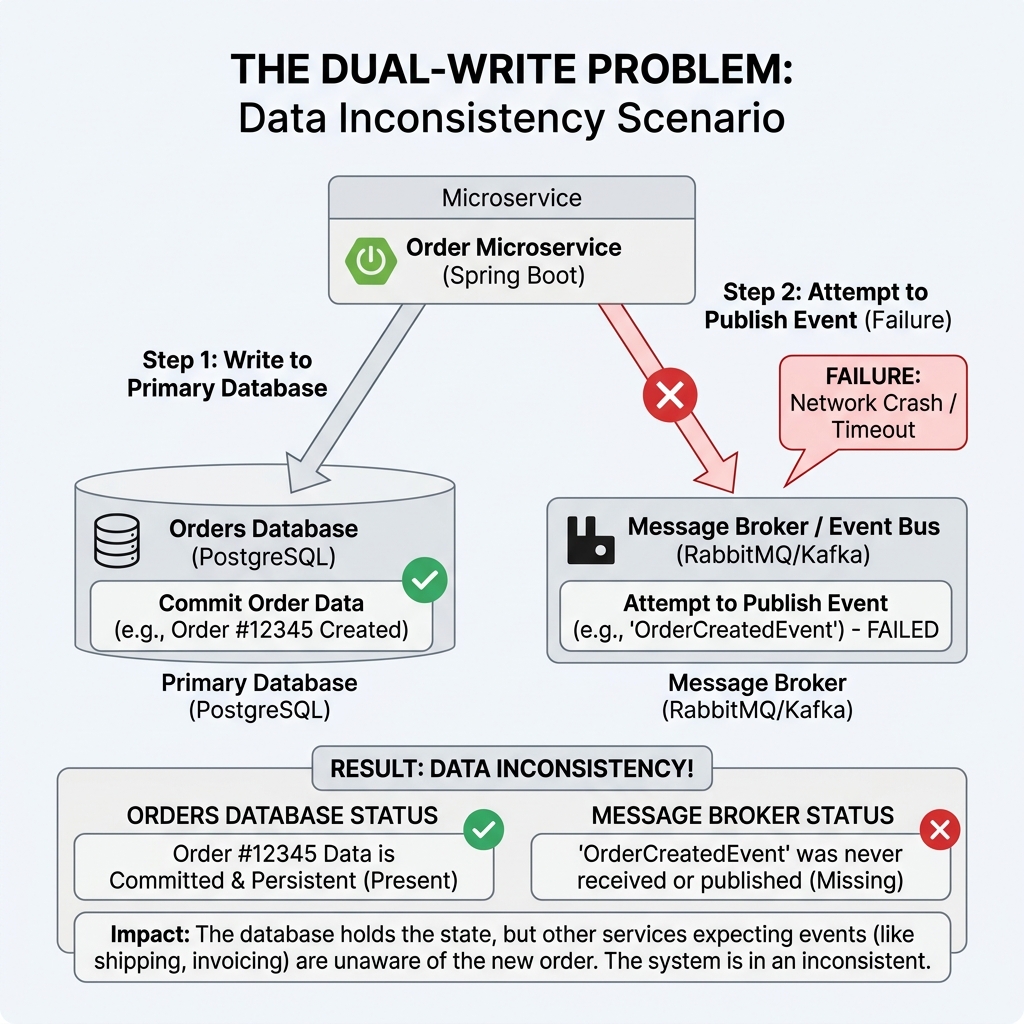
Scenario A: DB Commit Succeeds, Event Publishing Fails
@Transactional
public void createOrder(OrderRequest request) {
    // Step 1: Save entity to PostgreSQL (Local ACID Transaction)
    Order order = orderRepository.save(new Order(request));

    // Step 2: Publish event to Kafka (Network I/O)
    kafkaTemplate.send("order-events", new OrderCreatedEvent(order.getId()));
}
If the database commit completes successfully, but a transient network glitch causes kafkaTemplate.send() to fail or time out, the order is saved in the database, but downstream services are never notified. The customer’s credit card may be charged, but the Warehouse Service never ships the item. Result: Silent data inconsistency.
Scenario B: Event Publishing Succeeds, DB Commit Fails
What if you publish the Kafka event before committing the database transaction?
public void createOrder(OrderRequest request) {
    // Step 1: Publish event to Kafka
    kafkaTemplate.send("order-events", new OrderCreatedEvent(request.getOrderId()));

    // Step 2: Commit to Database
    orderRepository.save(new Order(request)); // Throws ConstraintViolationException!
}
If the database write fails due to a unique constraint violation or connection pool exhaustion, the Kafka message has already been broadcast. Downstream services receive OrderCreatedEvent, attempt to process Order #12345, and fail because Order #12345 does not exist in the primary database. Result: Phantom event processing.
Why 2-Phase Commit (2PC) / XA Transactions Are Obsolete
Historically, distributed systems used Two-Phase Commit (2PC / XA) to coordinate transactions across database engines and message queues. However, 2PC is widely avoided in modern cloud-native microservices because:
- High Latency & Blocking Locks: Database rows and resources remain locked throughout the multi-stage network handshake.
- Availability Bottleneck: If any single participant or broker is temporarily offline, the entire transaction blocks indefinitely.
- Broker Support Limits: High-throughput distributed brokers like Apache Kafka do not support traditional XA 2PC transactions across external databases.
What is the Transactional Outbox Pattern?
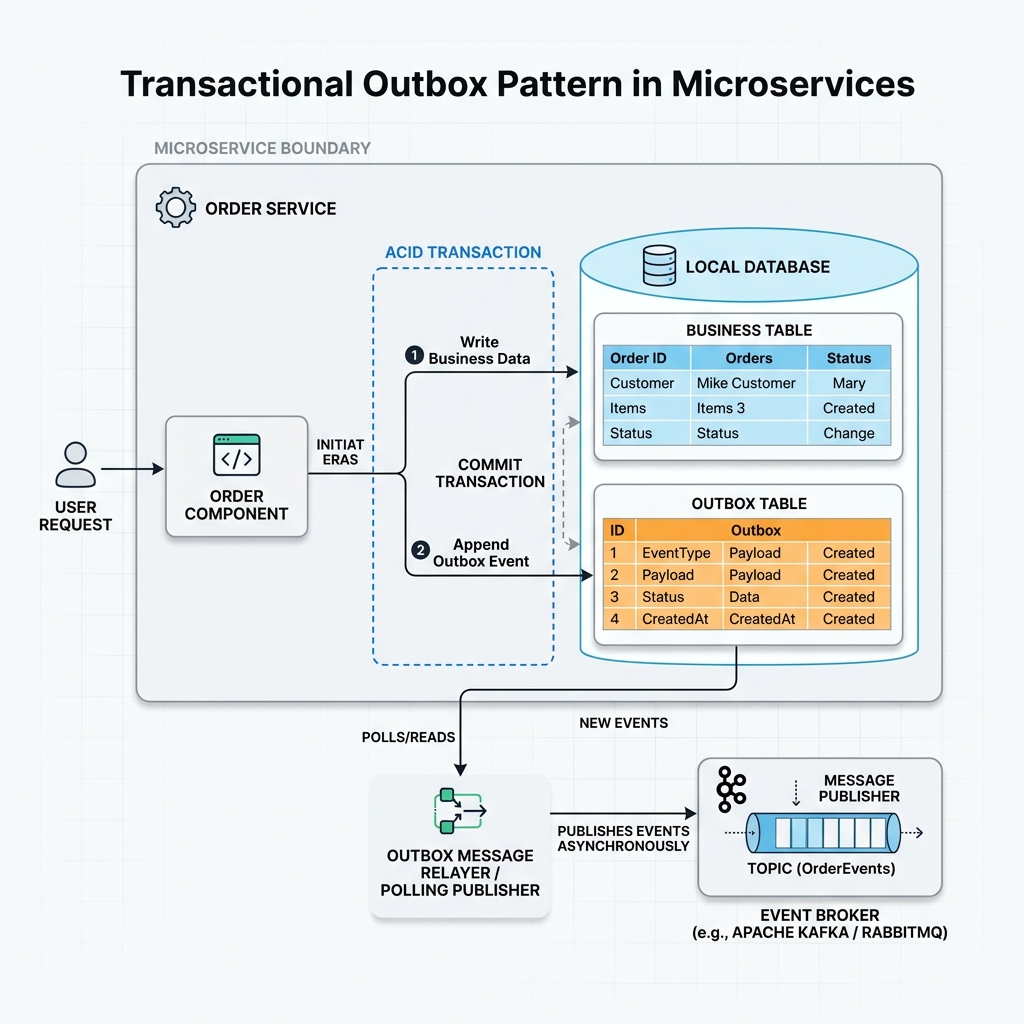
The Transactional Outbox Pattern solves the Dual-Write Problem by leveraging the one thing relational databases do exceptionally well: Local ACID Transactions.
Instead of attempting to publish a message directly over the network during the incoming HTTP/gRPC request, the service writes the event payload into a dedicated Outbox Table inside the same local database transaction that persists the business entity.
Because both the business entity update and the Outbox record insertion happen in the same SQL transaction boundary, relational database ACID guarantees enforce atomicity: either both writes commit permanently, or neither does.
Once committed, a separate, asynchronous background process (the Message Relay) reads records from the Outbox table and publishes them to the message broker.
Architecture & Workflow Breakdown
Here is how the end-to-end Transactional Outbox workflow executes:
- Client Request: The client sends an HTTP POST request to create an order.
- Local ACID Transaction:
- Insert new order record into the
orderstable. - Insert corresponding event payload into the
outboxtable. - Commit the local database transaction.
- Insert new order record into the
- Asynchronous Message Relay:
- A background process detects the new outbox entry.
- Reads the event payload and publishes it to the event broker (Kafka / RabbitMQ).
- Mark / Delete Outbox Record: Upon receiving acknowledgment from the broker, the Message Relay marks the outbox record as
PROCESSEDor deletes it. - Downstream Event Processing: Subscribing microservices consume the event from the broker idempotently.
Outbox Table Data Schema
A well-designed Outbox table must contain sufficient metadata for routing, tracing, payload deserialization, and idempotency tracking.
PostgreSQL DDL Schema Example:
CREATE TABLE outbox_events (
    id UUID PRIMARY KEY DEFAULT gen_random_uuid(),
    aggregate_type VARCHAR(255) NOT NULL,    -- e.g., 'ORDER', 'USER', 'PAYMENT'
    aggregate_id VARCHAR(255) NOT NULL,      -- e.g., 'ORD-88391'
    event_type VARCHAR(255) NOT NULL,        -- e.g., 'OrderCreated', 'OrderCancelled'
    payload JSONB NOT NULL,                  -- Full event JSON data
    created_at TIMESTAMP WITH TIME ZONE NOT NULL DEFAULT CURRENT_TIMESTAMP,
    processed BOOLEAN NOT NULL DEFAULT FALSE,
    processed_at TIMESTAMP WITH TIME ZONE
);

-- Index for polling publishers to quickly locate unprocessed records
CREATE INDEX idx_outbox_unprocessed
ON outbox_events (created_at)
WHERE processed = FALSE;
Message Relay Strategies: Polling Publisher vs. CDC (Debezium)
Once outbox records are safely committed to the database, how do we relay them to the message broker? There are two primary strategies:
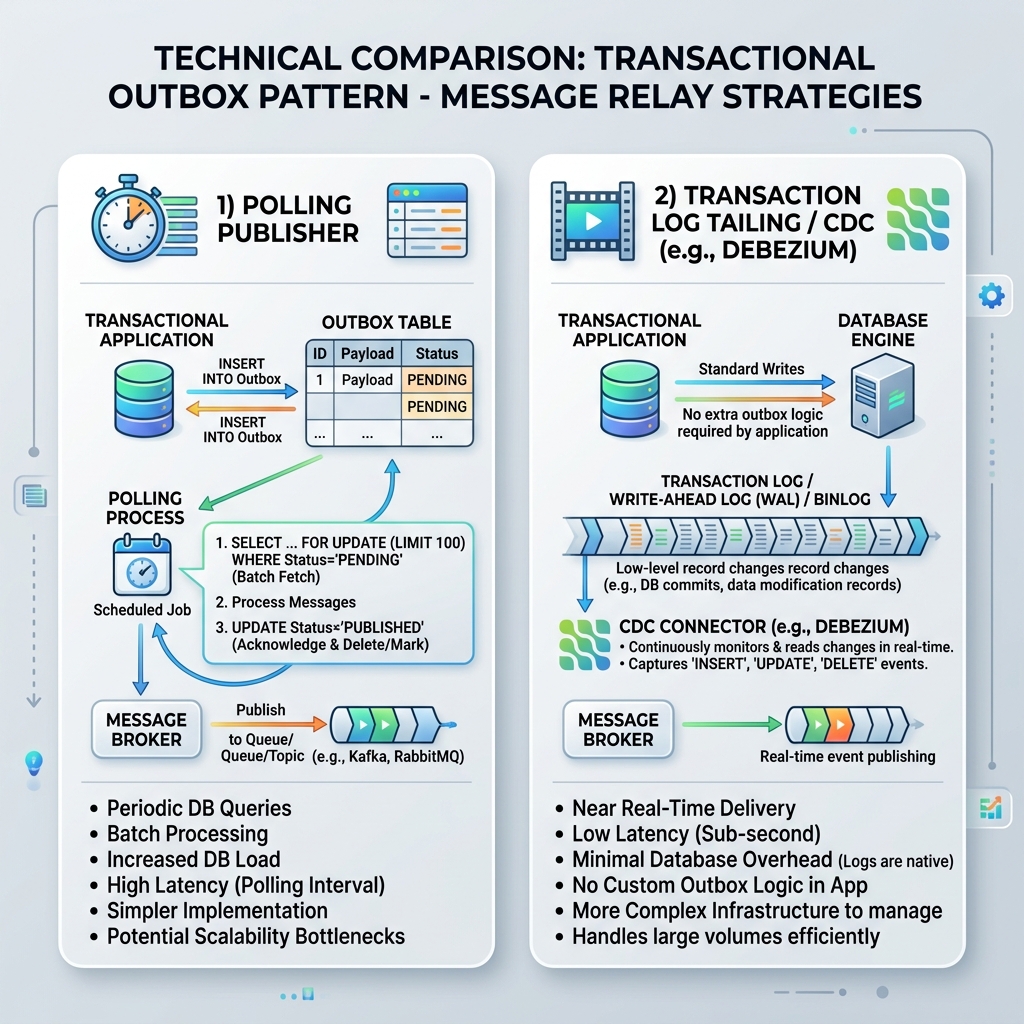
Strategy 1: The Polling Publisher (Scheduled Worker)
The Polling Publisher uses a background worker (e.g., a scheduled @Scheduled job in Spring Boot, or a Go goroutine ticker) that periodically queries the Outbox table for unprocessed records.
-- Fetch unprocessed events using row locking to prevent concurrent worker collisions
SELECT * FROM outbox_events
WHERE processed = FALSE
ORDER BY created_at ASC
LIMIT 100
FOR UPDATE SKIP LOCKED;
Pros:
- Simple Implementation: No extra infrastructure; resides within your application codebase.
- Database Agnostic: Works on any SQL database (PostgreSQL, MySQL, Oracle, SQL Server).
Cons:
- Polling Latency: Events are delayed by the polling interval (e.g., every 1–5 seconds).
- Database Overhead: Frequent
SELECTandUPDATEqueries increase CPU and IOPS utilization on primary DB instances. - Table Bloat: Unprocessed/processed records require ongoing pruning or partitioning.
Strategy 2: Transaction Log Tailing / Change Data Capture (CDC with Debezium)
Rather than polling the database with SQL queries, Change Data Capture (CDC) tools like Debezium tail the low-level database transaction logs (such as PostgreSQL’s Write-Ahead Log (WAL) or MySQL’s binlog).
When a new row is inserted into outbox_events, Debezium instantly captures the transaction log event directly from the database engine and streams it into Apache Kafka.
Pros:
- Near Zero Latency: Sub-second event publishing immediately upon DB commit.
- Zero Application Overhead: No polling SQL queries hitting active database tables.
- High Throughput: Capable of processing tens of thousands of events per second smoothly.
Cons:
- Infrastructure Complexity: Requires running Kafka Connect, Debezium connectors, and enabling DB transaction logging.
- Schema & Database Permissions: Requires elevated database privileges (e.g.,
REPLICATIONrole in PostgreSQL).
Complete Code Implementation
Let’s look at real-world production code implementations for the Transactional Outbox pattern.
1. Spring Boot (Java 17+ / JPA) Implementation
Step A: Domain Service writing entity & outbox event atomically
@Service
@RequiredArgsConstructor
public class OrderService {

    private final OrderRepository orderRepository;
    private final OutboxRepository outboxRepository;
    private final ObjectMapper objectMapper;

    @Transactional
    public OrderResponse createOrder(CreateOrderCommand command) {
        // 1. Save primary business entity
        Order order = new Order(command.getCustomerId(), command.getTotalAmount());
        Order savedOrder = orderRepository.save(order);

        // 2. Construct outbox event payload
        OrderCreatedEvent event = new OrderCreatedEvent(
            savedOrder.getId(),
            savedOrder.getCustomerId(),
            savedOrder.getTotalAmount(),
            Instant.now()
        );

        // 3. Persist outbox event in the same ACID transaction
        try {
            OutboxEvent outboxEntry = OutboxEvent.builder()
                .aggregateType("ORDER")
                .aggregateId(savedOrder.getId().toString())
                .eventType("OrderCreated")
                .payload(objectMapper.writeValueAsString(event))
                .createdAt(Instant.now())
                .processed(false)
                .build();

            outboxRepository.save(outboxEntry);
        } catch (JsonProcessingException e) {
            throw new IllegalStateException("Failed to serialize order event payload", e);
        }

        return new OrderResponse(savedOrder.getId(), "ORDER_CREATED");
    }
}
Step B: Polling Publisher Worker (Spring Scheduled Task)
@Component
@RequiredArgsConstructor
@Slf4j
public class OutboxPublisherScheduler {

    private final OutboxRepository outboxRepository;
    private final KafkaTemplate<String, String> kafkaTemplate;

    @Scheduled(fixedDelay = 2000) // Runs every 2 seconds
    @Transactional
    public void publishPendingEvents() {
        List<OutboxEvent> pendingEvents = outboxRepository.findTop100ByProcessedFalseOrderByCreatedAtAsc();

        for (OutboxEvent event : pendingEvents) {
            try {
                // Publish to Kafka topic named after aggregateType or eventType
                String topic = "events." + event.getAggregateType().toLowerCase();

                kafkaTemplate.send(topic, event.getAggregateId(), event.getPayload())
                    .get(5, TimeUnit.SECONDS); // Wait for broker ACK

                // Mark event as processed or delete
                event.setProcessed(true);
                event.setProcessedAt(Instant.now());
                outboxRepository.save(event);

            } catch (Exception e) {
                log.error("Failed to publish outbox event ID: {}", event.getId(), e);
                // Retried on next scheduled iteration
            }
        }
    }
}
2. Go (Golang + GORM) Outbox Implementation
package service

import (
	"context"
	"encoding/json"
	"time"

	"github.com/google/uuid"
	"gorm.io/gorm"
)

type OutboxEvent struct {
	ID            string    `gorm:"primaryKey;type:uuid"`
	AggregateType string    `gorm:"not null"`
	AggregateID   string    `gorm:"not null"`
	EventType     string    `gorm:"not null"`
	Payload       string    `gorm:"type:jsonb;not null"`
	CreatedAt     time.Time `gorm:"not null"`
	Processed     bool      `gorm:"default:false"`
}

type Order struct {
	ID         string    `gorm:"primaryKey"`
	CustomerID string    `gorm:"not null"`
	Amount     float64   `gorm:"not null"`
	CreatedAt  time.Time `gorm:"not null"`
}

type OrderService struct {
	db *gorm.DB
}

func (s *OrderService) CreateOrder(ctx context.Context, customerID string, amount float64) (*Order, error) {
	orderID := uuid.New().String()
	order := &Order{
		ID:         orderID,
		CustomerID: customerID,
		Amount:     amount,
		CreatedAt:  time.Now(),
	}

	payloadMap := map[string]interface{}{
		"order_id":    orderID,
		"customer_id": customerID,
		"amount":      amount,
		"created_at":  order.CreatedAt,
	}
	payloadBytes, _ := json.Marshal(payloadMap)

	outbox := &OutboxEvent{
		ID:            uuid.New().String(),
		AggregateType: "ORDER",
		AggregateID:   orderID,
		EventType:     "OrderCreated",
		Payload:       string(payloadBytes),
		CreatedAt:     time.Now(),
		Processed:     false,
	}

	// Atomic Database Transaction
	err := s.db.Transaction(func(tx *gorm.DB) error {
		if err := tx.Create(order).Error; err != nil {
			return err
		}
		if err := tx.Create(outbox).Error; err != nil {
			return err
		}
		return nil
	})

	if err != nil {
		return nil, err
	}

	return order, nil
}
Consumer Idempotency: Handling At-Least-Once Delivery
A critical guarantee of the Transactional Outbox Pattern is At-Least-Once Delivery. Because network acknowledgments between the relay worker and message broker can fail after a message is successfully delivered, consumers will eventually receive duplicate messages.
To prevent duplicate side-effects (e.g., charging a credit card twice or shipping two packages), downstream consumer services MUST be idempotent.
Idempotent Consumer Pattern (Unique Event Tracking)
Downstream consumers should maintain a processed_events table with a unique constraint on event_id.
CREATE TABLE processed_events (
    event_id UUID PRIMARY KEY,
    consumer_name VARCHAR(255) NOT NULL,
    processed_at TIMESTAMP WITH TIME ZONE DEFAULT CURRENT_TIMESTAMP
);
Downstream Consumer Implementation (Java Example):
@KafkaListener(topics = "events.order", groupId = "shipping-service-group")
@Transactional
public void consumeOrderCreatedEvent(ConsumerRecord<String, String> record) {
    OrderCreatedEvent event = objectMapper.readValue(record.value(), OrderCreatedEvent.class);

    // Check if event was already processed
    boolean alreadyProcessed = processedEventRepository.existsByEventIdAndConsumerName(
        event.getEventId(), "shipping-service"
    );

    if (alreadyProcessed) {
        log.info("Duplicate event skipped: {}", event.getEventId());
        return; // Idempotent skip
    }

    // Execute business logic (e.g., schedule shipping package)
    shippingService.createShipment(event.getOrderId());

    // Record processed event ID atomically
    processedEventRepository.save(new ProcessedEvent(event.getEventId(), "shipping-service"));
}
Production Best Practices Checklist
- Delete or Partition Processed Events:
High-traffic microservices generating millions of outbox rows will quickly bloat table indexes. Implement a cleanup job that hard-deletes processed rows older than 24 hours (
DELETE FROM outbox_events WHERE processed = TRUE AND processed_at < NOW() - INTERVAL '24 HOURS'), or use PostgreSQL table partitioning. - Use
SKIP LOCKEDfor Polling Workers: If running multiple instances of your application relay worker, always useFOR UPDATE SKIP LOCKEDin SQL queries to prevent workers from contending for the same database row locks. - Preserve Message Ordering:
Ensure events targeting the same aggregate (e.g.,
Order #12345events) useaggregate_idas the Kafka Partition Key. This guarantees that all events for a given entity are appended to the exact same Kafka partition and processed in strict sequential order. - Monitor Outbox Lag:
Set up Prometheus / Datadog alerts for outbox lag:
SELECT COUNT(*) FROM outbox_events WHERE processed = FALSE. A rising count indicates message relay worker failures or broker connection issues.
Summary
The Transactional Outbox Pattern is an essential design pattern in cloud-native microservices architecture. By wrapping entity updates and event publishing into a single local database transaction, it eliminates the Dual-Write Problem and guarantees eventual consistency across distributed systems.
| Feature / Pattern | Dual Writes | 2-Phase Commit (2PC) | Transactional Outbox |
|---|---|---|---|
| Consistency | Risk of Data Loss / Inconsistency | Strong Consistency | Eventual Consistency |
| Performance | High | Low (Blocking Locks) | High |
| Availability | Fragile | Low | High |
| Broker Support | Any | Very Limited | Any (Kafka, RabbitMQ, SQS) |
| Delivery Guarantee | None | Exactly-Once | At-Least-Once (Requires Idempotent Consumer) |
By combining the Transactional Outbox Pattern with Debezium CDC and Idempotent Consumers, you can build highly resilient, fault-tolerant microservices that handle high throughput without compromising data integrity.
Tags
Empower Your Digital Presence & Workflows
Explore top-tier tools built by Ghaznix to streamline your links, surveys, and brand growth.