How Computer Vision Works: From Pixels to Real-World Intelligence
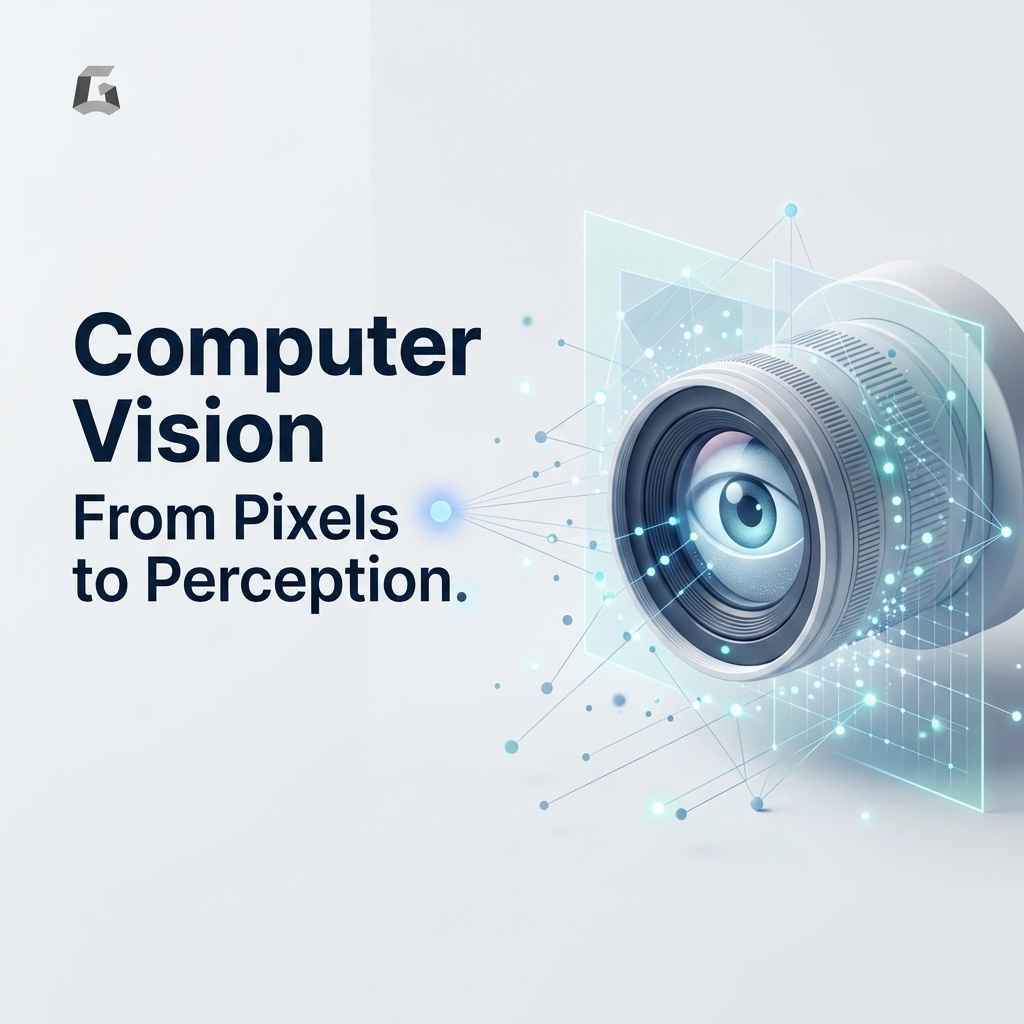
In the digital era of 2026, Computer Vision (CV) has become one of the most transformative branches of Artificial Intelligence. It is the science that allows computers to “see” and interpret the visual world just as humans do—if not better. From the facial recognition on your smartphone to the autonomous drones delivering packages, CV is everywhere.
But how does a machine actually translate a grid of numbers into a recognized object?
1. The Foundation: What is a Digital Image?
To a computer, an image is not a picture; it is a massive grid of numbers called pixels. Each pixel represents a color value. In a standard RGB image, every point is defined by three numbers (Red, Green, Blue).
Computer Vision is the process of using complex algorithms to find patterns in these numbers.
2. The Computer Vision Pipeline
Before a machine can identify a cat or a stop sign, the data goes through several critical stages:
- Image Acquisition: Capturing visual data via cameras, LiDAR, or thermal sensors.
- Pre-processing: Cleaning the data—adjusting brightness, removing noise (denoising), or normalizing image sizes to ensure consistency across the dataset.
- Feature Extraction: Identifying the important parts. Algorithms look for edges (lines), corners, and textures that define a shape. In 2026, this is largely handled automatically by deep neural layers.
- Classification/Detection: The final step where the AI decides what it is looking at based on the extracted features.
3. The Magic of Convolutional Neural Networks (CNNs)
The real breakthrough in CV came with Deep Learning, specifically Convolutional Neural Networks (CNNs).
CNNs mimic the human visual cortex. They scan an image through multiple layers using a process called convolution, where a small filter moves across the pixels to extract spatial features.
- Lower Layers: Detect simple patterns like horizontal or vertical lines.
- Middle Layers: Combine lines into shapes like circles or rectangles.
- Higher Layers: Recognize complex structures like eyes, wheels, or leaves.
By the time the data reaches the final layer, the network can distinguish between thousands of different categories with incredible accuracy.
4. Detection vs. Segmentation: Knowing Where and What
Modern Computer Vision doesn’t just name an object; it maps it.
- Object Detection: Draws a “bounding box” around an object (e.g., “There is a car at these coordinates”).
- Semantic Segmentation: Labels every single pixel in the image (e.g., “These 5,000 pixels are part of the road, and these 200 pixels are part of a pedestrian”).
- Instance Segmentation: Distinguishes between multiple objects of the same type (e.g., “This is Car A, and that is Car B”).
5. Computer Vision in the Real World (2026)
As of 2026, CV is no longer experimental; it is essential:
- Autonomous Mobility: Self-driving cars and delivery robots use CV and LiDAR fusion to detect pedestrians, lane markings, and obstacles in real-time, even in adverse weather conditions like heavy fog or snow.
- Precision Healthcare: AI-driven diagnostic tools analyze MRI, CT, and X-ray scans to detect anomalies—such as early-stage tumors or fractures—that are often invisible to the human eye.
- Retail & Automated Logistics: “Just Walk Out” technology uses CV to track items as they are picked up from shelves, automatically updating a digital cart and eliminating checkout lines entirely.
- Generative CV & Scene Reconstruction: Using technologies like NeRFs (Neural Radiance Fields), computers can now reconstruct 3D environments from a few 2D photos, creating perfect digital twins of real-world spaces.
6. Real-Time Processing & Edge AI
In 2026, speed is as important as accuracy. To power self-driving cars, vision models must run in milliseconds. This is achieved through Edge AI, where the heavy processing happens on specialized chips (like TPUs and NPUs) directly on the device, rather than sending data to a distant cloud server. This reduces latency and increases privacy.
7. The Challenges of Sight
Despite its power, CV still faces hurdles.
- Occlusion: When an object is partially hidden behind something else.
- Adversarial Attacks: Subtle, invisible changes to pixels that can trick an AI into thinking a “Stop” sign is a “Speed Limit” sign.
- Environmental Variability: Drastic changes in lighting or shadows can still confuse less robust models.
8. Conclusion: Beyond Recognition to Reasoning
Computer Vision is moving beyond simple recognition into visual reasoning—understanding the context and intent of what it sees. As we move further into 2026, the line between human perception and machine vision will continue to blur, making our world safer, faster, and more efficient.
Empower Your Digital Presence & Workflows
Explore top-tier tools built by Ghaznix to streamline your links, surveys, and brand growth.