How AI is Transforming Modern Cybersecurity

The modern threat landscape is evolving at a breakneck speed. In an era where cyberattacks occur every few seconds and corporate networks span multi-cloud environments, traditional signature-based defense systems are no longer sufficient. Firewalls and legacy antivirus programs are designed to stop known threats, but they are blind to novel “zero-day” exploits and highly targeted, AI-driven attacks.
To combat these challenges, organizations are turning to Artificial Intelligence (AI) and Machine Learning (ML). AI is not just a tool for optimization; it has become the foundation of modern cybersecurity, enabling security teams to automate threat detection, predict attacker behavior, and coordinate defense strategies at machine speed.
In this article, we explore the deep architectural transformations AI is bringing to digital defense, the algorithms driving these innovations, and the looming challenges of adversarial AI.
1. Shift from Reactive to Proactive Threat Detection
Traditional Security Operations Centers (SOCs) operate reactively. An analyst receives an alert, investigates the logs, and takes containment action. However, the sheer volume of security telemetry makes manual triage nearly impossible.
AI-driven systems process millions of security events per second across endpoints, networks, and cloud logs, transforming threat hunting from reactive cleanup to proactive defense.
[Network, Cloud, & Host Telemetry]
               │
               ▼
   [AI Anomaly Detection Engine] ──(Processes millions of events/sec)
               │
      ┌────────┴────────┐
      ▼                 ▼
[Normal Behavior]  [Suspicious Pattern]
  (Allowed)             │
                        ▼
             [Automated SOAR Action]
             - Isolate Endpoint
             - Revoke Active Tokens
             - Alert SOC Team
Through Security Information and Event Management (SIEM) and Security Orchestration, Automation, and Response (SOAR) platforms integrated with AI, organizations can automatically analyze telemetry, prioritize alerts based on risk scores, and execute playbook actions—such as isolating an infected host or resetting active session tokens—in milliseconds.
2. Advanced Anomaly Detection with Machine Learning
Traditional endpoint detection relies on matching file hashes against a database of known malware. If a hacker alters a single byte of a malicious file, the hash changes, and the signature-based detector is bypassed.
Modern AI security agents use machine learning models trained on millions of benign and malicious software files to analyze the behavioral characteristics of processes. By monitoring file system modifications, memory access patterns, and network socket connections, unsupervised learning models can flag malicious activities even if the program has never been seen before.
Here is a practical Python demonstration using the IsolationForest algorithm from scikit-learn to identify anomalous network activity (potential data exfiltration) from access logs.
import numpy as np
from sklearn.ensemble import IsolationForest

# Simulated features: [request_count_per_minute, data_transferred_mb, session_duration_seconds]
# Standard network user traffic logs
normal_traffic = np.array([
    [10, 0.5, 45], [12, 0.7, 50], [15, 1.2, 80], [8, 0.3, 30],
    [25, 2.5, 120], [14, 0.9, 60], [11, 0.6, 40], [18, 1.5, 95]
])

# Outlier data: a compromised endpoint exfiltrating data (huge transfer in few requests)
anomaly_traffic = np.array([
    [2, 850.0, 5],     # Massive data transfer, short duration
    [400, 12.0, 10],   # Extremely high request count
])

# Combine dataset for training
X = np.vstack([normal_traffic, anomaly_traffic])

# Initialize and train Isolation Forest
clf = IsolationForest(contamination=0.2, random_state=42)
clf.fit(X)

# Predict anomalies (-1 indicates anomaly, 1 indicates normal)
predictions = clf.predict(X)

for idx, pred in enumerate(predictions):
    status = "⚠️ ANOMALY DETECTED" if pred == -1 else "✅ Normal"
    print(f"Log {idx+1} {X[idx]}: {status}")
3. Signature-Based vs. AI Behavioral Threat Detection
To understand the core paradigm shift, we must look at how the execution models differ. Traditional engines verify what a file looks like (its static hash and structural definitions), while AI models verify what a file does (its runtime execution characteristics, system interactions, and behavioral footprints).
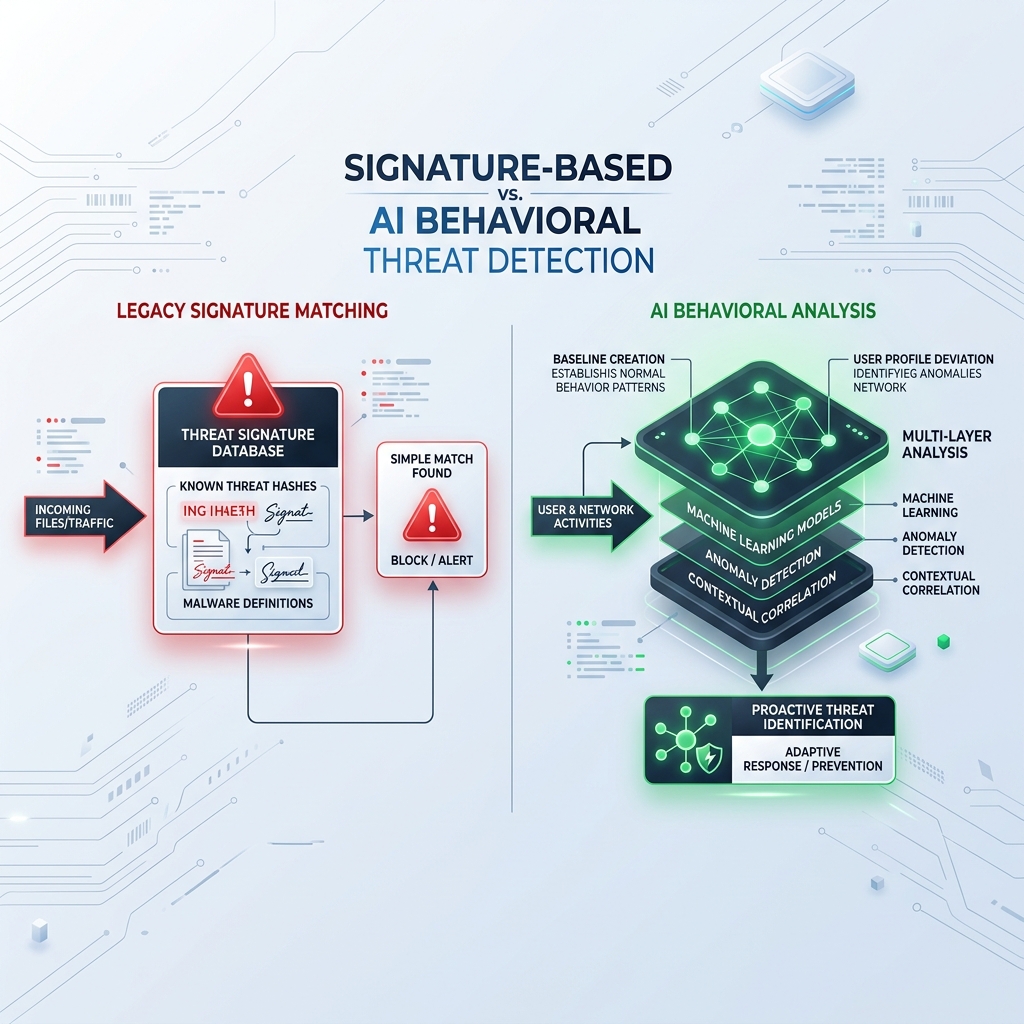
As illustrated above:
- Legacy Signature Matching: Evaluates incoming files using static lists. If no match is found in the threat signature database, it passes, leaving the system completely vulnerable to zero-day modifications.
- AI Behavioral Analysis: Aggregates continuous activities into multi-layer machine learning pipelines. The engine establishes a baseline of normal behavior and tracks deviations in real-time, executing adaptive preventions dynamically.
4. Zero-Trust Architecture: Continuous Adaptive Authentication
Traditional network architectures relied on a perimeter defense model: once an employee authenticated through a VPN or local login, they were trusted implicitly with access to internal resources. This “castle-and-moat” model fails completely if an attacker compromises a single set of credentials.
Modern Zero-Trust Architecture (ZTA) operates on the principle of “never trust, always verify”. AI acts as the central engine for Zero-Trust by providing Continuous Adaptive Trust (CAT).
Instead of a one-time login verification, neural network models dynamically evaluate a user’s risk score throughout their entire active session by monitoring contextual telemetry:
- Keystroke Dynamics: The subtle cadence and timing patterns of a user typing on their keyboard.
- Geographic Velocity: Detecting if a user logs in from New York and then accesses an API from Frankfurt 10 minutes later (impossible physical travel).
- Resource Access Patterns: Triggering step-up authentication if a developer who typically queries database A suddenly attempts to download a bulk dump of customer logs from database B.
If the dynamically computed risk score crosses a threshold, the system immediately downgrades authorization levels or requests an MFA prompt, securing the environment without degrading user experience for legitimate activities.
5. Large Language Models in Phishing and Identity Protection
Phishing remains the primary entry point for major corporate breaches. Historically, email filters searched for malicious attachments, blacklisted links, or poor spelling. Today’s attackers use sophisticated social engineering and LLM-assisted spear-phishing that mimics internal corporate correspondence perfectly.
To counter this, AI email protection platforms utilize Natural Language Processing (NLP) and Transformer models. Rather than scanning for static indicators of compromise, these models analyze:
- Semantic Intent: Detecting requests for sensitive financial actions, password resets, or urgent credential verification.
- Stylometric Profiling: Analyzing if the sender’s vocabulary, sentence structures, and tone match their historical email profile.
- Relationship Graphs: Evaluating communication frequency and trust scores between internal users and external domains.
If a message deviates from these context metrics, it is automatically flagged or quarantined, preventing high-impact Business Email Compromise (BEC) attacks.
6. The Defensive vs. Offensive AI Arms Race
As defenders implement AI, threat actors are weaponizing it. This has sparked an active “AI vs. AI” arms race on three major fronts:
- Adversarial Machine Learning: Attackers analyze defensive ML models to discover “blind spots.” By adding imperceptible noise or specific patterns to malware binaries, they can fool neural networks into classifying malicious software as harmless.
- Automated Vulnerability Discovery: Advanced offensive LLMs can scan open-source software and target architectures, find vulnerabilities, and automatically write functional exploit payloads within minutes.
- Deepfakes and Social Engineering: High-fidelity AI voice cloning and real-time video manipulation are used to conduct multi-channel social engineering, convincing employees to authorize unauthorized bank transfers or reveal master credentials.
To stay ahead, cybersecurity frameworks must employ continuous reinforcement learning, model hardening, and robust multi-factor authentication (MFA) that does not rely solely on human verification.
Conclusion
Artificial Intelligence is no longer an optional addition to the cybersecurity toolkit; it is the core engine of digital resilience. By moving from legacy reactive detection to autonomous, real-time response, AI allows organizations to stay ahead of sophisticated modern threat actors.
However, as offensive AI capabilities grow, security teams must treat AI implementation as a continuous cycle of reinforcement, validation, and training. The future of cybersecurity belongs to those who can build adaptive, autonomous defenses capable of outlearning the adversary.
Explore more software development and backend engineering insights on the Ghaznix Blog →
Tags
Empower Your Digital Presence & Workflows
Explore top-tier tools built by Ghaznix to streamline your links, surveys, and brand growth.