The Fallback Pattern: Designing Graceful Degradation in Microservices
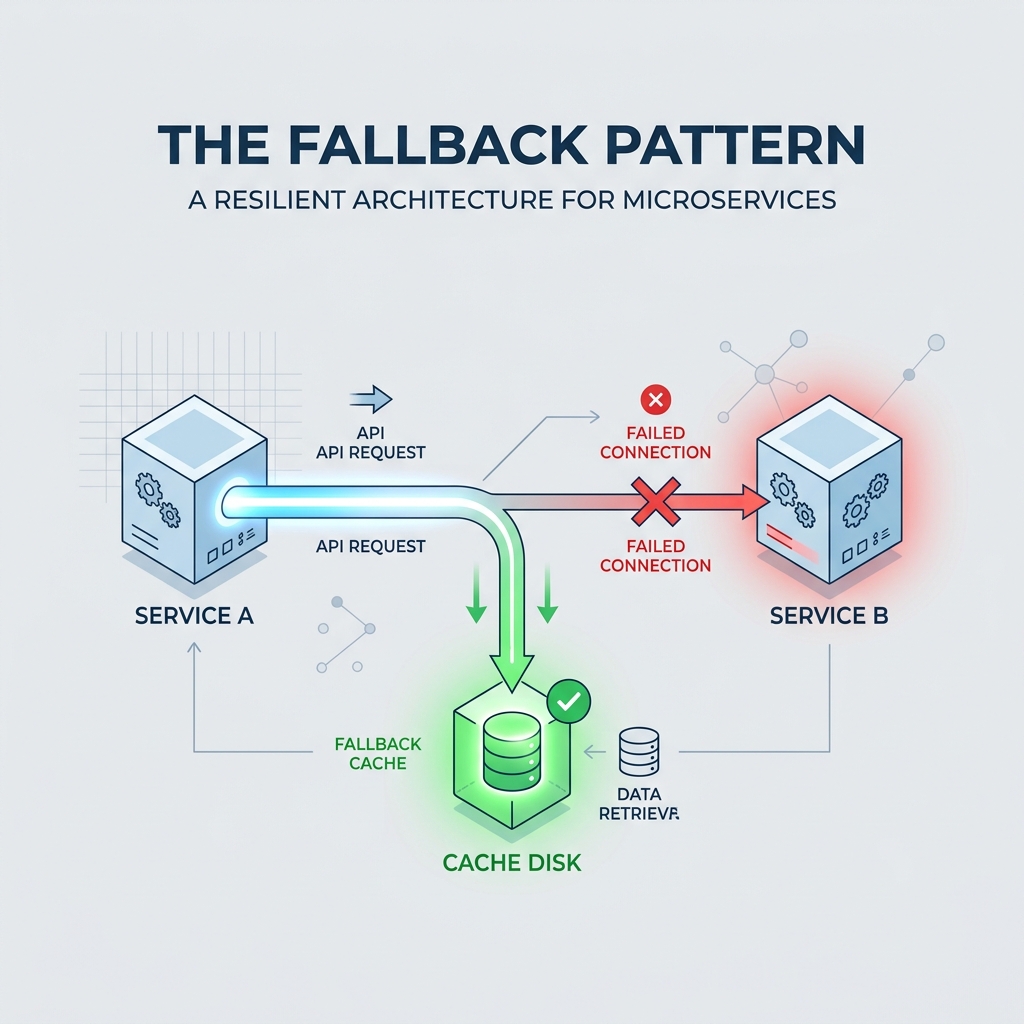
In a microservices architecture, services form a web of distributed network calls. While this allows teams to build and scale services independently, it also means that the overall reliability of your system is only as strong as its weakest link. If a critical service goes down or becomes unresponsive, it can trigger a cascading failure that disrupts the entire application.
Returning a generic “500 Internal Server Error” or a blank page to users the moment a single dependency fails is a poor user experience. Instead, resilient systems are built to degrade gracefully when things go wrong.
This is where the Fallback Pattern comes in. By defining a safe, alternative path of execution when a primary service call fails, you can keep your application functional—even in a degraded state.
In this guide, we will explore the Fallback pattern, common strategies for implementing it, how it interacts with other resilience patterns, and how to write fallback logic in Java (Resilience4j) and Go.
The Real-World Analogy: The Coffee Shop Backup Plan
Imagine you walk into a local coffee shop to buy a latte. The barista inputs your order, but when you go to tap your card, the payment terminal flashes a connection error—the shop’s internet provider is experiencing an outage.
Does the coffee shop immediately turn off the lights, lock the doors, and send all customers home?
Of course not. They implement a fallback strategy:
- If they have cash on hand, they ask if you can pay with cash.
- If you are a regular customer, the barista might write your name and order down in a ledger and ask you to pay on your next visit.
- They might use an offline card reader that stores the card token locally and processes the payment later when the internet recovers.
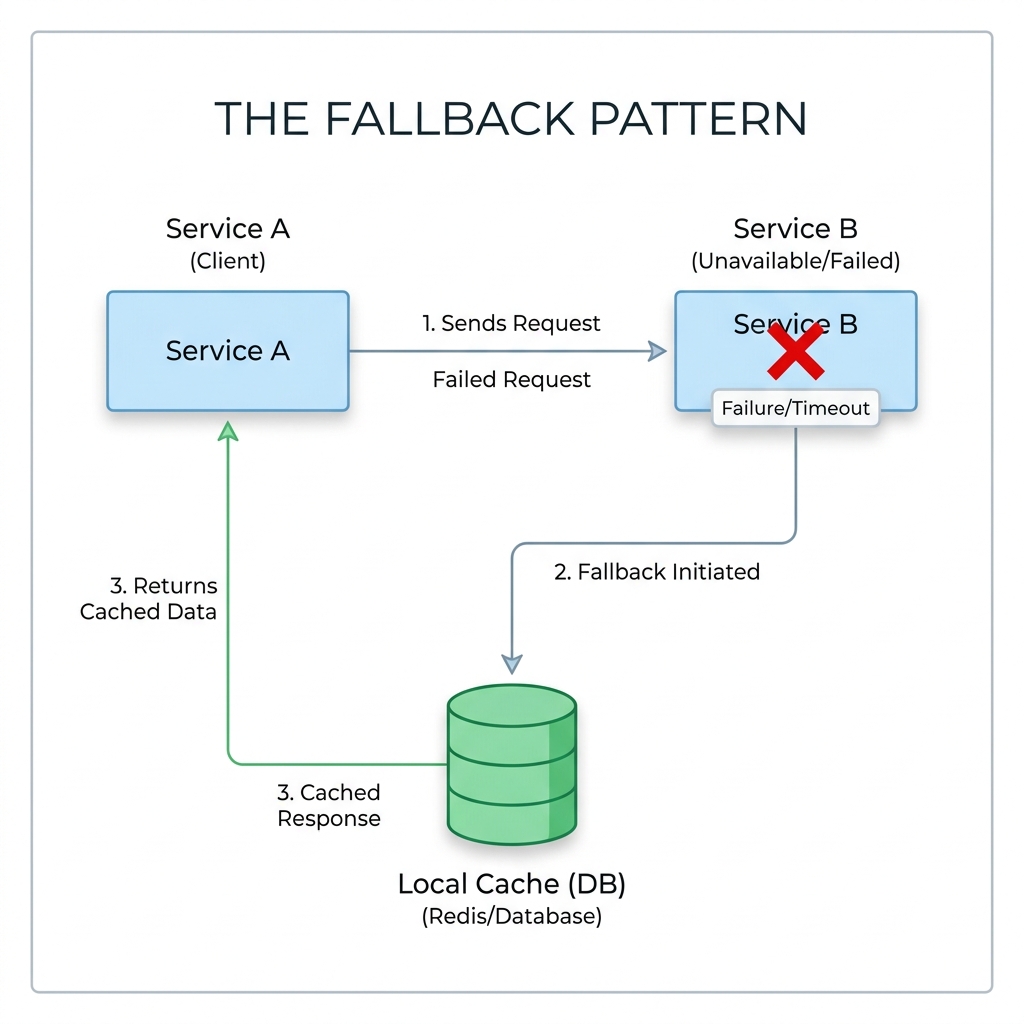
In software design:
- The Coffee Order is the client request.
- The Card Terminal is the primary downstream service (e.g., a Payment Gateway API).
- The Internet Outage is a network timeout or service crash.
- The Ledger / Offline Reader is the fallback execution path.
Common Fallback Strategies
Depending on the business logic and the criticality of the failed service, you can choose from several fallback strategies:
1. Static Default Values
The simplest strategy is to return a safe, pre-configured static value. This is highly effective for non-critical features where displaying blank or default data is acceptable.
- Example: If a profile personalization service fails, return a default avatar image and generic greeting.
- Example: If a recommendation service fails, return an empty list or a hardcoded list of universal best-sellers rather than throwing an error.
2. Cached Responses (Stale-While-Revalidate)
If live data is unavailable, you can fall back to read-only, stale data from a local cache or a fast distributed memory store like Redis.
- Example: If a product inventory service goes down, display the quantity in stock cached from 5 minutes ago, along with a subtle UI message indicating that the data might not be fully up to date.
- Example: If a user settings service fails, load the cached user profile instead of blocking their login flow.
3. Alternative Service (Multi-Provider)
When executing a critical operation that must succeed, you can configure a secondary service provider as a backup.
- Example: If your primary payment gateway (e.g., Stripe) returns a 5xx error or times out, the fallback mechanism immediately redirects the transaction request to a secondary gateway (e.g., PayPal or Adyen).
- Example: If a geocoding API fails, fall back to a secondary mapping provider.
4. Queue for Later (Asynchronous Buffer)
For write operations that do not require immediate synchronous processing, the fallback can buffer the request in a local queue or database to be retried later.
- Example: If an email notification service is down, write the notification payload to a dead-letter queue or a local database table. A background worker will read from this queue and deliver the emails once the notification service is healthy again.
The Resilience Trio: Retry vs. Circuit Breaker vs. Fallback
To build a highly resilient architecture, you need to combine the Fallback pattern with Retry and Circuit Breaker patterns. They form a three-tier line of defense:
| Pattern | Role | Action | Scenario |
|---|---|---|---|
| Retry Pattern | Resolves short-lived transient glitches. | Repeats the request after a short delay (backoff + jitter). | Brief network packet drops, socket resets. |
| Circuit Breaker | Prevents resource exhaustion. | Trips open to block calls to a failing service immediately (fail-fast). | Persistent service downtime, database deadlocks. |
| Fallback Pattern | Preserves user experience. | Executes an alternative action when the primary call fails or is blocked. | When retries are exhausted or the circuit breaker is open. |
How They Work Together
- An incoming request hits the service gateway.
- The request passes through the Circuit Breaker.
- If the Circuit Breaker is closed, the request goes to the Retry wrapper, which makes the actual call.
- If a transient error occurs, the Retry mechanism attempts the call again.
- If all retries fail, or if the Circuit Breaker was already open (failing fast to save resources), the Fallback Handler intercepts the failure and returns the degraded/cached response.
Code Implementations
Let’s look at how we can implement fallback logic in both Java and Go.
1. Java (Resilience4j)
In Java, Resilience4j is the industry standard for fault tolerance. We can define a fallback method declaratively using annotations or programmatically.
import io.github.resilience4j.circuitbreaker.annotation.CircuitBreaker;
import org.springframework.stereotype.Service;
import java.util.Collections;
import java.util.List;

@Service
public class ProductService {

    private final InventoryClient inventoryClient;
    private final CacheManager cacheManager;

    public ProductService(InventoryClient inventoryClient, CacheManager cacheManager) {
        this.inventoryClient = inventoryClient;
        this.cacheManager = cacheManager;
    }

    // Bind this method to a circuit breaker. If it fails or is open, route to fallback
    @CircuitBreaker(name = "inventoryService", fallbackMethod = "getInventoryFallback")
    public List<String> getProductInventory(String category) {
        return inventoryClient.fetchStockByCategory(category);
    }

    // Fallback method must have the same return type and accept the same parameters,
    // plus a Throwable parameter containing the error that triggered it
    public List<String> getInventoryFallback(String category, Throwable throwable) {
        System.err.println("Primary inventory service failed: " + throwable.getMessage());

        // Attempt to fetch from local cache (Strategy 2)
        List<String> cachedStock = cacheManager.get("inventory:" + category, List.class);
        if (cachedStock != null) {
            return cachedStock;
        }

        // Return static empty list if cache is empty (Strategy 1)
        return Collections.emptyList();
    }
}
2. Go (Golang)
In Go, we can write clean fallback decorators using functional programming patterns, which allow us to wrap any execution handler with a secondary handler.
package main

import (
	"context"
	"errors"
	"fmt"
	"time"
)

// Request represents a simple payload
type Request struct {
	UserID string
}

// Response represents the returned data
type Response struct {
	Data   string
	Status string
}

// ServiceFunc represents our primary function signature
type ServiceFunc func(ctx context.Context, req Request) (Response, error)

// WithFallback wraps a service function with fallback logic
func WithFallback(primary ServiceFunc, fallback ServiceFunc) ServiceFunc {
	return func(ctx context.Context, req Request) (Response, error) {
		res, err := primary(ctx, req)
		if err != nil {
			fmt.Printf("[Warning] Primary call failed: %v. Running fallback...\n", err)
			return fallback(ctx, req)
		}
		return res, nil
	}
}

func main() {
	// 1. Define primary service that occasionally fails
	primaryService := func(ctx context.Context, req Request) (Response, error) {
		return Response{}, errors.New("database connection timeout (504)")
	}

	// 2. Define fallback service that retrieves cached data
	fallbackService := func(ctx context.Context, req Request) (Response, error) {
		// Simulating cached read
		return Response{
			Data:   fmt.Sprintf("Stale cached profile data for user %s", req.UserID),
			Status: "DEGRADED (CACHED)",
		}, nil
	}

	// 3. Wrap them together
	resilientService := WithFallback(primaryService, fallbackService)

	// 4. Execute
	ctx, cancel := context.WithTimeout(context.Background(), 2*time.Second)
	defer cancel()

	req := Request{UserID: "user_992"}
	response, err := resilientService(ctx, req)
	if err != nil {
		fmt.Printf("Operation completely failed: %v\n", err)
	} else {
		fmt.Printf("Response Received:\n - Status: %s\n - Data: %s\n", response.Status, response.Data)
	}
}
Best Practices for the Fallback Pattern
- Keep the Fallback Path Dependency-Free: The fallback logic must not rely on the same downstream systems or infrastructure that just failed. If your database is down, falling back to another database query on the same server will likely fail as well.
- Execute Fast: Fallback logic should execute rapidly. Avoid complex computations or slow nested calls in your fallback paths. The goal is to return a response to the user as quickly as possible.
- Alert and Monitor: Always log fallback executions and increment telemetry counters. If your system is executing fallback paths, it means the system is operating in a degraded state. You need alerts to know when fallback rates exceed normal thresholds.
- Make UI Resilient: Work closely with frontend engineers to ensure the UI is designed to accept fallback payloads (like empty collections or partial states) without breaking the client-side layout.
Conclusion
The Fallback Pattern is the ultimate insurance policy for microservice reliability. By anticipating failures and providing elegant, fallback logic, you turn hard crashes into subtle, manageable disruptions. Combining this pattern with Retries and Circuit Breakers ensures your application can withstand major external outages while continuing to serve users.
Empower Your Digital Presence & Workflows
Explore top-tier tools built by Ghaznix to streamline your links, surveys, and brand growth.