Demystifying Cryptographic Hashing: Why It’s Irreversible and How It Secures Your Passwords
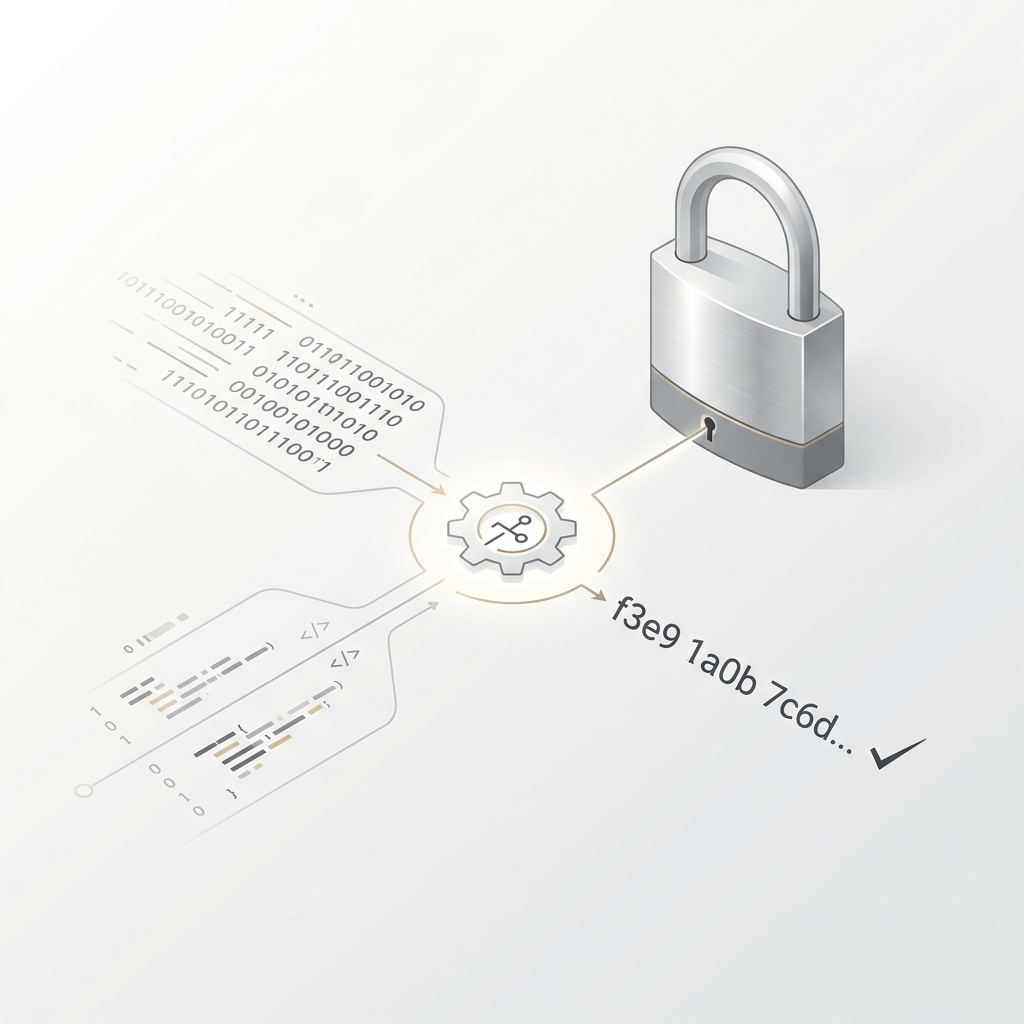
In the world of cybersecurity, hashing is one of the most fundamental yet misunderstood concepts. It is the invisible shield that protects your passwords, verifies the integrity of your downloads, and powers the blockchain.
But what exactly is a hash? Why can’t we “decrypt” it? and most importantly, if it’s irreversible, how does a website know you’ve entered the right password?
1. What is a Hash Function?
A cryptographic hash function is a mathematical algorithm that takes an input (or “message”) of any size and transforms it into a fixed-size string of characters, which is typically a “digest” that looks like a random sequence of letters and numbers.

The Golden Rules of Hashing:
- Deterministic: The same input will always produce the exact same hash.
- Quick to Compute: The algorithm should be fast enough for practical use.
- Fixed Output Size: Whether you hash a single word or an entire library of books, the output length stays the same (e.g., 256 bits for SHA-256).
- The Avalanche Effect: A tiny change in the input (like changing a single letter) results in a completely different hash.
2. Why is Hashing Irreversible?
Unlike Encryption, which is a two-way street (you can encrypt and then decrypt with a key), Hashing is a one-way street. Once you have a hash, you cannot “reverse” it to get the original data.
The “Mixing Paint” Analogy
Imagine you have a bucket of blue paint and a bucket of yellow paint. If you mix them, you get green. While you can easily create green from blue and yellow, it is physically impossible to take that green paint and perfectly separate it back into the original blue and yellow buckets.
The Mathematical Reason: Loss of Information
Hashing algorithms are designed to intentionally discard information. For example, if you have a simple “hashing” rule that says: “Sum the numbers and take the last digit,” then:
- Input
15->1+5 = 6 - Input
24->2+4 = 6
If you only see the result 6, you have no way of knowing if the original input was 15, 24, 33, or any other combination. In real-world algorithms like SHA-256, the complexity is astronomical, but the principle remains: information is condensed and discarded.
3. If it’s Irreversible, How does Password Matching Work?
This is the most common question: If a website stores my password as a hash and can’t reverse it, how do they know I logged in correctly?
The answer is simple: They don’t verify the password; they verify the hash.
The Verification Workflow:
- Registration: When you create an account, the server takes your password (e.g.,
MySecret123), hashes it, and stores only the hash in the database. - Login Attempt: When you try to log in, you enter your password again.
- The Comparison: The server takes the password you just typed and runs it through the same hashing algorithm.
- The Match: The server compares the new hash with the stored hash.
- If
Hash(Input)==Stored Hash, the password must be correct. - If they don’t match, the password is wrong.
- If
The server never actually “knows” what your password is. It only knows that the input you provided produces the expected mathematical fingerprint.
4. Modern Security: Adding “Salt”
Because hashing is deterministic, a common password like password123 will always produce the same hash. Hackers use “Rainbow Tables” (pre-computed lists of hashes for common passwords) to crack them instantly.
To prevent this, modern systems use a Salt—a random string added to your password before it’s hashed:
Hash(Password + Salt) = Secure Hash
This ensures that even if two users have the same password, their stored hashes will look completely different.
Summary
| Concept | Purpose | Reversibility |
|---|---|---|
| Encryption | Secret communication | Reversible (with key) |
| Hashing | Data integrity & Password security | Irreversible |
Hashing is the cornerstone of modern digital trust. By transforming sensitive data into irreversible fingerprints, we can verify identities and secure systems without ever needing to expose the original secrets.
Empower Your Digital Presence & Workflows
Explore top-tier tools built by Ghaznix to streamline your links, surveys, and brand growth.