The Bulkhead Pattern: Designing Fault-Tolerant Microservices
In a microservices architecture, a single application is broken down into dozens or hundreds of independent, collaborating services. While this design improves modularity and scalability, it also introduces a major risk: a failure in one service can cascade and bring down the entire system.
If a downstream service becomes sluggish or unresponsive, incoming requests to your upstream services will start to pile up. If they all share the same memory, CPU, or thread pool, a slow dependency can quickly exhaust all available resources, causing your entire application to crash.
This cascading failure is known as the domino effect. To prevent it, system architects use the Bulkhead Pattern.
In this guide, we will explore what the Bulkhead pattern is, how it works, and how to implement it using simple analogies, architectural concepts, and code examples in Java (Resilience4j) and Go.
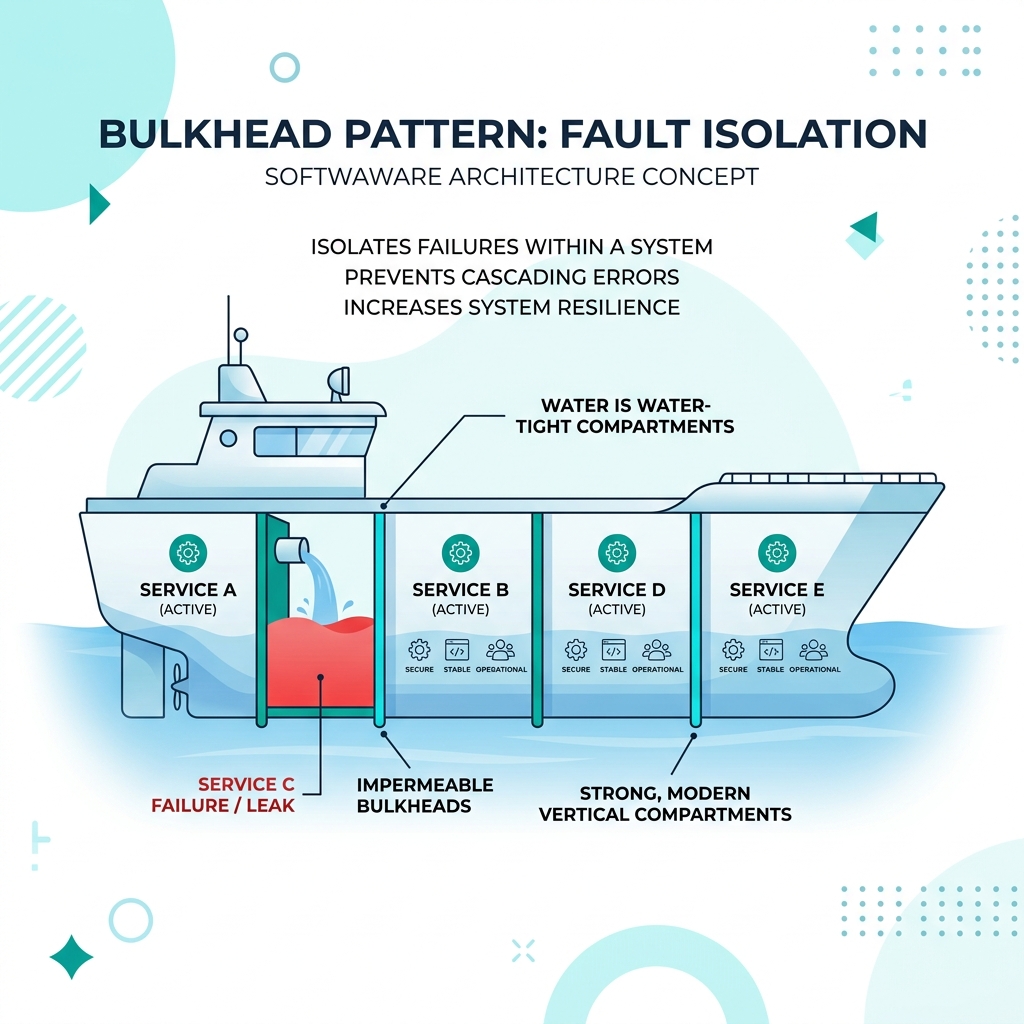
The Real-World Analogy: Watertight Ship Bulkheads
The name of this pattern comes from the shipbuilding industry.
A bulkhead is a watertight wall built inside the hull of a ship. Instead of having a single, massive open space inside the ship’s hull, the interior is partitioned into several independent, sealed compartments.
If the ship collides with an obstacle and its hull is breached, water will flood into the damaged compartment. However, because of the watertight bulkheads, the water is contained to that single compartment. The rest of the ship remains dry and buoyant, allowing it to stay afloat and reach safety.
Without bulkheads, water would flow freely throughout the entire hull, eventually sinking the ship.
In software engineering:
- The Ship is your entire application or service.
- The Compartments are isolated resource pools (threads, connections, CPU).
- The Hull Breach is a failure or slowdown in a downstream microservice.
- The Flooding is resource exhaustion.
The Problem: Shared Resource Pools & Thread Exhaustion
To understand why bulkheads are necessary, let’s look at what happens when resources are shared globally.
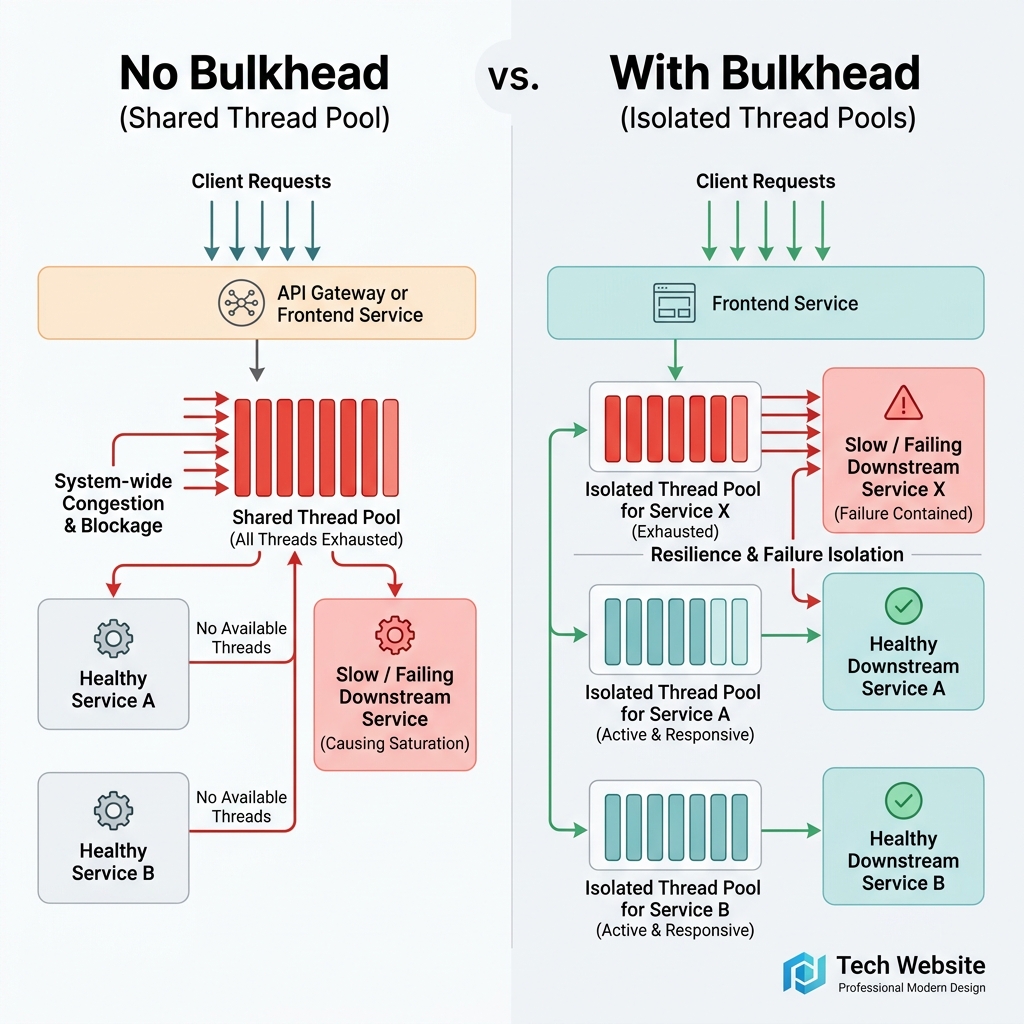
Imagine an API Gateway or a web server handling user requests. It has a single global thread pool of 100 threads to process all incoming calls. The server interacts with three downstream services:
- Catalog Service (fast, reads product list)
- Payment Service (fast, processes checkout)
- Recommendation Service (slow, calculates personalized items)
Normally, everything works fine. But suppose the Recommendation Service suffers from a database deadlock and starts taking 30 seconds to respond instead of 200 milliseconds.
Here is what happens:
- Users continue to visit the home page, triggering requests to the Recommendation Service.
- The server assigns a thread from the global pool to each request.
- Because the Recommendation Service is slow, these threads sit waiting for responses.
- Within seconds, all 100 threads in the pool are waiting on the Recommendation Service.
- When a new user tries to checkout or view the catalog, the server has no threads left to process their request.
Even though the Catalog and Payment services are completely healthy, they are now unreachable because the slow Recommendation Service has exhausted the shared thread pool. The entire system has gone offline.
The Solution: The Bulkhead Pattern
The Bulkhead Pattern solves this problem by partitioning resource pools so that a failure in one area does not affect the others.
Instead of a single global pool, we allocate separate, bounded pools for each service or downstream dependency.
If we allocate 10 threads specifically for the Recommendation Service, then at most 10 threads can ever be blocked waiting on it. If the Recommendation Service slows down, those 10 threads will be exhausted, and subsequent recommendation requests will be rejected immediately (fail-fast).
However, the remaining 90 threads are still reserved for the Catalog and Payment services. Users can still browse products and make purchases, even if the recommendation widget is temporarily unavailable.
Types of Bulkhead Isolation
There are two primary ways to implement bulkheads in software systems:
1. Thread Pool Isolation
In this model, each downstream dependency is assigned its own dedicated thread pool and execution queue.
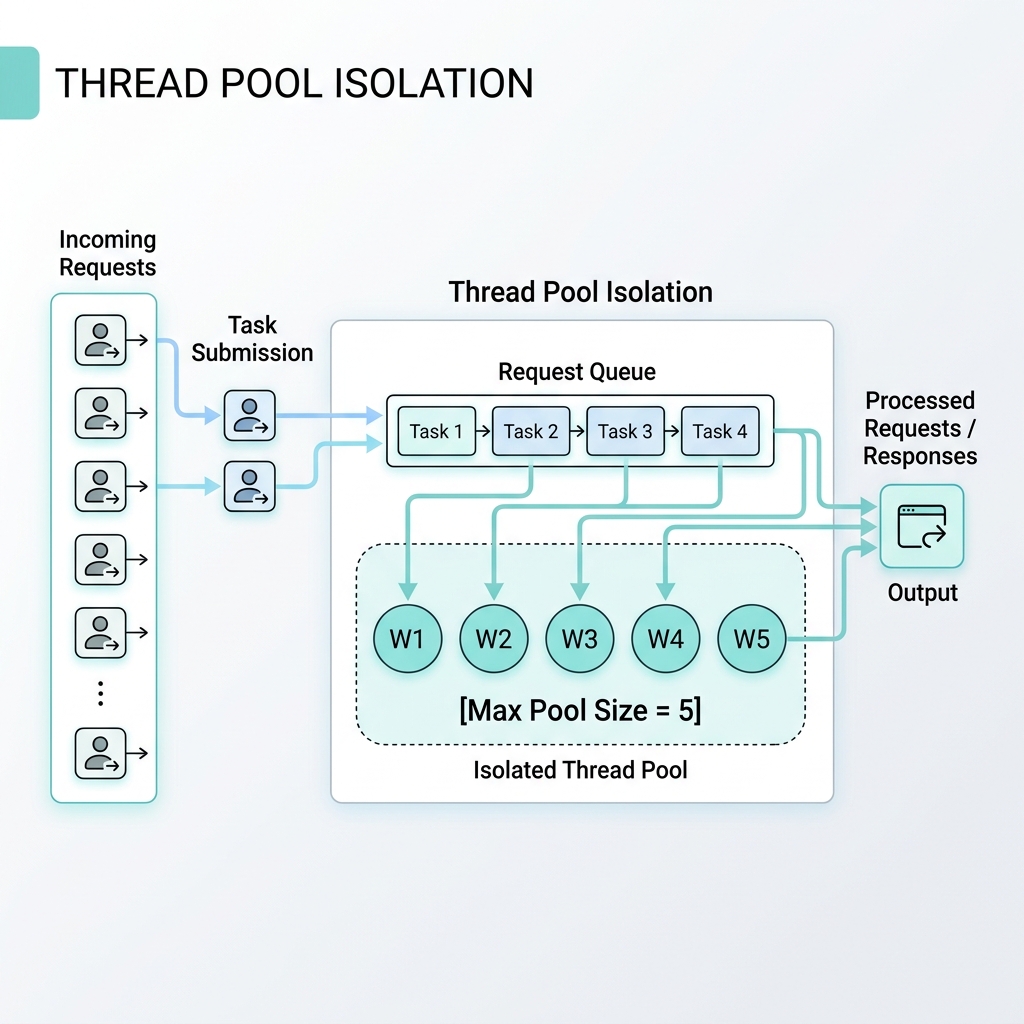
- How it works: The main application thread hands off the task to a specific thread pool. If the pool is full, the request is either queued or rejected.
- Pros: Provides complete isolation. If a service becomes slow, only its thread pool is affected. Threads are isolated at the operating system/JVM level.
- Cons: Introduces extra CPU overhead due to thread scheduling, context switching, and queue management.
2. Semaphore Isolation
Instead of creating new thread pools, semaphore isolation uses a counter (a semaphore) to limit the number of concurrent calls allowed to a specific service.
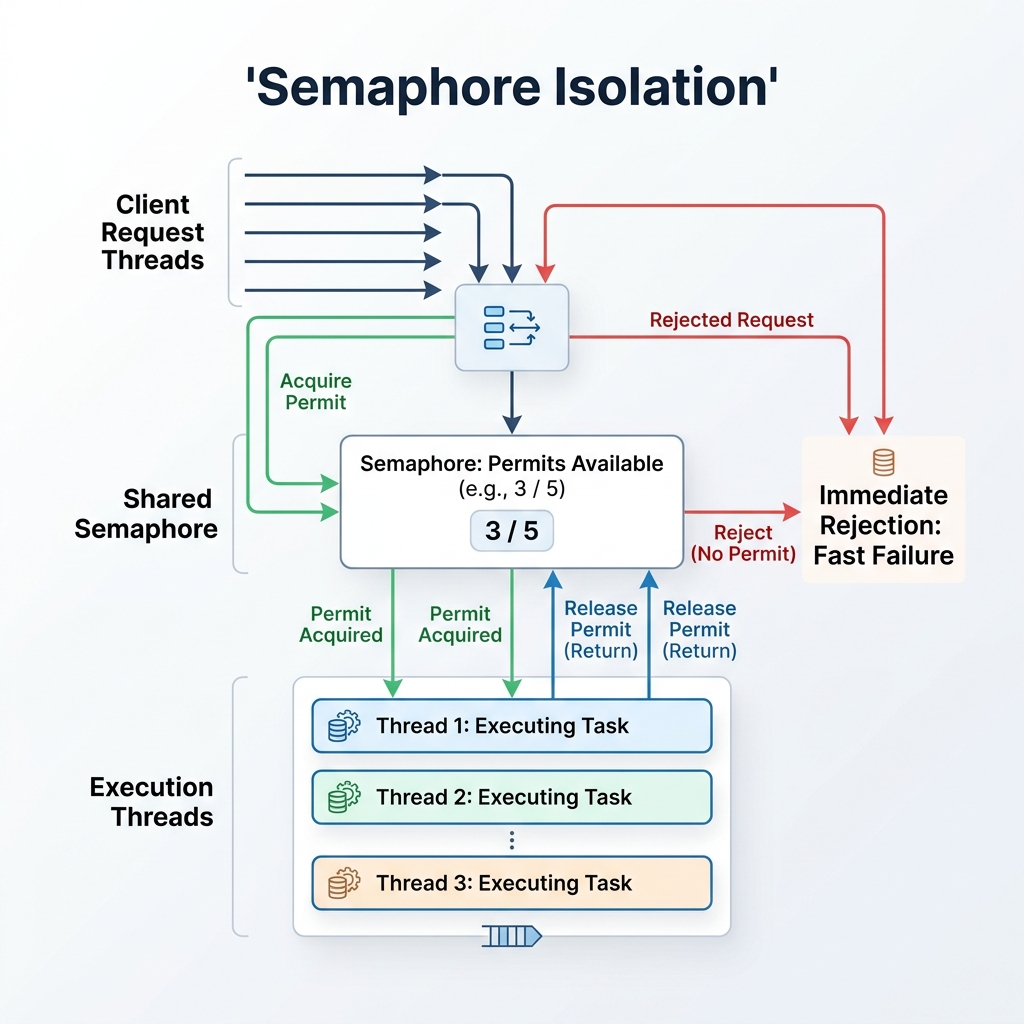
- How it works: When a request starts, it attempts to acquire a permit from the semaphore. If a permit is available, it executes the request on the calling thread and releases the permit when finished. If no permits are available, the request is immediately rejected.
- Pros: Very lightweight with virtually zero overhead since no thread context switching is involved.
- Cons: No thread separation. If a call is blocked on a network socket without a proper timeout, it can still block the calling thread.
Implementation Examples
Let’s look at how to implement bulkheads in two popular back-end languages.
1. Java (Resilience4j & Spring Boot)
Resilience4j is a lightweight, easy-to-use fault tolerance library designed for Java. Below is how you configure a bulkhead for a downstream payment service in a Spring Boot application.
Configuration (application.yml)
resilience4j.bulkhead:
  instances:
    paymentService:
      maxConcurrentCalls: 10
      maxWaitDuration: 10ms

resilience4j.threadpoolbulkhead:
  instances:
    paymentService:
      maxThreadPoolSize: 10
      coreThreadPoolSize: 5
      queueCapacity: 20
Code Implementation
import io.github.resilience4j.bulkhead.annotation.Bulkhead;
import org.springframework.stereotype.Service;
import org.springframework.web.client.RestTemplate;

@Service
public class OrderService {

    private final RestTemplate restTemplate;

    public OrderService(RestTemplate restTemplate) {
        this.restTemplate = restTemplate;
    }

    // Apply semaphore bulkhead
    @Bulkhead(name = "paymentService", fallbackMethod = "paymentFallback")
    public String processPayment(OrderDetails details) {
        return restTemplate.postForObject("http://payment-service/charge", details, String.class);
    }

    // Fallback method executed when the bulkhead is full
    public String paymentFallback(OrderDetails details, Throwable throwable) {
        return "Payment service is currently busy. Please try again later.";
    }
}
2. Go (Golang)
In Go, we don’t necessarily need a heavy framework because the language provides native concurrency primitives like Goroutines and buffered channels. We can implement a clean semaphore bulkhead using a buffered channel:
package main

import (
	"errors"
	"fmt"
	"net/http"
	"time"
)

// Bulkhead represents a concurrency limiter
type Bulkhead struct {
	semaphore chan struct{}
}

// NewBulkhead initializes a bulkhead with a max concurrency limit
func NewBulkhead(maxConcurrency int) *Bulkhead {
	return &Bulkhead{
		semaphore: make(chan struct{}, maxConcurrency),
	}
}

// Execute runs the task if resource permit is available, otherwise returns error
func (b *Bulkhead) Execute(task func() error) error {
	select {
	case b.semaphore <- struct{}{}:
		// Acquired permit
		defer func() { <-b.semaphore }() // Release permit
		return task()
	default:
		// Bulkhead is full, reject immediately
		return errors.New("bulkhead is full: request rejected")
	}
}

func main() {
	// Allow maximum of 3 concurrent calls
	paymentBulkhead := NewBulkhead(3)

	mockTask := func() error {
		fmt.Println("Processing payment...")
		time.Sleep(2 * time.Second) // Simulate network delay
		return nil
	}

	// Simulate 5 rapid requests
	for i := 1; i <= 5; i++ {
		go func(reqID int) {
			err := paymentBulkhead.Execute(mockTask)
			if err != nil {
				fmt.Printf("Request %d failed: %v\n", reqID, err)
			} else {
				fmt.Printf("Request %d completed successfully\n", reqID)
			}
		}(i)
	}

	// Keep main alive to watch output
	time.Sleep(3 * time.Second)
}
Common Use Cases for the Bulkhead Pattern
Here are some typical scenarios where implementing a bulkhead pattern is critical:
- API Gateway Routing: Isolating routes for different backend services. If the Recommendation Service goes down, the Order Service routes on the Gateway remain fully operational.
- Database Connection Pools: Dividing database connection pools by service or tenant. A surge of heavy analytical queries from one tenant won’t deplete all available connection handles, saving transactional queries for other tenants.
- Multi-tenant SaaS Applications: Separating compute resources or execution queues for premium versus free tenants. Free tier resource spikes will not starve premium tier requests of CPU or memory.
- Third-Party API Integrations: Dedicating separate HTTP client pools for external payment gateways, shipping providers, or notification engines. If one third-party service slows down, other external interactions continue without blockages.
Why Kafka/Message Brokers Cannot Replace the Bulkhead Pattern
A common question is: “If we have message brokers like Apache Kafka, why do we need the Bulkhead pattern? Can’t we just use queues to buffer requests?”
While message brokers decouple systems, they cannot replace the Bulkhead pattern. Here is why:
1. Synchronous vs. Asynchronous Communication
Kafka is designed for asynchronous, event-driven architectures. The producer pushes a message to a topic, and the consumer processes it eventually. However, user-facing applications often require synchronous (request-response) communication (e.g., loading a product catalog or charging a credit card via a REST/gRPC API). Introducing Kafka here requires complex request-reply patterns, adding high latency and overhead. Bulkheads are designed specifically to protect these synchronous execution threads in real time.
2. Thread Starvation inside Kafka Consumers
Even if your system is entirely event-driven and uses Kafka, you still need bulkheads!
Suppose a single consumer microservice listens to multiple Kafka topics (e.g., user-registrations and video-transcoding). If the consumer allocates all its internal worker threads to process a massive batch of slow video-transcoding jobs, it will experience thread starvation. The consumer won’t be able to process lightweight user-registrations messages, even though that partition is healthy. You still need internal bulkheads (separate thread pools) inside the consumer service to isolate work.
3. Client-Side Overhead & Fail-Fast Requirement
When a downstream service is down, a bulkhead allows the calling service to fail-fast and return a fallback response immediately. If you queue everything in Kafka instead, the queue might grow infinitely, leading to stale requests, high memory consumption, and delayed timeouts when the system recovers.
In short, Kafka decouples communication between systems over the network, while Bulkheads isolate resource execution within a running application instance. They are complementary, not mutually exclusive.
Best Practices when using Bulkheads
- Always Set Timeouts: A bulkhead limits concurrency, but it doesn’t solve slow socket reads. Combine bulkheads with strict network timeouts to release threads as fast as possible.
- Combine with Circuit Breakers: Use bulkheads alongside circuit breakers. If a bulkhead starts rejecting requests consistently, the circuit breaker should trip to stop traffic altogether and give the downstream service room to recover.
- Monitor Pool Saturation: Implement alerts on your bulkhead queue lengths and active thread counts. If a bulkhead is constantly full, you may need to scale your infrastructure or optimize the downstream service.
- Tune Sizes Individually: Don’t use a one-size-fits-all limit. Measure the latency and request rate of each dependency to determine the correct bulkhead limits.
Conclusion
The Bulkhead Pattern is an essential design pattern for building resilient, cloud-scale systems. By partitioning your resources, you isolate failures, prevent cascade effects, and ensure that a localized bug does not turn into a global outage.
Empower Your Digital Presence & Workflows
Explore top-tier tools built by Ghaznix to streamline your links, surveys, and brand growth.